Search Manic Mark's Blog

Tuesday, August 22, 2023

2 For The Money - The Brothers Candoli: Sextet


Caravan

2 For The Money
The Brothers Candoli: Sextet
Mercury Records MG 20515
1959

Pete Candoli & Conte Candoli - Trumpets
Jimmy Rowles - Piano
Max Bennett - Bass
Frank Capp - Drums
Howard Roberts - Guitar

From the back cover: There are many famous brothers in jazz – Cannonball and Nat Adderley, Hand and Thad Jones, Red and Whitey Mitchell, Abe and Sam Most, Ray and Zoot Sims, Charlie and Jack Teagarden, Claude and Stu Williams – to mention a few.

However, possibly none are as well known as the Candoli Brothers – Pete and Conte.

If you met these two popular trumpet men together you'd never guess they were brothers if you didn't know. Pete is assertive and aggressive. Conte is thoughtful and emotional. And their individual musical extemporizations are allied to their personalities. It's the contrast in their styles that is the spice of their joint performance here.

"Pete was originally taught by my father," Conte recalls.

"Pete was with a band on the road when I was at school," he continues. "When he came home he gave me lessons. Of course I was influenced by Pete at first but Harry James and Roy Eldridge were also my idols then. Later, however, I wanted to play like Dizzy (Gillespie). I still do!

"Pete's like my mother. She just comes in a room and takes over. I'm like my Dad – quiet and calm, Our jazz is probably just as contrasted," Conte opines.

Pete Candoli did all the imaginative arrangements on this LP except "Willow Weep For Me" which was the fine work of pianist Jimmy Rowles.

"With two trumpets and rhythm we really have to do everything differently," Pete declares.

Splanky
Soak Yo' Sally
A-Lue-Cha
Rifts For Rosie
Caravan
Take The A Train
Doodlin'
Willow Weep For Me
Blueing Boogie
Richard Diamond's Blues

The Stan Levey Quintet


Lover Come Back To Me

Stan Levey Quintet
Recorded June 1957 - Hollywood, California
Cover and Liner Photography: Dave Pell
Cover Portrait: Eva Diana
Mode Records MOD LP #101
1986 (reissue - VSOP Records)

Stan Levey - Drums
Conte Candoli - Trumpet
Richie Kamuca - Tenor Saxophone
Lou Levy - Piano
Monty Budwig - Bass

From the back cover: When a man displayed two or more distinct talents in separate fields, the time inevitably comes when he must decide in favor of one to the detriment of the other. Often the enigma is solved in related fields, but for Stan Levey the directions were as diametrically opposite as one can imagine.

Today the jazz world knows Stan as the big (6 ft. 2 in.) cross-current dynamo who soared to musical fame as the king-pin drummer in Stan Kenton's 1052-53 rhythm section. His lability to sustain perfect time, whether at fast or slow tempo, makes his presence on one of the country's greatest jazz orchestras a foregone conclusion.

At one point, however, Stan was more concerned with timing of another kind. This is the timing that separates the men from the boys in the toughest business of them all – the fight game. It is a not too generally known fact that Stan Levey the drummer might well have been a contender for the heavy-weight title had dame fortune smiled on him from that direction. There are still many not-so-old-timers around Philadelphia, Baltimore and Washington who remember the "big guy" when he worked the professional ring circuit in those cities.

Boxing's loss was more than jazz' gain – it was a genuine boon to the profession. Stan arrived in New York City in the early days of be-bop, and was in the right place at the right time when Dizzy Gillespie was forming one of his now famous small groups for a "swing street" nitery. Once again Stan's conception of time stood him in good stead for the task, and he immediately attracted attention as one of the forerunners of the school of modern drumming.

His career was building as a musician, though he often fondly remembered the tups and downs of his other chosen profession, and as he continued to improve technically the bigger jobs came his way. With his arrival on the Kenton band, he went on to establish himself a one of the steadier drummers in the profession.

For his first Mode LP, Stan relied on such jazz stalwarts as Richie Kamuca, the fast rising young tenor star who recently completed his own LP for the label (MOD LP #102); Lou Levey, the venerable modernist on piano, Monty Ludwig, a long-time favorite on bass of west coast jazz men; and Conte Condole, the trumpet playing colleague of Stan's from his Kenton days and one of the most exciting members of the modern trumpet fraternity. Stan's program selections for the date were equally divided between three originals and three standards, and all of the charts were prepared by Richie Kamuca.
The orderly proceeding follow:

Stan Still - This is the first of two originals by Kamuca incorporating another play on Stan's name in the title. Richie and Lou Levy have two choruses apiece with the Count sandwiched in between for one. The final bridge features Stan.

What Can I Say Dear (After I Say I'm Sorry) - Conte Condole with a harmon mute gets this evergreen underway, followed by Kamuca and Lou Levy. The tempo is danceable.

Lover Come Back To Me - The tempo is anything buy danceable here, save for portions of the first chorus. Count, Richie and Lou Levy all make contributions at at the frantic up beat, leading to Stan's solo of varying patterns. The close is moody.

Ole Man Rebop - This one is reminiscent of the ear when Stan began his professional drumming career. Penned by Floyd Wilson, it give Kamuca, Candoli and Lou Levy a chance to "stretch out" for two choruses apiece. The happy riff is broken briefly for Stan's eight bars in the final ensemble.

Old Folks - Stan's right hand opens this band with Count muting the way through the nostalgic melody. Richie and Lou Levy toy with the line before completion.

One For Joan - An up tempo original by Kamuca and named for his wife is a solid blues line which makes for healthy expression by Lou Levy, Count, Richie and bassist Ludwig. The exchange of 6's between drummer Levey and the front line leads the way out. 

Apart from the obvious values of these sides, it must be remembered that Stan Levey is ever in tune with the fluctuating tastes of America's jazz fans. His selections of tunes and personnel reflect the music scene up to date as well as prolonging a happy listening adventure. – Joe Quinn

Stan Still
What Can I Say (After I Say I'm Sorry)
Lover Come Back To Me
Ole Man Rebop
Old Folks
One For Joan

Twisting The Jug - Gene Ammons


Born To Be Blue

Twisting The Jug
Gene Ammons
With Joe Newman & Jack McDuff
Supervision: Esmond Edwards
Engineer: Rudy Van Gelder
Recorded November 28, 1961
Prestige 7238

Gene Ammons - Tenor Sax
Joe Newman - Trumpet
Jack McDuff - Organ
Wendell Perkins - Bass
Walter Perkins - Drums
Ray Barretto - Conga

From the back cover: Don't let the title Twisting The Jug scare you. This is not one of those teen-age party albums consisting of twelve non-melodic, hard swinging(?), twang ridden, noisy, tunes. True, you can twist to this album, but this is mainly a good jazz album. The twist, as I am sure you all know, has come to great prominence within the last year or so. I believe that this dance has sold more phonograph records in a short period of time than any other dance. To say the least, it has helped everybody in the music business, from the artists, to the publishers, and to the record companies themselves. Another great asset of this dance is that it is readily compatible to jazz, as you shall hear within. It might be of little note, that Gene Ammons made an album in 1959 for Prestige called the Twister (PRLP 7176). However, most music lovers today give the credit for this dance to a young Rock And Roll singer from Philadelphia. In any event, Ammons is a Twister, and in fact a good one.

Perhaps a mistake was made in titling this album. It might have been called Twisting Marathon, or How To Loose Twenty Pounds In Seven Minutes, or maybe Dr. Ammons New Cure For Stiff Backs. Being an old fan of the twist myself, I find this album, and in particular the title tune to be one of the most substantial twists ever conceived. To say the least, it swings. – Elliot F. Mazer

From Billboard - March 23, 1960: Gene Ammons, the tenor sax star currently on top with the bossa nova LP, teams with organist Jack McDuff and trumpeter Joe Newman for a swinging set that could get stiff jazz, r&b and pop action. The album features solid tenor sax and organ duets with that walking, rocking tempo that's become so popular. "Twisting The Jug," "Moten Swing" and "Stormy Monday Blues" are solid tracks.

Twisting The Jug
Born To Be Blue
Satin Doll
Moten Swing
Stormy Monday Blues
Down The Line

Monday, August 21, 2023

The Kid From Denver - Paul Quinichette


The Kid From Denver

The Kid From Denver
Paul Quinichette
Produced by Chuck Darwin
Cover: Burt Goldblatt
Engineering: David Hancock
Dawn DLP-1109
1956

Tenor - Paul Quinichette
Trumpets - Thad Jones, Renauld Jones, Joe Newman
Trombone - Henry Coker
Bariton Sax - Bill Graham
Piano - Nat Pierce
Guitar - Freddie Green
Bass - Ed Jones
Drums - Sonny Payne

Arrangements: 
Manny Albam - Come Rain Or Come Shine / Happy Feeling
Ernie Wilkins - Pardon The Blues, Please / Big Deal / Start Here
Paul Quinichette - Kid From Denver / Pennies From Heaven / Honeysuckle Rose

From the back cover: It's a long way from Denver to the "apple." 1800 miles as the crow flies – but for an aspiring young musician fifteen years ago, it was that and a lot more. And one kid from Denver – Paul Quinichettee – found that out. Hard as the road was, from an early age Paul apparently has known where he was going and has been willing to learn how to get there.

"The first turning point for me," Quinichette relates, "was the Chicago World's Fair in 1933. I was fourteen and taking in the exhibits with my mother. Among the attractions at this "exposition of Progress" was a jazz concert led buy Mezz Mezzrow. After a few houris, my mind was made up. I, too, was going to be a jazz musician."

Many a teen-ager goes thru a phase like that. It was characteristic of Quinichette, however, to act upon his conviction ion and stick to it. Returning to Denver, he applied himself systematically to the clarinet and the alto sax – and finally, tenor. His formal musical education was supplemented  buy stints at Denver University and Tennessee State College.

A long period of apprenticeship in the big bands of the early Forties gave Paul his basic turning. After a few gigs around Omaha with Nat Towles and Lloyd Hunter, he gravitated to Chicago and the Shorty Sherlock quintet. Regular desk jobs with Jay McShann, Johnny Otis in California, Louis Jordan, Lucky Millinder, Benny Carter, Sid Catlett, Jimmy Lunceford and Eddie Wilcox followed.

1945 found the "kid from Denver" beginning to make a dent around Manhattan. His work with the J. C. Heard combo at Cafe Society and with other small groups in that year did not go unrecorded – or unappreciated. A close association with Hot Lips Page ensued, terminating in 1951. By that time, Quinichette had worked for a decade in an atmosphere of musical revolution and counter-revolution, without losing his roots in "main stream" jazz or failing to respond to the new ideas and sounds of the period.

"I still have a collection of well-grooved phonograph records of Count Basie, Duke Ellington, Benny Goodman and Lester Young to show what I studied most and where my greatest inspiration came from in my early career." When Wardell Gray, in 1950, introduced Quinichette to Count Basie with an eye to turning over his tenor chair in the Basie band to him, the "kid" was ready. "That was really the biggest thrill of my life to that point," he said, when Basie hired him.

Quinitette remained with the Count only two years, but the impression left on him – as this LP frankly documents – was indelible. Yet, by 1953, clearly the time had come for him to go his own way. He had been well schooled, but there is always the danger of learning too well. A writer for Downbeat reviewing the Basie band while Paul held the tenor post characterized his playing as "more like the "Press" (Lester Young) than "Prez" himself." This – as well as the "Vice President" title that Quinichette came by at about this time – was meant as a compliment, but to Paul it was also a warning.

Stimulating as the Basie association was, Paul has achieved a freer and more individual style since he has been on his own. His tone and general approach have undergone a refining process that bespeak solid musical growth. The fat has been sliced off, but the meat remains. Paul's solo work in "Pennies From Heaven" in this album might be selected to illustrate that taste and delicate touches that appear consistently in his playing today.

If the "kid from Denver" has learned anything at all for the long years of barnstorming, it is the importance of getting right down into the audience to make your pitch. He is no "ivory tower" innovator and is not embarrassed when he defines the primary function of the jazzman to be "to entertain." It has always been Basie's philosophy that it is not inconsistent to have a ball and to say something musically worthwhile at the same time. That attitude has probably rubbed off on Paul, if we use this LP as a gauge.

The personnel here are a simpatico group for Paul. It's a Basie band of reduced proportions (tho still "big") composed mainly of members of the "modern" wing of the current Basie band. Nat Pierce is the only one here who hasn't worn the Basie tie, but even he has done some arranging from the Count, and in his decorative noodling in this set, he shows that he also has "done time" with Basie spiritually, off not physically.

John Lewis once described what he thought Basie's aim in music was. He thought his ideal was "an integration of ensemble playing with projected – and sounded like – the spontaneous playing of ideas which were the personal expression of each member of the band rather than the arrangers or composers." (Metronome Yearbook, 1955). It takes skillful arranger to make it seem that way, however. Manny Albam and Ernie Wilkins have down enough work for the Count to supply Quinichette (and Thad Jones, Joe Newman and Henry Coker, too, for that matter) with all the space he needs to let his personality express itself.

Here then is a youngish group of musicians who, under Basie's tutelage, have learned to synthexize successfully the sounds and forms of the new jazz with the beat and drive of the old. When you speak of Basie you have to speak of a beat, and it is impossible not to draw special attention to the stimulus Paul Quinichette gets on this date from Freddie Green Sonny Payne and Ed Jones, the swingingest rhythm section this side of the moon.

For its variety and intelligent utilization of the talent present, this is a program to savor. Come Rain Or Come Shine pits Paul tastefully against a brass backdrop. He swings into a high-spirited strut and gets solid ensemble support. Pardon The Blues, Please is a stomping, earthy blues which shows the other side of Paul's nature. Here he is really "down with it", warm and uninhibited, communicating a basic emotional appeal. Start Here is a tribute to Basie in up-tempo, with Nat Pearce believably making like the Count at the Steinway. Pennies From Heaven harks back nostalgically to an older Basie day. Freddie Green's work is the solid link between the past and the present. Quinichette's solo here is one of his best.

Happy Feeling is a Manny Albam creation, with inspired take-offs by Quninchette and by trumpeters Thad Jones and Joe Newman. Honeysuckle Rose features Paul's subdued horn in subtle off-beat improvising to Freddie Green's unswerving beat. This is likely to be one of the favorite band for Quinichette fans. In Big Deal, arranger Ernie Wilkins makes effective contrasts of brass sonorities, while Henry Coker, towers the end, gets sassy and satirical over a firm walking figure supplied by guitar and bass. Kid From Denver gives almost everybody a chance to solo (get a load of Sonny Payne, man!) creating a kind of relay effect as each in turn, works over a riff reminiscent of "A Train". The Kid From Denver has arrived! – Gary Kramer

From Billboard - December 22, 1956: There are several tracks of happenings here that rate with anything produced this year. The mood is predominantly Basie, with ex-Basie-ite Quinichette starring in the role and style originated by Lester Young. The sidemen are from the current Basie band, with Nat Pierce filling in for Count on piano. Good programming mixes up swinging, intimate items with just sax and rhythm, with big blowing sides by 10 men. Basie trumpets Thad Jones and Joe Newman have sensational battle on "Happy Feeling." That, and the Quartet's "Honeysuckle Rose" are strong selling bands.

Come Rain Or Come Shine
Pardon The Blues, Please
Start Here
Pennies From Heaven
Happy Feeling
Honeysuckle Rose
Big Deal
The Kid From Denver

Sunday, August 20, 2023

Trapeze - Muir Mathieson


Lola's Theme

Trapeze
Released through United Artists
Orchestra under the direction of Muir Mathieson
Columbia Records CL 870
1956

From the back cover: One of the most exciting motion pictures of 1956, Trapeze offered not only the built-in thrills of the circus, bug a high-voltage team of stars, Burt Lancaster, Gina Lollobrigida and Tony Curtis, along with direction by Carol Reed and a lavish production. One of the most interesting aspects of the movie was its use of music, composed and assembled by Malcolm Arnold, to underline the atmosphere of the Parisian circus and the drama crackling among the principal players. Some of the high spots of the score have been collected in this recording taken from the soundtrack, demonstrating not only Mr. Arnold's skill and craftsmanship, but the building suspense of the film as well.

Mr. Arnold, one of Britain's foremost young composers, is well-known for his many film scores, as well as for symphonic works in many forms. For the Diamond Jubilee of the Bournemouth Municipal Orchestra in 1953, he was commissioned to write a symphony, his second, which in the words of Malcolm MacDonald is "gay and uninhibited... a frolic resolutely refusing to carry the world's sorrows on its shoulders." Similarly gay and uninhibited is Mr. Arnold's music for Trapeze, as indeed music for such a film should be. Here, then, are moments reflecting some of the moods of Trapeze, exhilarating, romantic, brooding, exciting, a mirror, in fact of the kaleidoscopic circus life so vividly presented in a fascinating film.

Prelude
Lola's Theme
Fanfare And Elephants' Waltz
Mike And Lola's Love Theme
Trapeze
Washington Post March
Entry Of The Gladiators
Juke Bo
Tino's Arrival In Paris
Blue Danube
Above The Ring
Stars And Stripes Forever

Swingin' With Terry Gibbs


Slittin' Sam

Swingin' With Terry Gibbs and His Orchestra
EmArcy MG 36103
1957

From the back cover: Although Terry Gibbs has been heard in a variety of moods and styles on his previous long playing released this album will come as a surprise to the year to many Gibbs fans. Heard perviously with his quartet (in Terry Gibbs on MG36047 and Mallets A-Plenty on MG36075) and in a series of ballads accompanied by a saxophone section and rhythm (Vibes On Velvet, MG36064) he now comes to  you for the first time in a setting no less ideally suited for him, and in many ways the most exciting yet – a big, swinging band.

Nothing but the best was good enough for Terry on an occasion like this, and the best meant New York's finest arranging talent as well as a troupe of sidemen capable of ding the utmost justice to the scores. For his trumpet section Terry had Bernie Glow, Ernie Royal, Nick Travis, Al De Risi and Don Elliott (with Don doubling as mellophonist for his solos). On trombone there were such distinguished men as Chauncey Welsch, Bob Brookmeyer, Tommy Mitchell and Urbie Green. The saxophones were Sam Marowitz and Hal McKusick on altos; Frank Socolow and Al Cohn on tenors and Al Epstein on baritone. For his rhythm section there was the redoubtable Miss Terry Pollard, as usual, at the keyboard; Herman Wright on bass; Jerry Segal on drums for Let's Wail, Julie's Bugle and Bewitched, and Osie Johnson drumming on the other titles. Turk van Lake, the excellent guitarist, also known as Vanig Hovsepian, played throughout this album.

Let's Wail was composed by Terry Gibbs and arranged by Ernie Wilkins. An up-tempo blues in the Woody Herman style, it features solos by Gibbs, Cohn and Terry Polland. Night Cap, which was composed and arranged by Ernie Wilkins, includes a mellophone solo by Don Elliott. Just Plain Meyer, composed and arranged buy Bob Brookmeyer (the title is Terry's predictable way of abbreviating Bobby's last name) is a bright-tempted item on which the band achieves a modern Fletcher Henderson sound. The tenor solo is by Al Cohn.

Heads Or Tails was composed by Gibbs and arranged by Brookmeyer. Notice the pulsating block voicing a la Basie in the last chorus, the relentless swinging of Terry's vibes. Miss Pollard is heard briefly on piano. Happiness Is Just A Thing Called Joe is a Bob Brookmeyer arrangement featuring a simple melodic approach and almost a spiritual feel in the background. Terry plays beautifully sensitive vibes here; Don Elliott is again heard on mellophone.

Funky Serenade, composed and arranged by Manny Albam, hits a medium swinging groove with vibes and bass featured. Bewitched is a fine Manny Albam arrangement, starting with Al De Risi's open trumpet. Al Epstein has the melody lead on baritone; in the tronbone passage Urbie has the first two measures and the rest is Brookmeyer.

Slittin' Sam (the Saychett Man), an Al Epstein composition arranged by Manny Albam, is an up-tempo, puckish, minor theme with solos by Gibbs, Brookmeyer, Cohn and Pollard.

Al Cohn wrote the arrangement of Duke Ellinton's I Didn't Know About You, a slow, pretty treatment featuring fine saxophone section work in the background and Terry's most melodic vibes mood.

Julie's Bugle (short for Julius Gubenko's nose – and anyone who doesn't know that this is Terry's square monicker is a square) is another Al Cohn arrangement. 

Gubi (short for Gubenko, and let's not go into that again) was composed by Terry and arranged by Al Cohn. It's another minor theme, with solos by Don Elliott and the two Terries.

It's a cinch that Terry Gibbs had a ball on this session, wailing in front of a fine band with the kind of men and arrangements that were after his own heart – and it's a cinch that you will agree this is one of the best sessions in his illustrious ten-year history as a top jazzman.

Funky Serenade
Gubi
Happiness Is A Thing Called Joe
Just Plain Meyer
Bewitched
Let's Wail
Heads Or Tails
Slittin' Sam (The Saychett Man)
I Didn't Know About You
Night Cap
Julie's Bugle


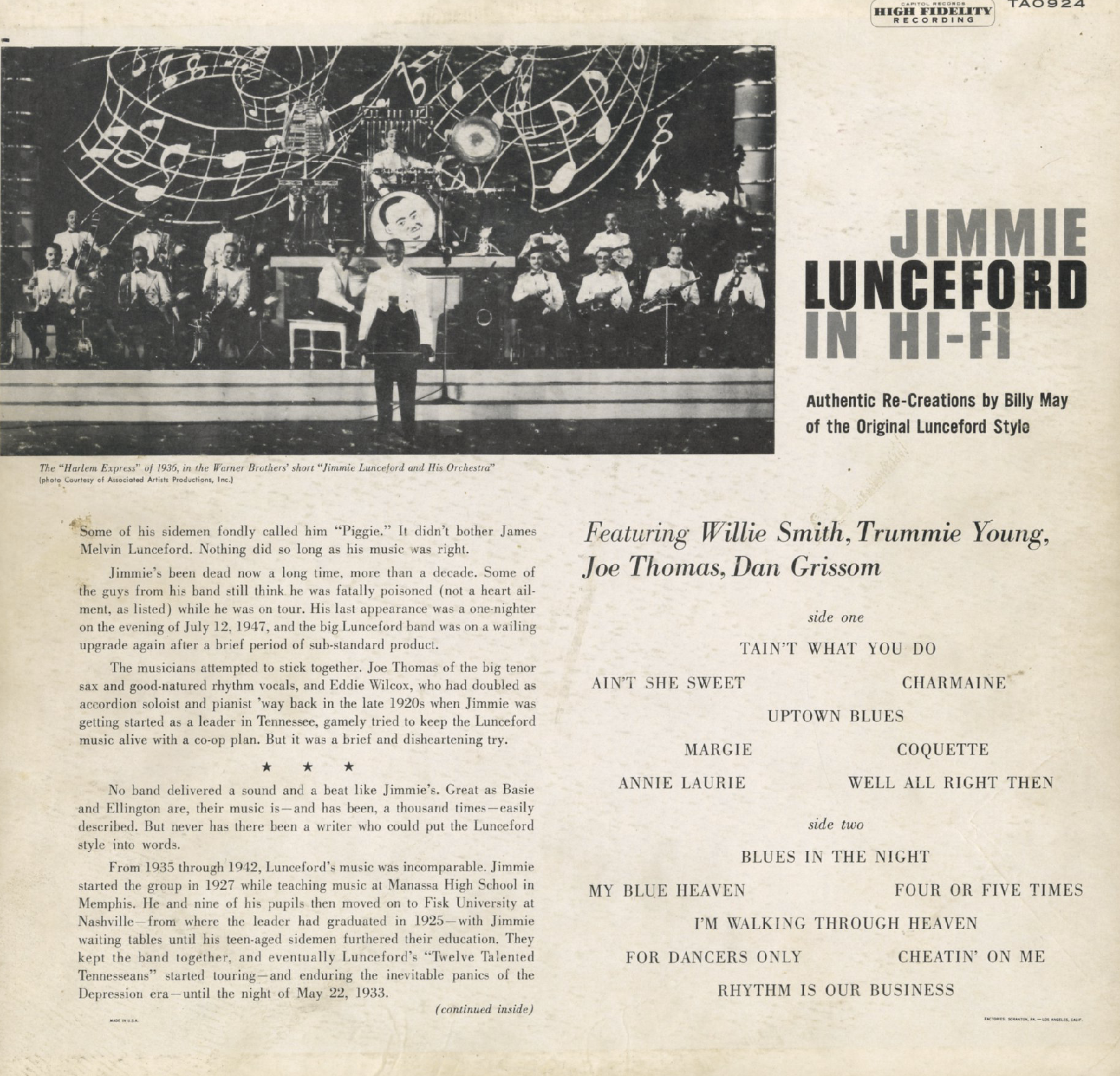
Jimmy Lunceford In Hi-Fi


Well All Right Then

Jimmie Lunceford In Hi-Fi
Authentic Re-Creations by Billy May of the Original Lunceford Style
Capitol Records TAO924
1957

Featuring Willie Smith, Trummie Young, Joe Thomas, Dan Grissom

Billy May - Leader
Dan Grissom - Vocalist
Willie Smith, Joe Thomas, Willie Schwartz, Ted Nash, Chuck Gentry, Bob Lawson - Reeds
Conrad Gozzo, Mannie Klien, Ollie Mitchell, Pete Candoli, Vito Mangano - Trumpets
Trummie Young, Eddie Kusby, Si Zentner, Dick Noel, Joe Howard - Trombones
Jimmie Rowles - Piano
Joe Mondragon - Bass
Al Hendrickson - Guitar 
Alvin Stoller - Drums
And on My Blue Heaven only, Benny Gill - Violin

From the liner notes: Some of his sidemen fondly called him "Piggie." It didn't bother James Melivn Lunceford. Nothing did so long as his music was right.

Jimmie's been dead now a long time, more than a decade. Some of the guys from his band still think he was fatally poisoned (not a heart ailment, as listed) while he was on tour. His last appearance was a one-nighter on the evening of July 12, 1947, and the big Lunceford band was on a wailing upgrade again after a period of sub-standard product.

The musicians attempted to stick together. Joe Thomas of the big tenor sax and good-natured rhythm vocals, and Eddie Wilcox, who had doubled as accordion soloist and pianist 'way back in the late 1920s when Jimmie was getting started as a leader in Tennessee, gamely tried to keep the Lunceford music alive with a co-op plan. But it was a brief and disheartening try.

No band delivered a sound and a beat like Jimmie's. Great as Basie and Ellington are, their music is – and has been, a thousand times – easily described. But never has there been a writer who could put the Luncerford style into words.

From 1935 through 1942, Lunceford's music was incomparable. Jimmie started the group in 1927 while teaching music at Manassa High School in Memphis. He and nine of his pupils then moved on to Fisk University at Nashville – from where the leader had graduated in 1925 – with Jimmie waiting tables until his teen-aged sidemen furthered their education. They kept the band together, and eventually Lunceford's "Twelve Talented Tennesseans" started touring – and enduring the inevitable panics of the Depression era – until the night of May 22, 1933.

"That is a night we'll never forget," Mrs. Crystal Lunceford, Jimmie's ballet-dancer, schoolteacher widow recalls. "On the big bandstand with the beautiful decorations was Guy Lombardo's orchestra. On the little stand, sparsely decorated, was the Lunceford gourd. But among the bookers in New York the next day the talk was all Luncerford – the band simply created a riot with the college kids. It was Jimmie's first break in the big time."

The May 22 date was at Cornell University. The dance was the annual Navy Ball. On September 29, Frank Schiffman and Teddy Blackman opened the band at New York's Lafayette Theater (later replaced by the Apollo as Harlem's showplace for live acts and music) and so great was the reaction that Irving Mills set the unit for March 11, 1934, opening at the Cotton Club.

"Adelaide Hall was the star of the show, and the songs were especially written by Harold Arlen and Teddy Koehler," Mrs. Lunceford reminisces. "Lena Horne was in the line, and the two big hits that emanated from the score were Ill Wind and As Long As I Live."

From the Cotton Club on, the rocking Lunceford Express roared to international success. Harold (The Gaffer) Oxley, a diminutive Englishman, managed Jimmie wisely and well. The band toured Scandinavia, France, Belgium and Holland in 1937, and was packed for a return trip in 1939 when World War II started. Its records were bought and played in astounding quantities throughout the world. In theaters, in ballrooms, on network radio and finally, in Hollywood motion pictures the Lunceford style attracted top money. Oxley, now dead, frequently boasted that "no promoter ever lost a nickel booking Jimmie."

Jimmie bought his own plane, a sleek Bellanca, and for a time flew to engagements alone with Mrs. Lunceford. Despite a minor Ohio crackup in September of 1941, he quit flying only because the government grounded all private planes following Pearl Harbor.

The war brought changes in the band. Some of Jimmie's best men left. Eddie Tompkins was killed by a rifle bullet in an army camp. Sy Oliver joined Tommy Dorsey. Willie Smith hooked on with Charlie Spivak and, later, Harry James. And the draft sucked up Jimmie's younger sidemen. But with the war ended, Jimmie confidently started building again. Some of his veterans helped – Thomas, Wilcox, Earl Carruthers, Russ Bowles. By 1947 the Lunceford star was rising fast.

And then Jimmie led his band for the last time.

•••

For all his Tennessee background in Memphis and Nashville, Jimmie Lunceford was a Mississippian. He was born June 6, 1902, in Fulton. But most of his childhood was spent in Denver. There in the mile-high Colorado capital he learned violin, trombone, guitar, flute, saxophone and clarinet. At one time he played in a Denver dance band with Andy Kirk, Hattie McDaniels and Mary Colston – Mrs. Kirk. He studied with the late Wilberforce Whiteman, Paul's father.

Soft-spoken, gracious, physically powerful, an immaculate dresser and perhaps for more intelligent than many of his band-leading contemporaries, Jimmie had the rare distinction of appealing to musicians and the box-office alike. He was the late Glenn Miller's favorite. But then everyone raved about the band. IT was a phenomenon. – Notes by Dave Dexter, Jr. - former editor of Down Beat and author of Jazz Cavalcade.

•••

Billy May was a kid practicing trumpet, in Pittsburgh, when he first head Lunceford's early records. To this day he regards Jimmie's as "the greatest all-around outfit ever." Later, arranging for Charlie Barnet and Glenn Miller, May frequently injected a touch of the Lunceford manner in his arrangements. Much later Billy and Capitol producer Dave Cavanaugh conceived this tribute to the Lunceford organization – a long-playing, high-fidelity album in which 15 or Lunceford's most popular standards are re-created with the exact sound and style of the original band.

Billy, famous for finishing his arrangements just before recording starts, had them ready ahead of time for a change. He lovingly and painstakingly wrote out the scores note for note form the old records, and even included the occasional minor "fluffs" of the original performances. Once the arrangements were finished, May and Cavanaugh rounded up as many of the original Lunceford stars as were available. And this remarkable album – is the result.

Authenticity is the keynote throughout the entire album. In My Blue Heaven, for instance, the violin spot behind the vocal in the old Lunsford record is heard here, along with a solo by Willie Smith on baritone sax, an instrument he hadn't played since he recorded the tune the first time around. All the swinging solos in this album, in fact, are as close to the originals as possible.

Tain't What You Do
Ain't She Sweet
Charamine
Uptown Blues
Margie
Coqette
Annie Laurie
Well All Right Then
Blues In The Night
My Blue Heaven
Four Or Five Times
I'm Walking Through Heaven 
For Dancers Only
Cheatin' On Me
Rhythm Is Our Business 

101 Strings Play Songs Of France


I Love Paris

101 Strings Play
Songs Of France
Alshire S-5214
1970

I Love Paris
Poor People Of Paris
Fifi
La Belle Parisienne
Montmartre 
Can-Can
Under Paris Skies
Le Soir; La Seine
Mademoiselle de Paris
Free Jacques
Gay Boulevardier

Themes From TV's Top 12 - Neal Hefti


Perry Mason

Themes From TV's Top 12
A Neal Hefti Spectacular
Featuring 40 Guitars and 8 Pianos
Reprise R9-6018
1962

Wagon Train 
The Flintstones
The Danny Thomas Show
Perry Mason
Ben Casey
My Three Sons
The Real McCoys
The Andy Griffith Show
Gunsmoke
Route 66
The Dick Powell Show
Bonanza

Chubby's Back! - Chubby Jackson


Raffles

Chubby's Back
Chubby Jackson's Big Band
Supervision: Phil Chess
Cover: Don Bronstein
Recorded at Universal Studios, March 31, 1957
Argo LP 614-S

Trumpets - Don Jacoby, Johnny Howell, Don Geraci, Joe Silvia
Trombones - Bill Harris, Tommy Shepard
Bass Trumpet - Cy Toff
Reeds - Howard Davis, Sandy Mosse, Vito Price, Bill Calkins (baritone)
Rhythm - Marty Rubenstein, 
Piano - Chubby Jackson
Bass - Remo Biondi
Rhythm Guitar - Jim Gourley
Drums - Don Lamond

From the back cover: "Chubby's back," it says here.

To some people, he never was gone.

The ebullient spirit that he helped to instill in a coupe or more of the various Woody Herman Herds, plus the various small groups he worked with after leaving Woody, remains a happy segment in the memories of those who recall the awesome sweep and charge of some of them.

A couple of years ago, however (this being written in the spring of 1957), Chub decided he'd pretty well had it, what with the jazz world being in a state where work was scarce even for the bright lights of the moment.

So he utilized his laws-he's-had-it talent for being able to entertain people, and he used an opening into the TV field. Not musically. He conducted a kids' show in Chicago called Chubby's Rascals. And not badly, either. The show was named by TV Guide as the most popular children's show of the year.

But the itch always remained. And the knowledge. The knowledge that he is best qualified to say his piece via jazz.

So, to make a long story short, as the saying goes, this album resulted.

You are the customer. You happen to have the final say as to whether the product is worthy or not. I happen to think it is.

Maybe it's because I was there throughout the long evening that produced these tracks. I was there when the last musician arrived – 15 minutes ahead of time – and got dirty looks from the rest of the men assembled because they were on hand to prove that the only good big band dates do not come from New York or Los Angeles, and they wanted nothing to go wrong.

I was there while the men pleaded, "Let's do one more take' we can do to better."

I was there while everyone involved hung around for more than an hour after the date to hear the playbacks instead of going home to families, or out for a drink.

I was there when the entire group broke into applause at the finish of Bill Harris' solo on Let's Talk.

I was there when Don Jacoby looked at the rest of the band and exulted, "You know, this is the first time I've hit a high F in years. And it came easy."

I was there. And I'm happy, because seldom have a I seen as pleased and satisfied group of musicians. This many not be the greatest big band ever recorded, but you'd have a difficult time telling that to the guys who played on it.

It was a trial date, and they came through with flying colors.

To those who have watched the jazz scene with interest for some years, it is needless to say that Chubby Jackson has long been noted as a talent scout extraordinary. He brought into the Herman band, among others, the brothers Candoli, Sonny Herman, Shorty Rogers, Ralph Burns, and many, many more.

In this album, he keeps the record up to date. You many not previously have heard of Sandy Mosse, Jim Gourley, or Vito Price. Maybe even of Cy Touff. But you will. Along with Bill Harris, they provide some drivingly vital solo moments.

When this date was being set up, no other drummer than Don Lamond was ever considered. He was a section-mate in the Herman Herd with Jackson, and they find more than considerable mutual satisfaction working together. Their camaraderie is readily apparent from the first bars of Tiny's blues, which kicks off the first side. It's probably the best-known of the late Tiny Kahn's compositions, and gets a roaring sound. Solos are by Gourley, Mosse, Price and Harris.

Raffles was written by guitarist Remo Biondi and features the saxes, lead by Howard Davis' alto, plus solos from Mosse and Touff.

Let's Talk is all Harris', and it is a credit to his musicianship that only two takes were needed, despite the fact that he saw the music for the first time at the date.

Mother Knckerbopper, which used to be played at a fantastic tempo by Chubby's 1949 big band, when it was a Father, is slowed down considerably here, with Gourley easing in as first soloist, followed buy Mosse and Price again on tenors. Harris winds it up wailingly, refusing to quit.

Keester Parade is the Johnny Mandel composition played originally by an octet Cy Touff led on a Pacific Jazz Recording date. Expanded to big band size, it still fits beautifully as Cy and Sandy sate the theme before taking solos, abetted in that department by Harris, Price and Jacoby. 

Flyin' The Coop is all Gourley and band. "He sounds like a reincarnated Charlie Christian," insists Chubby.

Plymouth Rock is the most uninhibited and powerfully raw side on the date, yet it is a pleasing rawness, one composed of sheer eagerness to play. Adapted by Frank Wess from the Neal Hefti arrangement that' splayed buy Count Basie, it contains an ensemble recreation of Joe Jewman's recorded solo before Gourley wiggles in. Succeeding slow are by Mosse, Price, Harris and Touff. The bands closing statements verge on the orgiastic. 

Marty Rubenstein's three notes at the end are neat tribute to Count Basie. Fitting, too, because that's the sort of band this is.

See if you don't agree. – Jack Tracy - Editor, Down Beat Magazine

From Billboard - October 28, 1957: Excellent big band disk made in Chicago by several Herman vets, plus talented natives. Soloists include Bill Harris, Cy Touff, talented tenor-man Vito Price and highly-touted Sandy Mosse. Style is Woody Herman tempered by Cassie – modern, but swinging and accessible. Will interest collectors.

Tiny's Blues
Raffles
Let's Talk
Mother Knickerbopper
Keester Parade
Flyin' The Coop
Plymouth Rock