Search Manic Mark's Blog

Friday, April 5, 2024

Living Guitars Play Songs Made Famous By The Rolling Stones


Brown Sugar

Paint It Black

Living Guitars Play The Songs Made Famous By The Rolling Stones
Arranged and Conducted by Al Caiola
Produced by Ethel Gabriel
Recorded in RCA's Studio C, New York City
Recording Engineer: Bob Simpson
RCA Camden Stereo CAS-2521
1971

Brown Sugar
Paint It Black
Heart Of Stone
(I Can't Get No) Satisfaction
Ruby Tuesday
Wild Horses
Lady Jane
You Can't Always Get What You Want
I Just Want To Make Love To You

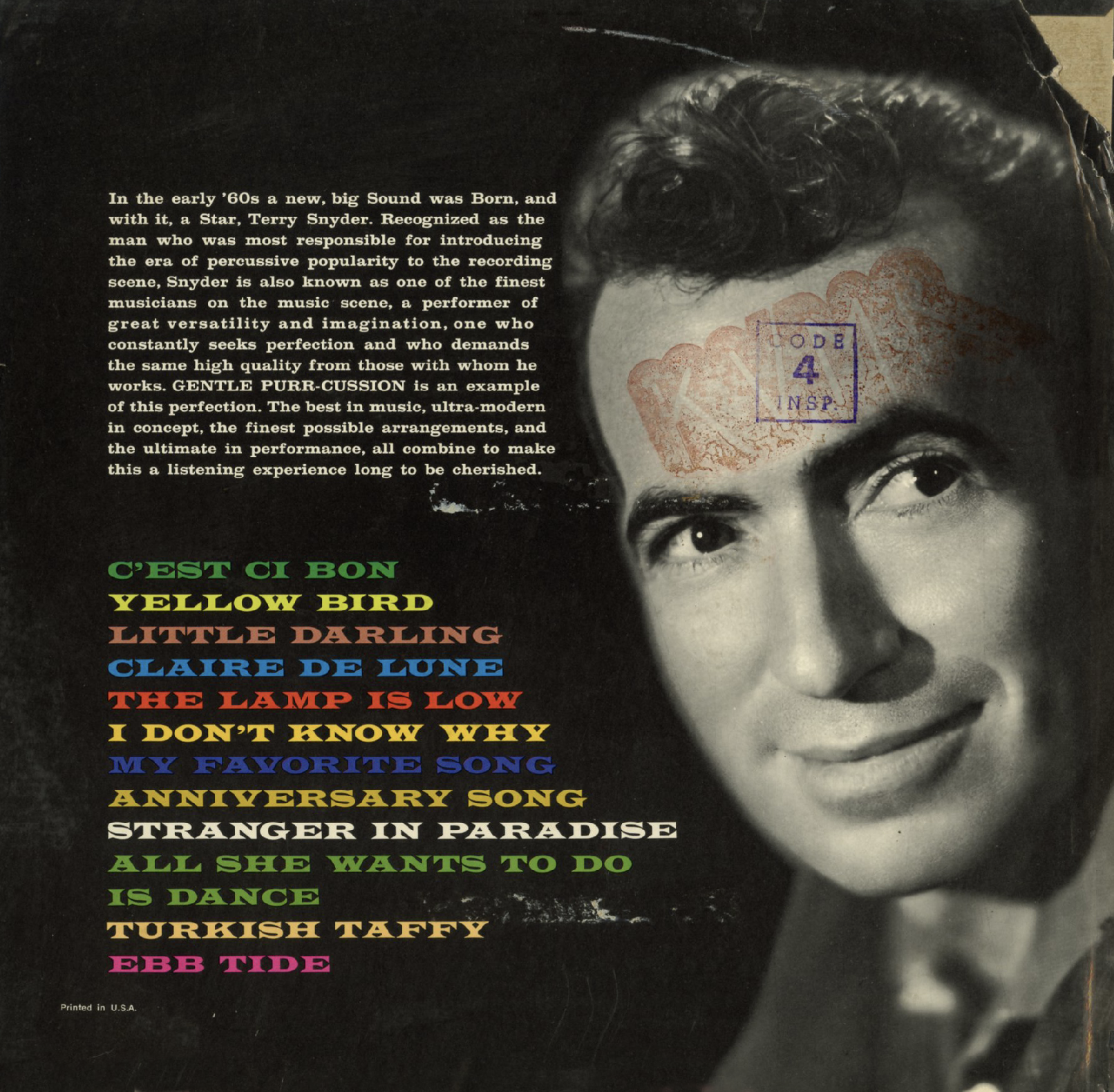
Gentle PURR-cussion - Terry Snyder


Ebb Tide

Gentle PURR-cussion
Terry Synder and His All Stars
United Artists Records Deluxe 3500 Series WWR 3521
1962

C'est Ci Bon
Yellow Road
Little Darling
Claire De Lune
The Lamp Is Low
I Don't Know Why
My Favorite Song
Anniversary Song
Stranger In Paradise
All She Wants To Do Is Dance
Turkish Taffy
Ebb Tide

Wade In The Water - Gulf Coast Jazz


Wade In The Water

Wade In The Water
Gulf Coast Jazz
Uncredited
Cover Photo: Bruce Zemby
Famous Hi-Fidelity F-510
Famous Enterprises, New Hampshire

Wade In The Water
Lil David
I Got Shoes
When The Saints Go Marchin' In
Nigeria
Reminiscence
Sinners, Don't Let This Harvest Go
Nobody Knows The Trouble I've Seen
This Little Light Of Mine
Salassi

Thursday, April 4, 2024

County & Western - Modern Sound

Five Hundred Miles Away From Home

Country & Western Award Winners
Producer: William Beasley
Recorder & Compatible Mastering: Columbia Recording Studios, Nashville, Tenn.
Cover Design: McPherson Studio, Nashville, Tenn.
Modern Sound MS 524

Five Hundred Miles From Home
The Matador
Ring Of Fire
Mama Sang A Song
Still
The End Of The World
Petticoat Junction
Detroit City
Going Thru The Motions
Let's Go All The Way

Journey To Capricorn - Stan Kenton


Celebration Suite

Journey To Capricorn
Stan Kenton
Recorded August 16, 17 & 18 at United Western Studios, Hollywood, California
Executive Producer: Stan Kenton
Producer: Bob Curnow
Production Supervision: Bill Putnam
Engineer: Jerry Barnes
Assistants: Gordon Shryock & Gary Boren
Remix: Jerry Barnes, Bill Stilfield & Julio Aiello
Mastering: Stan Ricker at JVC Cutting Center, Hollywood, California
Art Direction Yasuko Shannon
Cover Art: Dennis Millard
Personal Management: The Cameron Organization, Inc.
Creative World ST 1077
1976

Reeds: Terry Layne, Roy Reynolds, Dave Sov, Greg Metcalf, Alam Yankee (Bill Fritz on Celebration Suite)
Trumpets: Jay Sollenberger, Dave Kennedy, Steve Campos, Joe Casano, Tim Hagans
Trombones: Dick Shearer, Mike Egan, Jeff Uusitalo, Allan Morrissey, Douglas Purviance
Rhythm: Stan Kenton, piano; John Worster, acoustic & electric bass; Gary Hobbs, drums; Ramon Lopez, Latin percussion

From Billboard - January 15, 1977: One must approach the six tracks comprising this tightly grooved record just as one would a Messiaen record or Cage LP. It is only for the daring, for the adventurous, for those who welcome the uncommon.

Now well into his 36th year as a leader, the boldly uncompromising Kenton may well shock his most frequent disciples with this LP. He craftly introduces the set with Stevie Wonder's "Too Shy To Say" and, with cunning, leads the listener into an immensely complex Mark Taylor chart with his own simple, melodic piano introduction. Much of it is out of tempo – rubato – but the harmonies are tight, ultra modern and severe. Occasionally the Wonder melody is evident.

It isn't what Kenton does as a bandleader, but that he dares. No other maestro possesses his guts and integrity. Along the distant path from Balboa Beach in 1941 Stan has acquired and lost countless followers, but by striving for fresh musical sounds he constantly replaces his losses with new and youthful devotees. That's the way he wants it.

Hank Levy's "Pegasus" is a horse in a different color and mood. The second of the half-dozen instrumental tracks spots Timmy Hagan's, son of an Ohio banker, on solo trumpet along with Terry Layne's saxophone. Tempo is bright. Hagans again is featured on Mark Taylor's "Granada Smoothie" and there's a short Jeff Usitalo trombone contribution. The ensembles are powerful, propelling and precise but the band forever swings as Basie and Herman swing these days.

Kenton's attitude is that it doesn't have to swing to be good music. And his philosophy again is evident through "Ninety Degrees Celsius," another Levy original with Hagans and Layne again soloing at blistering tempo, and "Journey To Capricorn" with the indefatigable Hagans and saxist Alan Yankee hogging the solo mikes. Levy again is the composer-arranger.

To this long-time booster of Kentonia, the LP's prime rib is the final track on side two, Chick Corea's succulent "Celebration Suite" running 12 minutes and charted by Yankee. It is today's Kenton product at its juiciest and most meaty, harmonically and rhythmically. "Celebration" displays all of the most admirable facets of the band as Stan knuckles the Kanabe and John Worster, bass; Roy Reynolds, saxophone; Ramon Lopez, Latin percussion, and Cary Hobbs, conventional drums, pop through with uniformly ebullient, moving and often exciting contributions. 

"Celebration Suite" is an ideal track to close out a highly cerebral program unsweetened by old pop tunes in 1977 dress.

There is no pandering to commerciality in this package. One listens to the mass of sound coming down and recalls Stan's oft-repeated view that he is not ahead of the times. "There are," he offers, "just a lot of people who are behind the times."

He taped this package knowing well that its appeal is limited, an attitude he as maintained through the decades except for a period in the mid-40's when he half-heartedly emphasized a clarinet section and cute pie vocals not only by June Christy and Gene Howard but by a bulky, unimpressive mixed vocal group.

Yet one ponders if Kenton's complex fare may in time be accepted by the masses. People change just as music, art and everything else changes, perhaps imperceptibly, with the months and years. There are sufficient musicians and Kenton buffs today to sustain Stan's efforts; perhaps before the '70s end his intransigent convictions will be hailed and revered by a new legion of record buyers eager to discard the shallow pop and jazz confections of the moment.

"Journey To Capricorn" was recorded last August at United Western Studio, Los Angeles, with Bob Curnow as producer and Jerry Barnes, chief engineer. Creative World's sales and marketing director, Julio Aiello, assisted Barnes and bill Stilfield with the mix-downs. There is no acutely needed annotation – only titles and credits are listed. But as Big Stan willingly admits, only a minuscule minority of the nation's 215 million will give a damn. – Dave Dexter, Jr.

Too Shy To Say
Composer: Stevie Wonder
Arranger: Mark Taylor
Soloist: Stan Kenton

Pegasus
Composer & Arranger: Hank Levy
Soloists: Tim Hagans & Terry Layne

Granda Smoothie
Composer & Arranger: Mark Taylor
Soloists: Jeff Uusitalo & Tim Hagans

90° Celsius
Composer & Arranger: Hank Levy
Soloists: Tim Hagans & Terry Layne

Journey To Capricorn
Composer & Arranger: Hank Levy
Soloists: Alan Yankee & Tim Hagans

Celebration Suite
Composer: Chick Corea
Arranger: Alan Yankee
Soloists: Stan Kenton, Roy Reynolds, John Worster & Gary Hobbs

Monday, April 1, 2024

Woody's Winners - Woody Herman


Opus De Funk and Theme

Woody's Winners
Featuring The New "Northwest Passage"
Wood Herman
Recorded live at Basin Street West, San Francisco, on June 28, 29 and 30, 1965
Cover Photo: Columbia Records Photo Studio - Henry Parker
Columbia Records STEREO CS 9236

Clarinet, Alto Sax - Woody Herman
Tenor Sax - Gary Klein, Salvatore Nistico, Andy McGhee
Baritone Sax - Tom Anastasia
Trumpet - Gerald Lamy, Dusko Goykovich, Bob Shew, Don Rader, Bill Chase
Trombone - Henry Southall, Frank Tesinsky, Donald Doane
Piano - Nat Pierce
Bass - Anthony Leonardi
Drums - Ronnie Zito

From the back cover: Woody Herman himself has indeed been – and decidedly is – a winner. He has basked in the limelight of the winner's circle many times for more than a quarter of a century. He has ben honored by jazz polls for the high musical quality of his own performances and for his respective "Herds." His outstanding recordings, from the old 78's to albums of the 1960's, are collectors' items. He has even toured foreign lands for the State Department. Woody Herman, in short, has earned the rare respect, adulation and lasting enthusiasm of countless people from all over the world.

Woody's groups have been among the notably productive seedbeds for jazz musicians, who have been nurtured, trained and very often explosively introduced to the public. To cite specific cases would easily involve a long list of jazz musicians. Even in 1965 there were new talents in the Herman band whose brilliance, vigorous spirit and musicianship attracted and stirred crowds from San Francisco to the Jazz Festival in Juan les Pins, Antibes. This process, the subtle, complex evolution of the Herman bands under Woody's effectual leadership, has been occurring for a long time and cannot be explained by a single performance of relationship. The French have a word for it, I believe – épanouissement. Although it has no exact of literal English translation, it does convey the idea of "becoming," and encompasses such nuances as growth, development, unraveling, flowering and fulfillment.

This album, recorded live at Basin Street West in San Francisco, is the realization of a long-held hope of mine. Having Woody play for the first time in Basin Street West (a spacious, attractive club that John Hammond has called one of the finest jazz rooms in the country) was a three-day jazz joyride. Album Producer Teo Macero and other Columbia staffers were present during the engagement, and were rocked by this newest edition of Woody's wailing, free-swinging, smoking band. Woody's stand-up firing squad nearly blew the glasses and everything else off the patron's tables. No doubt about it, the band held its audiences spellbound. 

The selections: 23 Red - Bill Chase wrote this blistering swinger several years ago. When I first heard it in December, 1963 in Las Vegas, I hoped that it would be recorded some day. The seemingly mystic title is very simply explained. The numeral 23 and the color red are a "lucky" combination that composer Chase used at roulette tables in Reno, Tahoe and Las Vegas when the band played there. Actually, "23" is the band's repertoire code name for the tune "Four Brothers" ("hot tunes" such as "Caledonia," identified as "24," and "Early Autumn," "21," are also "lucky" at the felt-lined tables).

This opening track is one of the album's many highlights. The trumpet-centered chart features Chase, Dusko Goykovich and Don Rader in a romping trumpet choir that opens with lightening excitement and explodes into Chase's shout to initiate a fascinating series of exchanges (on chorus each of two bars, two choruses of four bars and two choruses of two's).

My Funny Valentine – This version has been labeled by its arranger, Don Rader, as "My Funky Valentin." Dig Woody's low-register clarinet with its natural, warm, woody sound. Rader's open-horn work is followed by an Al Cohn-tinged tenor of Gary Klein. The trumpets screech as lead trumpeter Chase impressively penetrates the sound barrier. My Wailin' Valentine it is!

Northwest Passage – Woody's galloping warhorse get a redressing job by arranger-pianist Nat Pierce. Originally recorded on March 1, 1945, by the "First Herd," it now joins the ranks of "Apply Honey" and "Caledonia," head arrangements rendered in later, contemporary versions. All we need now is "Your Father' Mustache" and "Wild Root," and the twenty-year cycle of up-tune overhauling will be nearly complete.

Woody, Nistico and Rader on mute kick it off and then Sal lashes into his long solo, much like a voracious Cro-Magnon devouring a long-sought meal. Chase's trumpet slices in, rapier-like, to boost the scorching excursion to its conclusion. A real pressure-cooker.

Poor Butterfly – an oldie scored by Rader who, incidentally, contributed several nice arrangements during this latest tenure with Woody. Previous associations with the Maynard Ferguson and Basie bands helped pave the way for Don's current creative outpourings. Father Herman's richly beautiful alto and clarinet never dip into the commonplace. His lyrical statements can be serene and lovely, yet at the same time be buoyed up by intense sincerity and passion.

Woody's Whistle – This is an original blues by Dusko Goykovich, who wanted to "get the guys to relax and release tensions, to rid themselves of cobwebs with the hard-walking feeling of this number." The chart processes highly interesting thematic phrases. Nat Pierce's groovy pianists carry the line again while over it Woody sometimes sings the short commentary: "Your sister smokes... your sister smokes... smokes in bed." Nistico's wailing is followed by Dusko' crying re-entry.

To close the tune, Woody blows hi pocket whistle. It is not just a device for this tune; it has been a functional part of Woody's stage accouterment for some time. Woody blows it to signal to members of the band that intermission is over, and that it's time to regroup on the bandstand for the next set.

Red Roses For A Blue Lady – Another arrangement by the Yugoslavia trumpet star, Dusko Goykovich, this has a good Herman reed-section sound. Andy McGhee fashions a cruising, warmly attractive tenor solo.

Opus de Funk and Them (Blue Flame) – I am delighted that this Horace Silver vehicle is included! Back in June, 1955, Woody recorded Nat Pierce's arrangement of it, and here it is again a decade later – and what a swinging version it is! Nat's wonderful piano work (Woody makes a jocose reference to pianist Mary Lou Williams) forecasts the visceral swing of the performance. Gary Klein uncorks a Lester/Al Cohn-ish solo, and Chase reaches way upstairs to lift the elation even higher. Finally, Dusko pours fresh, flaming fuel into this steamer, while the band grooves with propulsive riffs.

This was the final tune the band played that last night at Basin Street West. It was obviously inspired by the very hip crowd gathered there. Their enthusiasm was so demonstrative that they stood up and shouted, demanding more. The band, however, segued into the Herman theme, Blue Flame. Woody's recorded comment, "We dug it the most," sums up what happened at Basin Street West. The Herman band, playing with unusual élan, had provided some of its most arm-pumping, hand-clapping, finger-snapping, foot-tapping big-band jazz ever! – Herb Wong, KJAZ-FM, San Francisco

23 Red
My Funny Valentine (from "Babes In Arms")
Northwest Passage
Poor Butterfly
Greasy Sack Blues
Woody's Whistle
Red Roses From A Blue Lady
Opus de Funk and Theme (Blue Flame)

Friday, March 29, 2024

Clancy Hayes Sings - Lu Watters


Clancy Hayes Sings

Clancy Hayes Sings
Lu Walters And His Jass Band
Cover Design by David Stone Martin
Down Home Records MG D-3
1956

From the back cover: Back in 1920, a young drummer named Clancy Hayes had a notion. He was all of 13 and earning a fulsome 35 cents by playing Saturday nights in the pit at the Elite Theatre in his hometown of Caney, Kan. He was leading his own band, the "Harmony Aces". And that wasn't all. Clancy pumped the player piano in the local dancing academy and for this he pocketed a dollar a night. Still, Clancy wasn't altogether satisfied.

"I wanted," Clancy recalled not long ago, "to be a singer. And one thing for sure, I couldn't very well accompany myself on the drums. So I had to learn to play the banjo and guitar, which I promptly did."

From these beginnings, a career was born, a career which took Clancy Hayes ultimately to San Francisco where, starting in 1926, he worked intermittently through the years at NBC. By 1936, he had met Lu Watters and they soon were to become among the leaders in the burgeoning San Francisco jazz revival which, nearly two decades later, has yet to be dissipated.

On this album, jazz singer Hayes and Watters are united in a group of traditional favorites. They are all, as you might surmise, songs from another era, the oldest of the lot being "Frankie And Johnny", which dates back to at least the 19th century. (In his authoritative "Mauve Decade", Thomas Beer says the freewheeling ballad was sung during the siege of Vicksburg in the Civil War and there are reports of it being heard in 1850.)

To catalogue some of the others. "Strolling Down Chesapeake Bay" is an old opener on minstrel shows; "Roll Jordan" is, of course, a spiritual; "Nobody Knows When You're Down And Out" has long been associated with the great blues singer, Bessie Smith; "Auntie Skinner's Chicken Dinner" is in the old cakewalk tradition of pre-World War I; "Silver Dollar" is a barroom ditty which, surprisingly, as revived as a hit in England in the late 1940s. Two of the selections are novelties from the 1920s – "My Little Bimbo", which concerns a shipwrecked sailor and his romantic activities, and "Ragtime Rufus", a ragtime tune, obviously, is based on the classic "Humoresque". "Alcoholic Blues", naturally enough i a lament into prohibition (and is sung here in two eight-bar phrases in contrast to the standard blues treatment). "Alabama Bound", by Buddy deSylva, is the 1925 hit now turned standard.

For four of the songs – "Auntie Skinner's Chicken Dinner", "Ragtime Rufus", "Chesapeake Bay" and "Silver Dollar" – Hayes was accompanied by, first of all, himself on the banjo: Wally Rose, piano; Dick Lammi, bass: Bob Helm, clarinet, and Lu Watters, washboard (an illness prevented him at the time from playing his trumpet). The other features the same group augmented by Bill Dart, drums; Warren Smith and Don Noakes, trombones, and Pay Patton, banjo.

From Billboard - June 6, 1956: If modernists and Dixielanders agree on anything at all, it is the high place of Clancy Hayes in the hierarchy of jazz singers. His backing here comes from the Lu Watters Jazz Band, rather than Bob Scobey, but they are like branches of the same tree, and so the atmosphere is congenially familiar. Other than "Silver Dollar," "Peoria" and "Sailing Down Chesapeake Bay," not much of Haye's previously recorded repertoire is repeated here. Here he does "Frankie And Johnny," "St. James Infirmary," "Alcoholic Blues," etc. A top-notch buy for all segments of the jazz (and don't overlook pop!) market.

St. James Infirmary
Roll Jordan Roll
Frankie And Johnny
My Little Bimbo Down On The Bimbo Isle
I Wish I Was In Peoria
Alcoholic Blues
Nobody Knows You When You're Down And Out
Auntie Skinner's Chicken Dinner
Sailing Down Chesapeake Bay
Silver Dollar
Ragtime Blues
Alabamy Bound

Piano Portraits By Phineas Newborn


Caravan

Piano Portraits by Phineas Newborn
Produced by Teddy Reig
Roulette Birdland R 52031
1958

Phineas Newborn - Piano
Roy Haynes - Drums
John Simmons - Bass

From the back cover: The talents of Phineas Newborn known no bounds. His freedom of expression and unrestrained delivery is an inherent quality that only great musicians possess and display. He is a breed that will never permit complications or restrictions to set in and mar his work. The fact that Phineas is direct and completely free in his style does not mean that he is not a technician – a master of his art. This album, among other things, proves this fact. It allows us to hear Phineas as he paints his own piano portraits of some of the most memorable songs ever written. With an able assist from such jazz colleagues as Roy Haynes on drums and John Simmons on bass, Phineas manages to breathe new excitement into these familiar portraits.

Let's take, as case in point, his approach to two different songs: "I Can't Get Started" is given a touching, relaxed feeling, while the Cole Porter piece, "It's Alright With Me" sparkles with verve and has a drive to it right through to the end. Another interesting case in point is a song called "(Blues Theme) For Left Hand Only." Phineas does just what the title calls for... he plays this entire blues composition with just his left hand, never once going to the right.

Mention should be made of two compositions that belong in the Duke Ellington school of jazz. Phineas included "Caravan" and "Chelsea Bridge" because of his obvious admiration of this school of music. Finally, but certainly not least of all, is the rare performance he delivers here of the beautiful ballad, "For All We Know." He plays it straight all the way; he is melodic, sensitive, sentimental. He has an apparent deep feeling for this song and he makes the listener aware of this by his almost reverent interpretation.

This is the sound of Phineas Newborn – he is a master who owes his allegiance to on one. He feels his jazz and as he feels it he plays it. His Piano Portraits will become a favorite of yours almost at once and will take an honored place in your gallery of recorded music.

From Billboard - October 12, 1959: Newborn gives out with thoughtful interpretation on a group of standards and an original or two. He's fleet and deft on the up-numbers, and the ballads are also inventively styled. He gets excellent support from Roy Haynes on drums and John Simmons on bass. Sound is excellent. With exposure this could be a good seller. Selections include a fine treatment of "Just In Time," (Blues Theme) For The Left Hand Only" and "Sweet And Lovely."

Star Eyes
Golden Earrings
It's Alright With Me
I Can't Get Started
Sweet And Lovely
Just In Time
Caravan
For All We Know
(Blue Theme) For The Left Hand Only
Chelsea Bridge

Thursday, March 28, 2024

Little Band Big Jazz - Conte Candoli All Stars


Macedonia

Little Band - Big Jazz
Conte Candoli All Stars
Photography: Joesph Tauber
Cover Design: Hoboc Arts
Crown Records CLP 5162
1960

Conte Candoli - Trumpet
Buddy Collette - Tenor
Vince Guaraldi - Piano
Leroy Vinegar - Bass
Stan Levy - Drums

From the back cover: No one knows what came first.

Whether it was the men or the music is unimportant.

For jazz came, and jazz conquered!

The nimble-fingered "professors" earned their Ph.D's the hard way... furthering the ragtime rage in the bawdy houses of New Orleans.

This same "Crescent City" spawned Dixieland.

The rugged, two-beat school gave ground in 1935. The "Swing Era" had arrived.

Through the next fabulous decade, the bands of Tommy Dorsey, Benny Goodman, Cab Calloway, Jimmy Lunceford, Woody Herman and "Count" Bill Basie swung their way throughout the United States – straight into the hearts of young and old alike.

Suddenly, interest in the big band screeched to a halt. There were many reasons. An entertainment upstart, television, was growing increasingly popular. And it was impossible to make "the nut" on the road anymore. And so, the once proud and mighty kingpins of American music disappeared one by one.

But the mainstream of jazz would not be denied. The most literate and inventive solo artists formed combos. And these small groups have made, are still making history!

Five brilliant jazz instrumentalists poured their efforts into the creation of this Crown Album.

The remarkable trumpeter, Conte Condoli, was leader. He also wrote the six original tunes – penned the arrangements.

Conte i added by the driving tenor sax of Buddy Collette. And, by a solid, steady rhythm section: Vince Guaraldi is the pianist; the bassist, Leroy Vinegar; and the drummer is Stan Levy.

This all-star quintet performs provocatively – with intensity and always with heart

This, then is Little Band – Big Bass – John Marlo

Muggin' The Minor (Candoli)
Mambo Diane (Candoli)
Countin' The Blue (Candoli)
Zizane (Candoli)
Macedonia (Candoli-Guaraldi)
Little David (Candoli-Guaraldi)

The New Brass Sound Of The Hits - San Fernando Brass


Moscow Nights

The New Brass Sound Of The Hits
Great Favorites Performed by San Fernando Brass
Produced by Ernest K. Dominy & William A. Castleman
Quadraphonic Engineer: Carson Taylor
Realistic Quadraphonic 50-2026
Capitol Special Markets QL-6789
1972

Heart Of Gold
For The Good Times
Guantanamera
Raindrops Keep Fallin' On My Head
An Old Fashioned Love Song
Joy Of Man
Scarborough Fair
Moscow Nights
Help Me Make It Through The Night
Early In The Morning