Search Manic Mark's Blog

Friday, April 28, 2023

Bob Wilber's Wildcats


Camp Meeting Blues

Oh Daddy!

Bob Wilber's Wildcats
New American Jazz 
In The New Orleans Tradition
Photo by Robert Parent
Rampart Album No. A-101
3 Disc - 78 RPM Set

From the inside cover: One of the most exciting and rewarding development in recent jazz history has been the emergence of young musicians who have chosen to play in the tradition of the New Orleans jazzmen. For many years, before the return to activity of such men as Bunk Johnson and Kid Cry, it appeared that New Orleans music would be forgotten except for a handful of phonograph records. Even after the veterans came back to play as wonderfully as ever, there seemed to be little likelihood that their music would still be played after their generation had passed. But their return stirred the emotions of a new generation, and today there are youngsters, some not even out of their teens doing their best to play in the same tradition.

The best-known, and probably best, of these groups is Bob Wilber's Wildcats, a band that set New York jam session and jazz concert crowds on their ears a few seasons ago. It grew up out of sessions in private homes in Scarsdale and Greenwich, in which teen-agers who had learned their jazz from records an jazz concerts in near-by New York were able to play together under conditions suitable for their tender years. These youngsters centrally played alongside such fine jazzmen as Sidney Bechet, Bunk Johnson and Art Hoses. Within a year of two, Wilber's Wildcats were good enough to rate recording for a major company with Sidney Bechet, the first time that a veteran jazzman had ever mad records with his protegés. Their Rampart records, the only time the full Wiler band has ever recorded, are simple testimony to their ability to stand up on their own.

This album, like the single records which have already appeared on the Rampart label, was recorded on the last day before the 1948 recording ban. The boys simply knocked off 12 sides from their repertoire, one after another. The titles in this set, without intending to be significant, reflect the variety of influences that have gone into the Wildcats' playing. Jelly Roll Morton is represented by his beautiful Frog-I-More Rag, which features an unusual and delightful passage played without the rhythm section; Richard M. Jones contributes Trouble In Mind; Once In A While derives from the Louis Armstrong Hot Five recording; Oh Daddy! is a bow to Bessie Smith; Camp Meeting Blues celebrates King Oliver's Creole Jazz Band. On their own, the Wildcats have tossed in that starched-collar favorite of yesteryear, When You Wore A Tulip.

The band is no longer together – as this is written, Wilber is continuing a carte-blanche run of many months at the Savoy Cafe in Boston, and Dick Wellstood has just left Chicago to join him; Dennis Strong is playing in a Broadway show; Bob Mielke has returned to his native San Francisco and Jerry Blumberg is back in Baltimore; Charlie Traeger is studying at Columbia University and Johnny Glade is a Yale. But the records are right here for you to enjoy for always, just as the boys played to win their reputation as the op young band of the country.

Once In A While (R-9512)
Recorded in New York - December 31, 1947
Johnny Glasel, Jerry Blumberg - Cornets
Bob Mielke - Trombone
Bob Wilber - Clarinet
Dick Wellstood - Piano
Charlie Traeger - Bass
Danny Strong - Drums
Cornet solo by Johnny Glasel

Camp Meeting Blues (R-9508)
Recorded in New York - December 31, 1947
Johnny Glasel, Jerry Blumberg - Cornets
Bob Mielke - Trombone
Bob Wilber - Clarinet
Dick Wellstood - Piano
Charlie Traeger - Bass
Danny Strong - Drums

Trouble In Mind (R-9511)
Recorded in New York - December 31, 1947
Johnny Glasel, Jerry Blumberg - Cornets
Bob Mielke - Trombone
Bob Wilber - Clarinet
Dick Wellstood - Piano
Charlie Traeger - Bass
Danny Strong - Drums


When You Wore A Tulip
Recorded in New York - December 31, 1947
Johnny Glasel, Jerry Blumberg - Cornets
Bob Mielke - Trombone
Bob Wilber - Clarinet
Dick Wellstood - Piano
Charlie Traeger - Bass
Danny Strong - Drums
Cornet Solo by Jerry Blumberg

Frog-I-More Rag
Recorded in New York - December 31, 1947
Johnny Glasel, Jerry Blumberg - Cornets
Bob Mielke - Trombone
Bob Wilber - Clarinet
Dick Wellstood - Piano
Charlie Traeger - Bass
Danny Strong - Drums
Cornet Solo by Johnny Glasel

Oh Daddy!
Recorded in New York - December 31, 1947
Johnny Glasel, Jerry Blumberg - Cornets
Bob Mielke - Trombone
Bob Wilber - Clarinet
Dick Wellstood - Piano
Charlie Traeger - Bass
Danny Strong - Drums

I'm In the Nude For Love - Jon Trevanni


Poinciana

I'm In The Nude For Love
Jon Trevanni and His Continental Orchestra
Cover Photography: Ken Whitmore
Crown Records 5046
1957

My Ideal 
My Heart Tells Me
Poinciana
Reverie
None But The Lonely Heart
Nude For Love (French)
My Old Flame
Tender Love
Paradise For Love
All Alone
My Love (French)
Melody For Love

A Night At Red Arrow - Franz Jackson

St. James Infirmary

A Night At Red Arrow
Franz Jackson and The Original Jass All-Starts
Pinnacle Recordings PLP 203M
1961

From the back cover: This is Franz Jackson's second album, and my second set of liner notes for the group. Since the first album was done for a small label that is now out of business and unavailable, I'd like to quote a line or so from my first literary effort for the Original Jass All-Stars:

"I'm afraid this album will be labeled Dixieland, as if seems all things must bear labels landfill into categories these days. But Franz Jackson and the Original Jazz All-Stars transcend Dixieland, or New Orleans or Chicago, or Kansas city, or New York, or the Swing Era. it's a summation of all this. A total of 265 years playing experience in most of the great jazz organizations in history, a pocket edition of a jazz encyclopedia. And it's an exciting thing to hear talent and experience put to as effective sue as it is here."

The lonely thing that I'd change in the above paragraph after 4 years would be the total years of playing experience. But I'd like to stress even more the term Dixieland and its inadequacy when applied to this group. Dixieland covers a multitude of sins, being the term applied to almost everything done by a small group that predates the Bop Era. But to many of us, there's a distinction between Dixieland and Traditional Jass. A difference between men playing the music they grew up with, know, love and understand, and the straw hat and blazer crowd who go through the motions (and the accent is on motion) for a quick buck. To me, they're the Professional Dixielanders, the kids who found the Money Tree.

Dixieland is probably the easiest form of jazz to understand. It's must you feel. The happy, free-wheeling excitement not only offers the listeners a release but communicates its intensity directly to the audience, gigs them al most a feeling of participation. It's a starting point from which the listener should begin to look for something more... the great heritage of Traditional Jazz, and there complex harmonies of modern jazz.

The ideal would be to do away with the Modern Jazz fans, or Mainstream Jazz fans, or Traditional Jazz fans, and have just plan Jazz Fans... period!

But Jazz offers something for everyone certainly no in relationship to knowledge of the subject so that a person can become a convert to a particular school of jazz one week, and an expert on the entire field the next. The very best we can say about this is that it gives employment to all types of musicians. From Bunk to Monk... from Pontchartrain to Coltrane... every type of Jazz, every Era has its staunch defenders so willing to enlighten you with their humble opinion which they value highly. Records are made to appeal to these various tastes, which immediately limits the sale of the album, and which brings up the question, "How broad are your tastes?" Are you adding this album to a collection of Dixieland, or helping to round out a collection of all phase of Jazz?

Since linder notes are usually promotion pieces, the most direct approach here is... DON'T READ ABOUT IT, BUT IT!! But since myth constant complaint concerns liner notes that are promotional instead of informative, let's get down tho the heart of the matter.

From the first days of jazz recording, the sound-proofed walls and the electronic monster have been a problem for individuals who ordinarily earn their living performing for a live audience. The jazz histories make numerous mention of liquor in the recording studio, and this is not a piece on the evils or merits of John Barleycorn... but certain individuals have always felt the need to relax in front of a mike and alcohol seemed to be one of the answers. Some performed better because of it... others only thought they were.

The advances in recording technique made it possible to bring the equipment to the musician, and one of the major problems was solved. Of course, no musician or group can be judged by records alone, nor can his abilities be determined by a chance listening in person. But through this LP oil will get the feel of Franz Jackson's Original Jazz All-Stars as they appear at their home for the past few years, the Red Arrow. Franz said, "The LP was recorded on location in an attempt to capture the attitude that a musician has when playing to an audience. Being a performer myself, I certainly dislike looking at a control booth! IT's like someone looking over y9our shoulder when you're reading. Technically, it many be the ideal situation for recording, but no for playing! The  audience is there and their enthusiasm is recorded."

A couple of other posts to clarify before getting into the music. First a word about the Red Arrow. The Club is a landmark in the history of Jazz, and also in the pages of Chicago history. It was one of the real roarers of the Roaring Twenties, but over the years it has mellowed to an informal, hospitable club where Jazz is still king. Franz and the All-Stars have been there since 1956. It is the largest club in the Chicago area featuring Traditional Jazz.

Now about the name of the band, "The Original Jass All-Stars." Question are asked Nobu the spelling of the word "Jazz," and the world "Original.") No one ever question "All-Stars"!) Franz Jackson's explanation is, "As to the word 'Original,' the concept meant here is that a musician would take any tune that he felt or was asked to play and would add his feeling and idea of how he might like to add to that particular melody. This was the original concept of 'Jass' and therefore the reason I use the word 'Original." Not saying we were the first jazz musicians. 'Jass' was one of the early spellings of the word Jazz, and since we are attempting to go back to the traditional, I chose the tile of 'Jass'."

Franz is the youngster of the band at 48. He has worked with the bands of Carroll Dickerson, Jimmie No-one, Fletcher Henderson, Roy Eldridge and Earl Hines among others. Bob Shoffner is 60, and has worked with King Oliver, Erskine Tate, and Hines. John Thomas has been playing professionally since 1923 with numerous theatre bands, Louis Armstrong, McKinney's Cotton Pickers and Nat King Cole. Bill Oldham has played for pay for 34 years including the Savoy Ballroom and Regal Theatre bands, Louis Fletcher Henderson, and Eddie South. Rozelle Clayton has been playing piano all his life, doing it professionally since the days of Jimmie Lunceford's Chickasaw Syncopators, holds a Masters of Music Degree, and his credits include W. C. Handy, Walter Eldridge and Lucky Millinder. Richard Curry is 60 and recalls his days with James P. Johnson, Ethel Waters and Carroll Dickerson. Lawrence Dixon aught himself to play banjo on a farm in Chillicothe, Ohio, more than 50 years ago and has worked hotel orchestras in the Midwest, theatre bands in Chicago and with Earl Nines at the Grand Terrace.

To quote the Down beat review of their first album: "This is no Tigertown Five!... this is what they mean by 'authentic jazz." – Dick Buckley, WNIB and WAAF, Chicago

From Billboard - January 9, 1961: Recorded on location at this old Chicago club noted for featuring traditional jazz, the musicians involved are all veterans who have been playing this style of music since the '20's. Led by Franz Jackson, the Original Jazz All-Stars offer style and authenticity, heard too rarely these days. Despite kcal of big names, dealers who demonstrate this disk to their jazz clientele will be rewarded by a healthy quota of sales.

Red Arrow Blues
Clarinet Marmalade
St. Jame Infirmary 
Ice Cream
Won't-Cha Come On Home
Weary Blues
Mack The Knife
Panama
Mr. Banjo Man 

Saturday, April 22, 2023

The Jazz School


Evening Lights

The Jazz School
Featuring Joe Gordon (Trumpet), Art Mardigan (Drums), Paul Gonsalves (Tenor Sax) & Clark Terry (Trumpet)
Photo: Reed Hecht
Jazz Wing MGW-60002
Wind a subsidiary or Mercury Record Corporation, Chicago, Illinois
1955

From the back cover: There are sixteen students in this class of the Jazz School; sixteen young men whose grades are impeccable, who's studies have clearly qualified them for a successful and distinguished career.

At the head of the class for the first four exercises is a member of the drums corps, a familiar figure by the band or Arthur Mardigan.

Art is a native Detroiter, born in December, 1923 and a name band musician since the age of nineteen, when he joined Tommy Reynolds. After Army service in 1943-44 he spent a year with Georgie Auld's group, then went home to Detroit for a while before entering the New York scene, where he was a part of many noteworthy 52nd Street combos under the leadership of Charlie Parker, Dexter Gordon, Allen Eager and Kai Winding. In addition, Art worked off and on with Woody Herman and Elliot Lawrence. In 1954, when Pete Rugolo came east to form a band for a tour, Art was a cornerstone of that all-star ensemble. Not long ago he was heard on an EmArcy LP dis with Ball de Arango.

Featured with Art on his four performances here are Don Joseph, a cornetist who's been a familiar figure around New York Jazz circles for several years; Milt Gold, a trombonist who has seen service with such name bands as Stan Kenton's and Glade Thornhill's and Al Cohn, the tenor saxophonist and arranger who has been rising rapidly to jazz eminence in the past year. (Al wrote Moroccan Blues for this session.) Heard with Mardigan in the rhythm section are John Williams, the 25-year-old pianist from Windsor, Vermont, best known for his work with Stan Getz and Teddy Kotick, at 27-year-old bass man who has been prominent on the New York scene with Charlie Parker, Buddy Rich, Buddy De Franco and a flock of other combos.

These students guide their class through four exercises that require little or no homework; the welcome strains of I've Found A New Baby (with Williams comping happily through Cohn's swinging solo chorus); the usual Milt Gold trombone work and the unexpected combination of ancient and modern melodic ideas by Joseph on Moroccan Blues; the pensive swing and easy-riding tenor work on Old Gold, and the happy, west-coast-style theme and solos on Golden Touch.

Class dismissed.

A new group moves in: at the head of the class is Paul Gonsalves, tenor saxophonist from Brockton, Massachusetts. Raised in Pawtucket, R.I., Paul started his musical life as a guitarist at the age of sixteen, in 1936; later, switching to tenor saxophone, he became popular as a featured member of the Tabby Lewis orchestra, a well known Boston group, with which he made his record debut.

A three-year hitch in the Army, from 1942 to '45, was followed by a stint in the Count Basie orchestra, and a brief fling in Dizzy Gillespie's final big band. Then, early in 1951, Paul joined the great Duke Ellington orchestra, of which, except for a few weeks in Tommy Dorsey's band in 1953, he has been member ever since.

Paul's colleagues on this, his first record session under his own leadership, include Clark Terry, another great Ellintonian of several years standing and sitting; Porter Gilbert, baritone saxophonist, who worked briefly on alto with Ellington in 1951; Junior Mance, a gifted 27-year-old pianist from Chicago, best known for the fine work he has done as Dinah Washington's accompanist; Eugene Miller on drums; and the inimitable, poll-winning bassist of erstwhile Woody Herman fame, Greig Stewart "Chubby" Jackson.

Paul, Clark, Junior and Cubby share the spotlight in the famous Ellington standard It Don't Mean A Thing, and again in a catchy blues riff theme, Take Nine. On the other two numbers Paul takes over for two uninterrupted performance of a pari of great standard tunes, Matt Dennis' Everything Happens To Me and the Dorothy Fields-Jimmy McHugh favorite Don't Blame Me. Both the latter numbers, with their solo cadenza endings, are tenor saxophone solos in the classic jazz tradition along lines established in the 1930's by Coleman Hawkins and later followed by Don Byas. Paul's own style reflects the influences mainly of Byas and Ben Westster.

... dismissed ...

Time now for graduation exercises. The class is headed by Joseph Henry Gordon, another brilliant New Englander on the modern jazz scene. Born in 1928 in Boston, Joe worked as a sandwich boy on the Boston-Albany railroad as recently as 1947, but later in that same year made his professional bow with his own combo at Boston's Savoy Ballroom, where the above-named Sabby Lewis was a frequent favorite. Joe also worked as a sideman with Abby, as well as with a variety of other gourds, from Georgie Auld to Charlie Mariano, from Charlie Parker to Lionel Hampton.

Heard with Joe on these sides are Charlie Rouse, a tenor sax and from Washington, D.C., who was with Duke Ellington in 1949-'50; Junior Mance, reappearing on piano; Jimmy Schenck on bass; and the pride of Pittsburgh, winner of the 1953 New Star award in the critics' poll, Art Blakey on drums.

With this personnel, Joe carries his handsome horn through these impressive performances of Evening Lights and Body And Soul, pausing only for sixteen bars of tenor on the former and of piano on the latter. Both numbers are eloquent demonstrations of his inventive musicianship and technical facility.

So these are the men you will meet in the Jazz School. It seems superfluous to point out that every last man of these sixteen students has graduated, as he deserves to, summa cum laude.

From Billboard - December 31, 1955: A modern jazz sampler that features three different ensembles. Outstanding in the Mardigan sextet is tenor-man Al Cohn. Paul Gonsalves, the fine Ellinton tenor soloist, gets his principal support from trumpeter Clark Terry. The variety of talent and ideas exposed here make for an interesting (and readily marketable program).

I've Found A New Baby
Moroccan Blues
Old Gold
Golden Touch
Evening Lights
It Don't Mean A Thing
Take Nine
Everything Happens To Me
Don't Blame Me
Body And Soul

Music To Remember You By - Herbie Layne


Cherry Pink and Apple Blossom White


Music For Everyone
Music To Remember You By
Herbie Layne and His Orchestra
Hollywood Records LPH-9
A Blue Ribbon Product

The Song Is You
Lisbon Antigua 
Just One Of Those Things
You Go To My Head 
The Theme From Picnic
Moonlight Serenade
Yesterdays
Don't Get Around Much Anymore
Autumn Leaves 
The Nearness Of You
Cherry Pink And Apple Blossom White

The Alley Cat - Nursery Rhymes With The Teen Dance Beat Of Today


The Shake

The Alley Cat
Nursery Rhymes With A Teen Dance Beat Of Today!
The Mod Moppets
International Award Series KIA-1028

Alley Cat Dances
The Frug - Old MacDonald
The Swim - Row, Row, Row Your Boat
The Jerk - Twinkle, Twinkle Little Star
Hokey Pokey
The Shake - Farmer In The Dell
The Monkey - Oh Top Old Smokey
Mexican Hat Dance
Watusi - A Tisket, A Tasket
Cha-Cha - Oh Dear, What Can The Matter Be

Friday, April 21, 2023

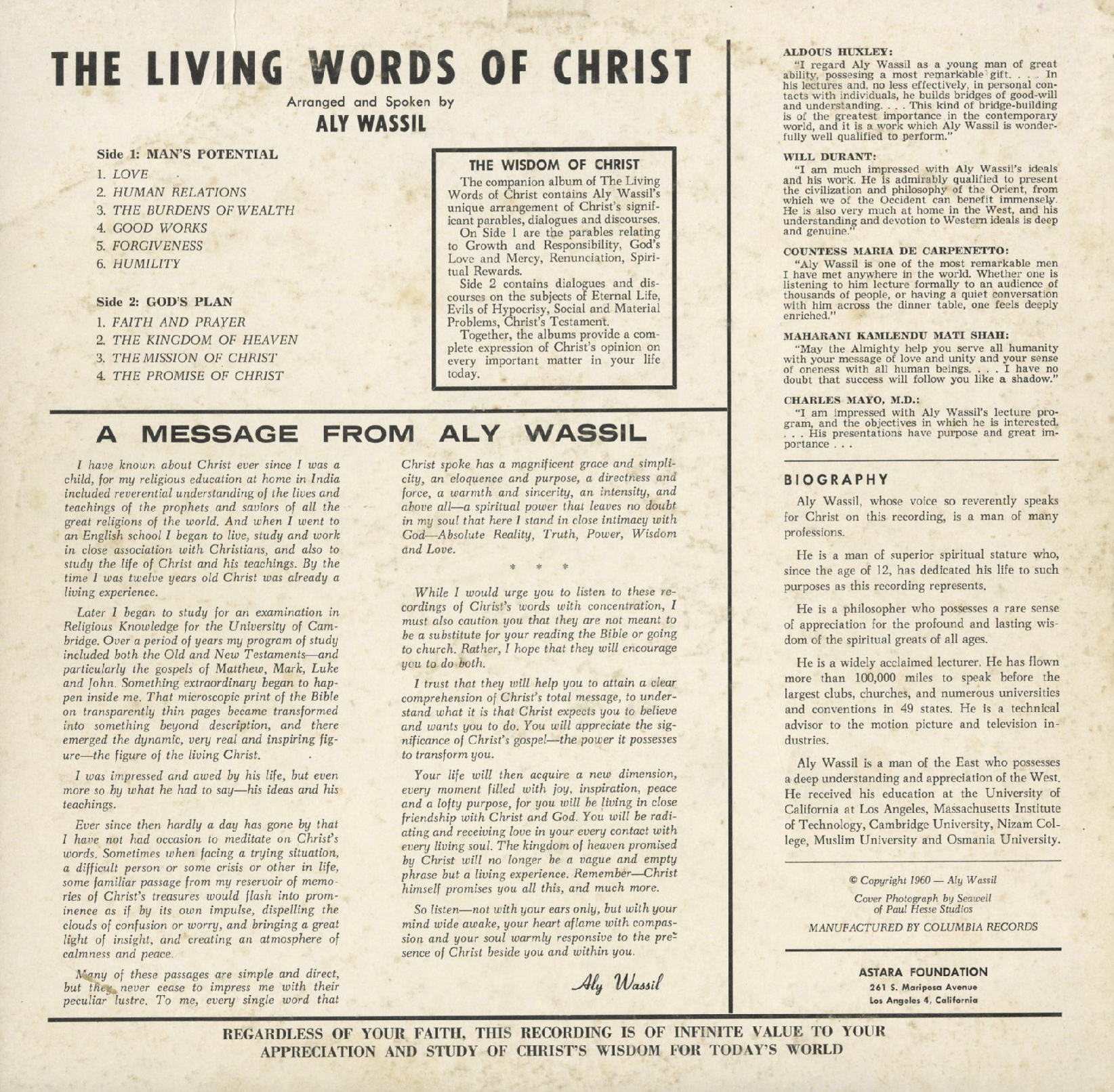
The Living Words Of Christ - Aly Wassil


The Living Words Of Christ

The Living Words Of Christ
Arranged and Spoken by Aly Wassil
Cover Photo by Seawell of Paul Hesse Studios
Astra Foundation AW 60915
Manufactured by Columbia Records
1960

From the back cover: Aly Wassil, whose voice so reverently speaks for Christ on this recording, is a man of many professions.

He is a man of superior spiritual stature who, since the age of 12, has dedicated his lief to such purposes as this recording represents.

He is a philosopher who possesses a rare sense of appreciation for the profound and lasting wisdom of the spiritual greats of all ages. He is a widely acclaimed lecturer. He has flown more than 100,000 miles to speak before the largest clubs, churches, and numerous universities and conventions in 49 states. He is a technical advisor to the motion picture and television industries.

Aly Wassil is a man of the East who possesses a deep understanding and appreciation of the West. He received his education at the University of California at Los Angeles, Massachusetts Institute of Technology, Cambridge University, Nizam Collage, Muslim University and Omani University.

Love
Human Relations
The Burdens Of Wealth
Good Works
Forgivness 
Humility
Faith And Prayer
The Kingdom Of Heaven
The Mission Of Christ
The Promise Of Christ

Wednesday, April 19, 2023

How To Overcome Discouragement - J. Martin Kohe


How To Overcome Discouragement

How To Overcome Discouragement
By J. Martin Kohe - Author, Publisher, Psychologist
Success Motivation Institute, Inc. SMI-1320
1961

From the back cover: J. Martin Kohe was a man who listened to the problems of others... and helps solve those problems. A nationally known author, lecturer, and psychologist, Mr. Kohe spent more than thirty years in the educational field... teaching public speaking and psychology. He personally taught more than 10,000 people and helped many thousands more through his writings and lectures. His book, "Your Greatest Power" has sold over 250,000 copies to date; two additional books, "Everybody Speaks" and "how To Become A Mental Millionaire" have met similar successes. 

Mr. Kohe began his career as a successful lawyer, but give up his practice in order that he might help people stay out of trouble; rather than helping them after they were already in trouble! He was a graduate of Baldwin Wallace College and conducted classes in applied psychology for major companies through the country; including General Electric Co., Standard Oil Co., Republic Steel Corp., Kroger Grocery and Baking Co., Addressograph Multigraph Corp., and many others. It was his firm conviction that there was a better way of life for troubled men and women, and it was his life's work to help others help themselves. Now, through the magic of recording, he can help YOU!

Introduction
Being Your Better Self
Fear Is Uncertainty
The Right Mental Attitude
People Think Differently
Criticism Can Help!
Live And Laugh!
You Can't Please Everyone!
Don't Quit Too Soon
Something Can Always Be Done

Meditation Moods


Meditation Moods

Meditation Moods
Introduction by Ralph M. Lewis
Organ Selections Arranged and Performed by Rosa Rio
Rosicrucian Recordings AMORC No. 2

Improvisation
Lotus Land
Thais Meditation
Libestraum Nocturne
Improvisation
Improvisation
Nocturne C Major
To A Water Lily
To A Wild Rose
Improvisation

Tuesday, April 18, 2023

Return To Paradise - Tommy Garrett


Quiet Village

Return To Paradise
The 50 Guitars Of Tommy Garrett
Producer: Tommy "Snuff" Garrett
Arranger: Ernie Freeman
Guitar Solos: Tom Tedesco
Engineer: Eddie Brackett
Design: Studio Five
Photography Courtesy of U.T.A. French Airlines
Liberty Premier LMM-13033
1965

Enchante Island
Pearly Shells
Quiet Village
Soft Sands
Bali Ha'i
Red Sails In The Sunset
Off Shore
Return To Paradise
Beyond The Reef
South Sea Trade Winds
Flamingo
Ebb Tide