Search Manic Mark's Blog

Wednesday, January 17, 2024

Big Hits For Swingers - Ray Ellis


I Feel Fine

Bit Hits For Swingers
Ray Ellis
Recording Engineer: Tom Dowd
Cover Photo: Nick Samardge
Cover Design: Haig Adishian
Supervision: Nesuhi Ertegun
ATCO Records SD 33-187
1966 Atlantic Recording Corporation

King Of The Road
Yesterday
Hand On Sloopy
(I Can't Get No) Satisfaction
I Feel Fine
Ferry Cross The Mersey
I'll Never Be Lonely Again
Flight To Mexico
Portrait Of Jan
1-2-3
I Got You Babe
Wait Till We're Sixty-Five

First Recordings - Leon Kirchner - Lilly / String Quartet No. 2


First Recordings

First Recordings
Leon Kirchner
Lily / String Quartet No. 2
Modern American Music Series 
Produced by Jay David Saks
Engineering: Edward T. Graham, Stanley Tonkel, Raymond Moore, Arthur Kendy
Cover Art and Design: Teresa Alfieri
Photography: Norman Myers from Bruce Coleman Inc.
Columbia M 32740
1974

Lilly (1973)
Conducted by the Composer
Diana Hoagland - Soprano
Columbia Chamber Soloists
Leon Kirchner - Piano
James Buswell - Violin
Nobuko Imai - Viola
Laurence Lesse - Cello
Paul Dunkel - Flute
Allan Vogel - Oboe
Richard Stalzman - Clarinet
Robert Routch - Horn
Alexander Heller - Bassoon
Lorin Hollander - Celesta
Allen Beard - Percussion

String Quartet No. 2 (1958)
Lenox String Quartet
Peter Marsh - Violin I
Delmar Petty's, Colin II
Toby Appel - Viola
Donald McCall - Cello
I–Moderato
II–Adagio
III–Allegro molto

From the back cover: The Modern American Music Series celebrates the phenomenon of contemporary music that it exists, is continuous and continuously surprising.

No oracle, happily, has ever been able to foresee what art – in the long run – will survive. On the basis of criticism at the moment of birth, most of our great music would have been quietly allowed to die. Performers and audiences have served to nurture new music past its newborn – and in some cases incubator – stages.

Today, when new music is invented more and more for a record-listening as opposed to a concert audience, it falls to the record companies to keep new works alive long enough for them to win a proper judgement. The emblem of the Modern American Music Series on this album signifies the continuing commitment to this purpose by the Masterworks Department of CBS Records. – Thomas Frost and Thomas Z. Shepard, Directors of Masterworks, CBS Records

Golden Greats - Martin Denny


A Taste Of Honey

Golden Greats
Martin Denny
Art Direction: Woody Woodward
Cover Photography: Ken Kim and David Gooley
Liberty Records LST-7467
1966

A Taste Of Honey
Scarlet Mist
More (Theme from "Mondo Cane")
Quiet Village
Black Orchid
Cast Your Fate To The Wind
Little Bird
The Enchanted Sea
Beyond The Reef
Ebb Tide
Hawaii Tattoo
Call Me (Produced by Joe Sarageno)

Tuesday, January 16, 2024

King Guitar - Al Caiola


Sleep Walk

King Guitar
Al Caiola
Performed by Al Caiola and Al Caiola, Jr.
Produced by Al Caiola
Mixing Engineer: Brooks Arthur
United Artists Records UAS 6586
1967

From the back cover: Pop guitarists may come and may go, but amiable Al Caiola is the reigning monarch of them all. He has been elevated to this august position by both fans and the musicians themselves, and, as a matter of fact, ever since the "guitar explosion" of several years ago, the gifted Caiola has been able to count an ever-growing number of swinging youngsters among his legion of devotees. That is why he is often called "King Guitar". That is why this album is called "King Guitar".

The Caiola artistry with a lovely ballad has never been more in evidence than here with his treatments of "A Man And A Woman", "This Is My Song" and "Lady". Then Al reverses his field and his feeling and gets with today's contemporary sounds via low-down and gutsy versions of later-day smashes like "Detroit City" and "Kansas City", plus "Somethin' Stupid", in which he plays a guitar duo with a young comer named Al Caiola Jr. If further proof of our boy's versatility is needed, it has been promptly supplied by "Front A Palacio", a tremendous hit from Spain, that has been made into a Top Ten contender by King Guitar's instrumental magic. Add "For A Few Dollars More", a movie theme done in the tradition of his memorable "The Magnificent Seven" success, "Tiny Bubbles", handled with an entirely new, and exciting conception, "Sleep Walk", a dazzling exhibition of the Caiola mastery of his instrument, and the brand-new "Stag Or Drag", an ear-arresting sound with a great dance beat, and man, you've got a guitar album with goodies for everybody. And, of course, Al doesn't do it all alone. For support, he's got many of the top hit making sidemen in the nation wailing behind him.

From Billboard - August 12, 1967: This album moves musically and should move commercially. Caiola's styling, mostly on pop hits, produces sound with such numbers as "Sleep Walk" taking on a new dimension. His is joined by his son Al Caiola, Jr., for a swingin' "Somethin' Stupid" that's tops. Other gems include "A Man And A Woman" and "Kansas City."

Detroit City - Arranged by Bert DeCoteaux
This Is My Song - Arranged by Al Caiola
Frente A Palacio - Arranged by Bert DeCoteaux
Somethin' Stupid - Arranged by Al Caiola
Kansas City - Arranged by Bert DeCoteaux
For A Few Dollars More - Arranged by Bert DeCoteaux
Tiny Bubbles - Arranged by Bert DeCoteaux
A Man And A Woman - Arranged by Al Caiola
Sleep Walk - Arranged by Al Caiola
Lady - Arranged by Al Caiola
Stag Or Drag - Arranged by Al Caiola

The All New Hawkshaw Hawkins


This Particular Baby

The All New Hawkshaw Hawkins
King Records 808

From the back cover: Many people in our organization, including publicity and adverting men, and even at times the artists themselves write these liners (as they are known in the trade) so that you, the public, can become more familiar with the artist that  you are listening too. However, in this case, an exception is being made. I am writing this liner myself.

Some eighteen or nineteen years ago, about six months or so after I had been in the record business, I received a paper audition record from Hawkshaw Hawkins, which at the time anyone could make by going into a booth and dropping in a quarter. It was crudely wrapped and when I opened the package, the paper record was curled to such a degree that I was tempted to throw it away, but some little voice said to me, "Listen to it," and so I did.

Upon listening to the record, I felt that the person of H. H. had a quality and a depth in his voice that was different and definitely unique. I made arrangements to record H. H. in Huntington, W. Va. Upon arriving there, I met a good looking teenager, who introduced himself to me as Hawkshaw Hawkins. I recorded my first four sides with him in Huntington. The radio station that we used was so small that I had to put the bass player in a closet and close the door, because even playing soft in this small room, which was about 7 x 8 feet, it was impossible to hear anything but the bass.

Hawkshaw Hawkins remained at King for over ten years. He then recorded for RCA Victor and for Columbia, but his first love was always King Records and we are happy and proud to have him back.

These 12 sides were recorded in a period of three days in September of 1962. Most of the Country-Western music lovers might get the impression that Hawkshaw Hawkins is an old man – but figure it out – he has not yea reached his 40th birthday. I believe when he is 60, he will have the same quality and same appeal to the young and old as he had 18 years ago.

Lonesome 7-7203
Silver Threads And Golden Needles
Caught In The Middle Of Two Hearts
I'm Beginning To Forget
Let Them Talk
This Particular Baby
Bad News Travels Fast (In Our Town)
Girl Without A Name
Teardrops On Your Letter
Everything Has Changed
Love Died Tonight
In The Shadow Again

Percussive Vaudeville - The Big Theatrical Sound


Sidewalks Of New York

Percussive Vaudeville
The Big Theatrical Sound
Doctored For Super-Stereo
Musical Arrangements by Harry Breuer
Production, Artist & Repertoire: Sidney Frey
Recording Engineer: Ray Hall
Re-recording Engineer: Ernest Oelrich
Editing: William Hamilton
Mastering: Clair Krepps
Cover Art: Irving Sloane
Liner Notes: Harry Breuer, Jr.
Audio Fidelity DFS 7001
1960

Percussion - Harry Breuer, Sam Herman, Arthur Marotti
Drums - Bob Rosengarden, Chauncey Morehouse
Piano - Nick Tagg
Banjo - Carmen Mastren
Bass - Frank Carroll
Tuba - Don Butterfield
Trombone - Frank Saraco
Trumpets - Manny Weinstock, Ray Crisara
Flute - Julius Baker, Al Howard

From Billboard - September 26, 1960: Here is a collection of the favorite vaudeville and minstrel tunes taken from the palmy days of that era of showbiz, but done in a polished stereo manner that would never have been heard in the tank town theater circuit. A top-notch complement, which includes men on banjo and tuba, turns out "Sidewalks Of New York," "Mr. Tambo And Mr. Bones," etc. A myriad of percussion appears to the delight of the stereo buff and it's all recorded in the highest professional manner. Package can generate excitement.

Wild Cherries
Sidewalks Of New York
Georgia Camp Meeting
Mr. Tambo & Mr. Bones
Popularity
The Smiler
Daisy Bell
Rustic Dance
Hot Time In The Old Town Tonight
Hey Rube
Lassus Trombone
The Whistler And His Dog

Ray Anthony Plays For Dancers In Love


You Do Something To Me

Ray Anthony Plays For Dancers In Love
Capitol Records T786
1957

Day By Day
You Do Something To Me
I Hadn't Anyone Till You
Easy To Love
Where Am I?
I've Got You Under My Skin
Through!
Falling In Love With Love
I'll Close My Eyes
Blue Champagne
Where Or When
Dancers In Love

Monday, January 15, 2024

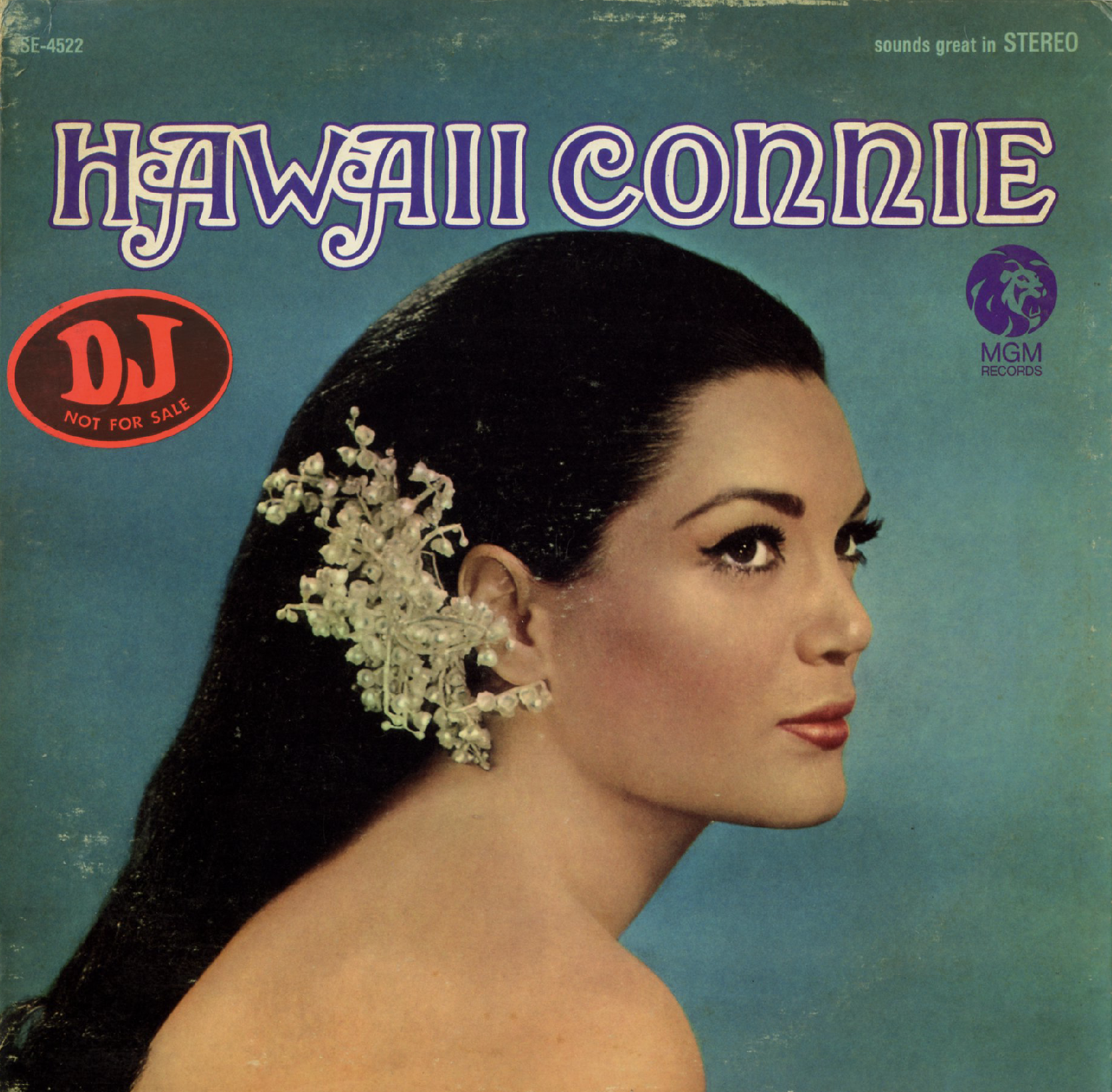
Hawaii Connie - Connie Francis


Harbor Lights

Hawaii Connie
Connie Francis 
Arrangements: Al Ham, Joe Mazzu & Clem Low
Produced by Bob Morgan
Cover Photo: John Engstead
Art Direction: Acy Lehman
Recored at Commercial Sound, Honolulu / Regent Sound, New York / Columbia, New York
Engineers: Bob Lang, Bob Linton, Frank Laico
MGM Records SE-4522
1968

Singers: Mary Mayo, Toni Wine, Jerry Duane, Stephen Steck, Ronald Martin, Jack Manno, Harry du Val, Jimmy Ryan, Anne Gable, Marlene Ver Planck

Violin: Julius Held, Gene Orloff, Leo Kruczek, George Ockner, Harry Katzman, Paul Gershman, Harry Lookofsky, Raoul Poliankin, Emanuel Green, Max Pollikoff, Paut Winter, Arthur Bogin, Julius Brand, Arnold Eidus, Joseph Malignaggi

Cello: George Ricci, Lucien Schmit, Charles McCracken, Harvy Shaprio

Clavietta: Angelo Dellaira

Organ, Celeste: Morris Wechsler

Percussion: Doug Allen

Reeds: Henry Freeman, Joseph Soldo

Guitar: John Pizzarelli, Vincent Bell, Frank Cerchia

Tiny Bubbles
I'll Remember You
One Paddle, Two Paddle
Red Sails In The Sunset
Waikiki
Happy Hours
Pearly Shells (Popo O Ewa)
Lahaina Luna
Blue Hawaii
Forevermore
Harbor Light
To You Sweetheart

Stimulus Progression Number One - Muzak


Easy Come, Easy Go

Stimulus Progression 
Number One
Muzak SZB 497 H-1(1)80

Tonight I'll Say A Prayer
Raindrops Keep Fallin' On My Head
Easy Come, Easy Go
Everybody's Talkin'
Jean
Copy Cat
California Girl
Spinning Wheel
Children 
Jingle Jangle
Cecelia 
New Fangled Preacher Man

Porgy & Bess - Mundell Lowe


Porgy & Bess

Porgy & Bess
Mundell Lowe and His All Stars
Arranged by Mundell Lowe
Produced by Peter Delheim
Recorded in RCA Victor's Studios A and B, New York, July 16 and 17 and October 3, 1958
Recording Engineer: Ray Hall
RCA Camden CAL-490
1959

From the back cover: When George Gershwin turned from the sleek, sophisticated Broadway scores that had been his stock in trade during the 1920s and the early Thirties to compose "Porgy and Bess" he had to adopt an approach that was quite different from the attitude that had served him so well for such shows as "Lady Be Good," "Tip-toes," "Oh, Kay," "Funny Face" and "Girl Crazy." For these carefully calculated romps, a glib pattern had been evolved and if Gershwin managed to create more quality within the pattern than most of his contemporaries, still the pattern existed and he knew its outlines well.

But the people of Charleston's Catfish Row who had been created by DuBose Hayward in his novel, Porgy, could not be interpreted in the usual songwriting evocations of the South – the Tin Pan Alley concept of Mammy, Alabama, fields of cotton and Swanee, stereotypes to which Gershwin had already made his full contribution. This was a score that required contract with reality, so Gershwin went to Charleston to absorb the sounds and sights and smells and attitudes that would form the setting for "Porgy and Bess." He brought back some things which he transcribed literally – the flavorful street cries, for instance. But most of what he heard there served simply as the basis and guide for the composer's transudations, which retained the essential idiom of Catfish Row but expressed it in terms more suited to the high dramatic concept of "Porgy and Bess."

Something of the same process has been gone through by guitarist Mundell Lowe in adapting "Porgy and Bess" to a jazz interpretation. In writing his arrangements, he has first bone back to the basic idiom of Catfish Row, which is one of the contributory roots of jazz, and, whereas Gershwin adapted this idiom to the needs of the dramatic theater, Lowe has built on it in terms of present-day jazz.

"I wanted to get a modern jazz feeling," the guitarist has explained, "and yet maintain the flavor Gershwin had put into the score – the lonesome, empty feeling in the ballads, for instance."

He felt that this could be achieved partly through his won writing approach, partly through a choice of musicians who playing spanned jazz styles and jazz history from the raw earthiness represented by Catfish Row to is more cerebral modern equivalent. And that is why he put together the unusual group which plays all but three of these elections.

The key men are Ben Webster who, as Lowe says, "goes back to the Catfish Row days," who provided the magnificent Duke Ellington band of the early Forties with much of its rampant surge and whose playing has grown richer and more direct as the years have gone by; Tony Scott who was born, musically in the Benny Goodman era and has progressed from there; George Duvivier, a veteran of the Jimmie Lunceford band and a brilliant bassist with an unusually broad range of sympathetic interpretation; and Art Farmer, one of the new crop of jazz stars whose "lackadaisical way of phrasing," Lowe points out, provided him with just the type of modernist expression that he wanted.

And, of course, the key to this key men is Mundell Lowe himself, who plays from one of the most fabulously varied sets of jazz and folk roots that any current musician can boast of – a background that began in the jazz heartland of New Orleans and includes encounter with the Swing Era as a miner of Jan Savitt's orchestra, a pioneering modern jazz venture with Ray McKenley's brilliant but unappreciated big band of the late 1940s, emergence as a polished small-gourd performer with Red Norvo and Ellis Larkins, recognition as an unusually able all-around performer as an NBC studio musician from 1950 to 1958 and even, back in his early days, a fling with country music on "Grand Ole Opry."

For his septet, Lowe has written arrangements that have a loose swinging blues-tinged base. Summertime he viewed as the theme of the whole score. "I wanted to establish a loose feeling," he said, "so it starts very simply with the baritone (Scott) playing paraphrases of melody and gradually the whole band comes in."

Bess, You Is My Woman is taken at a tempo which, Lowe says, "most good singers use when they do this tune. We've just added a little swing and syncopation to it." Redheaded Woman, one of the less familiar tunes in the score, was chosen by Lowe because "it afforded a nice little blues for the band to play." The blues in this are recipes suggestions of a Basie interpretation. 

My Man's Gone Now is one of two pieces which Lowe felt required some basic changes for jazz treatment.

"It's such a beautifully mournful piece, "he asserts, "but it was a waltz in the original score and I felt that doing it in three-four didn't bring out the feeling I though it should have. So I rewrote it from a rhythmic point of view. And on It Takes A Long Pull To Get There, which is sung by a grouped men going out to the fishing grounds, it seemed to me that a twelve-eight rhythm portrayed this particular situation. As I've written it, it start in twelve-eight and shift to a four-four release in the middle."

The three trio selections were designed  by Lowe to achieve a change of sound and style – a shift to a light, carefree, small sound. His cohorts in the trio – Duvivier and drummer Ed Shaughnessy – are members of ta group which Lowe usually leads on weekends (pianist Bobby Pancoast is an added starter on these occasions). Shughnessy makes his first recorded appearance as a vibraphone soloist on I Love You, Porgy.

"Ed has been studying vibes for a few  years," Lowe related, "but he was very apprehensive about this little solo. You know, when you've always been a drummer it's a little hard to adjust yourself to playing a melody instrument. I think his solo is one of the tenderest things int he album."

An original Shaughnessy device – or, more accurately, an approximation of it – is heard on There's A Boat Dat's Leaving' Soon For New York. He has invented a small snare drum trimmed with little bells which he has with a foot pedal, giving off an effect something like rhythmic sleigh bells. Ed had to rush to the trio's recording session direct from a television show and he didn't have time to pick up his little bell drums. To replace it, he improvised an equivalent sound by setting a tambourine on top of a regular snare drum and hitting it with his fingers.

The flow and style in which the trio lays this number is based on Lowe's memories of working at Cafe Society with Avon Long, who played Sportin' Life and and this song in the first revival of "Pray And Bess."

"Avon did it in his night club act," Lowe recalls, "he did it very simply, dancing around and waving his cigaret. I've always felt that he was the best of all the Sportin' Lifes and I've tried to catch the wonderfully gay and seductive feeling he gave the song." – Frank Talmadge

Summertime
Bess, You Is My Woman
I Love You, Porgy
I Got Plenty Of Nuttin'
Where's My Bess
Redheaded Woman
My Man's Gone Now
It Takes A Long Pull To Get There
It Ain't Necessarily So
There's A Boat Dat's Leaving' Soon For New York