Search Manic Mark's Blog

Wednesday, November 22, 2023

Lisa Kirk Sings


Limehouse Blues

Lisa Kirk 
Sings At The Plaza
Assisted by Jim Brooks, Jimmy Harris, Jerry Rush and Scooter Teague
A new act written by Robert Wells
Staged by Tony Charmoli
Musical Director: Don Pippen
Gowns by Jean Louis
Special Material by Robert Wells and David Saxon
Cover Photography by Harold Corsini/Gamma
MGM Records E3737
1959

From the back cover: Lisa Kirk is from the Broadway stage. She was discovered by Rodgers and Hammerstein and played a major role in their "Allegro". Her singing of "The Gentleman Is A Top" won her the critics acclaim and during the New  York run of the play the doubled into the world famous Copacabana. The ever-alert Cole Porter was quick to recognize her talent and signed her for his "Kiss Me Kate", in which she snag "Why Can't You Behave" and "Always True To You In My Fashion"; the latter of which became the most talked-about song of the season in the entertainment world. While playing in "Kate" Lisa doubled into the Plaza Hotel's Persian Room... this was the first of what was to become the recognized opening of the "Season" in New York.

Lisa has the unusual distinction of having starred at the Persian Room eight times in seven years – and packing the room to the rafters for every performance. This album contains the "One Woman Show" that Lisa presented in her 8th appearance. She got the season off to another booming start which is evidenced in the following quotes from he New York Critics...

Gene Knight – New York Journal-American... "Neither rain, nor rain, nor rain could stay the admirers of Lisa Kirk from packing the Persian Room of the Hotel Plaza last evening for the premiere performance of their favorite entertainer. Include me in ... What Miss Kirk has more of than most supper club stars is show-womanship. She can sing. She can act. Here was a real pro at work. Few, indeed are the entertainers who can put over a song better than she... It is customary for critics to be critical. But, I must report truthful, there in nothing I can criticize in Lisa Kirk's act. Indeed I have no hesitancy in writing publicly that Lisa Kirk is one of the best entertainers the Persian Room has ever presented."

Robert Dana – New York World-Telegram... "Lisa Kirk captured everybody with the dramatic scope of her personality. Lisa was magnificent... her full-spirited voice was as pretty to the ear as any notes I've heard in many a moon... Miss Kirk's perform ace, fascinating as it was, probably will be bet remembered for "Far Away Places', 'The Riviera'... and 'Limehouse Blues' in which she reveals one of the best formed pari of legs in tonight clubs. Her performance in the Plaza's Persian Room is one that must be recorded among the greats of our time."

Louis Sobol – New York Journal-American... "Lisa Kirk scored the greatest triumph of her career with her sizzler of an act at the Plaza's Persian Room. I can't recall a supper club act in many years that has tugged such an ovation."

Walter Winchell "Orchids... Lisa Kirk's stage magic at the Persian Room."

These are just a few of the bouquets that have been showered on Lisa since her opening in New York. She is currently keeping busy touring the country appearing at such places as the Ambassador in Los Angeles, the Fairmont in San Francisco, the El Rancho Vegas in Las Vegas, House in Chicago and the Hilton hotels in San Juan, Puerto Rico and Havana, Cuba. She will also be seen in both dramatic and musical television performances including the Dinah Shore Chevy Show, Ed Sullivan Show, General Electric Theater and many others.

Lisa has captivated audiences wherever she has found them... so sit back, relax, close your eyes and enjoy an unforgettable evening in New York, as... Lisa Sings At The Plaza .

I Travel Light 
I'm Sitting On Top Of The World 
Anything Goes
You'd Be So Nice To Come Home To
Hi-Lili, Hi-Lo
How Come You Do Me Like You Do
Why Can't You Behave
Good Little Girls
Far Away Places And The Riviera 
Limehouse Blues

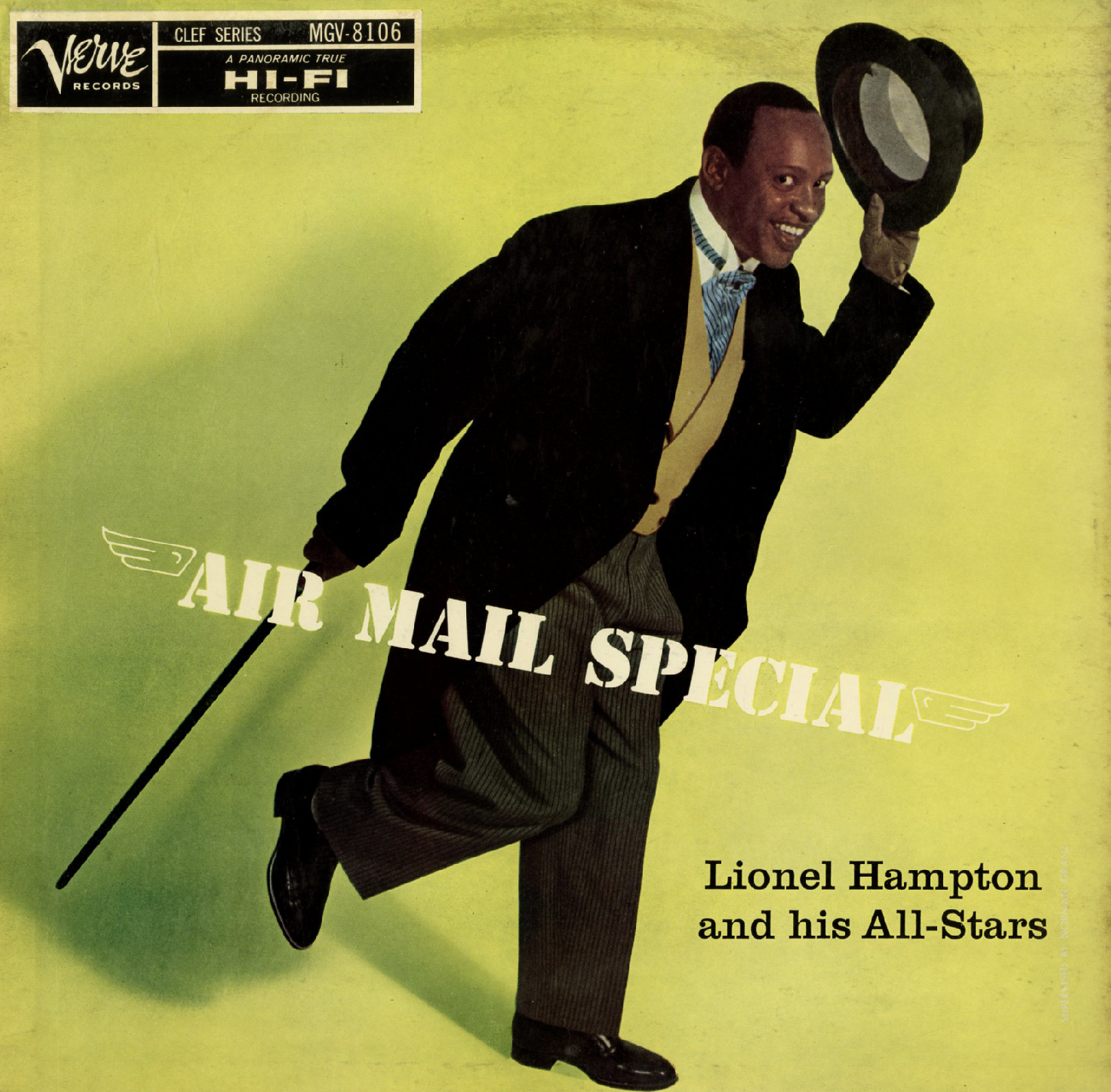
Air Mail Special - Lionel Hampton


Airmail Special 

Air Mail Special
Lionel Hampton And His All Stars
Cover Photo by Herman Leonard
Verve Clef Series MGV-8106

From the back cover: Lionel Hampton is, as the author Richard Gehman once quoted of one of his more ardent fans, "a virtual virtuoso," which is a phrase that hits the ear pleasantly, insinuatingly. Hampton is indeed a virtual virtuoso and his music, too, hits the ear pleasantly – but with force. Hampton, of course, is one of the more forceful personalities to come along in jazz. To quote Gehman once more: "The only time he (Hampton) is still is when he is crouched over the vibes, and then the stillness is only relative. He bounces up and down in rhythm, singing to himself in a sort of half-chant, half-ground. Invariably, the audience and band take up this curious sound and sing along..."

There is no audience to  be heard on these sides, but Hampton himself is, as always, fairly audible. Whether or not his own personal accompaniment helps Hampton swing just a little better is a debatable point – it might, at that. In either case, this would scarcely be a Hampton album without it and this most certainly is a Hampton album; if there were any lingering doubts one listen to the insistency throbbing beat would settle such an issue. Appropriately enough, Hampton and his All-Stars start off with "Airmail Special," the old Benny Goodman-Jimmy Mundy-Charlie Christian tune – appropriately, because it was Goodman who discovered Hampton, encouraged him, gave him confidence, even backed him in his first venture as a bandleader away from the Goodman fold. This was in 1940 and it wasn't too long after then, as time is measured, that Hampton was high on his way.

Lionel Hampton, born in Louisville and reared in Chicago, started out as a drummer, turning to the vibraharp only by accident while he was with the Les Hite band, fronted by the redoubtable Louis Armstrong himself. Later Hampton formed his own band on a small caste, playing in the old Cotton Club in Los Angeles. It was there, playing "Avalon" (as everyone who saw "The Benny Goodman Story" will recall) that Goodman found him; soon Hampton was a part of the Goodman trio and quartet – until the breakaway in 1940 and subsequent success through the years.

In this album you will hear the Lionel Hampton Quartet, with Oscar Peterson, Piano; Ray Brown, Bass and Buddy Rich, Drums, an A side. On side B the group with augmentation by Buddy DeFranco. On Side B you will hear the Lionel Hampton Quartet, with the addition of Buddy DeFranco on Clarinet.

Airmail Special 
Soft Winds
The Way You Look Tonight
It's Only A Paper Moon

Say It Isn't So - Herb Jeffries


Ghost Of A Chance

Say It Isn't So
Herb Jeffries
Back cover photo: R. Parent
Rep Records REP-215
1958

From the back cover: About Herb Jeffries there is much to be said, but listening to his voice describes him better than any words. In a musical period where singer are coming and going like the latest model cars, Jeffries' essentially masculine voice and superb tone quality have only matured and improved like wine since he shot to fame with his famous rendition of Flamingo. For the last few years, Jeffries has been trolling and singing in European casinos and vacation spots and turning down all major company offers to record an American album. He returned to the United States in January, 1957, and this is his first album since then and the first opportunity American music lovers have to hear his maturing voice and interpretations.

"Say It Isn't So" is a calculated album for us and for Jeffries. Studying the plethora of popular record packages of the current market, Jeffries realized that mass American tastes musically lay in the mood album. Jeffries decided also that an essential mood of musical expression was missing. This album is the result of that decision.

This is truly a Torch album. Torching is a universal and a unique experience for true lovers. Arranger-conductor Russ Garcia calls it Sad Joy. The brilliant Brazilian writer, Machida De Assis, writing in Portuguese, calls it the voluptuousness of misery; a yellow, lonely, morbid flower, one of the most subtle emotions of which and is capable. In defining and characterizing this Torching mood, Jeffries, Garcia and the research staff of Bethlehem began to search the thousands of standard songs for those ones which truly lit the torch of voluptuous misery and lined the sides of its sad joy with the memories of lovers' time together; of cocktail haunts, of special restaurants, of smoke from drifting cigarettes and certain moments of ecstasy.

Say It Isn't So
Ghost Of A Chance
Penthouse Serenade
It's The Talk Of The Town
If You Could See Me Now
Angel Eyes
Glad To  Be Unhappy
Easy To Remember
The End Of A Love Affair
Dinner For One, Please James

Monday, November 20, 2023

Cool Velvet - Stan Getz


'Round Midnight

Cool Velvet
Stan Getz and Strings
Orchestra Conducted and Arrangements by Russell Garcia
Cover: Merle Shore
Verve MGV-8379
1960

From the back cover: The marriage of jazz with strings is not always a happy one. Too often the incongruity between the toughness of one with the tenderness of the other creates a comic effect. Of all the leading instrumentalists today, it is doubtful whether there is anyone whose style is better suited to the muted emotions of a string background than Stan Getz, for the elements required for a felicitous blending of jazz horn with orchestral orthodoxy are all natural elements of Getz's own style. He has what might be called a non-belligerent tone, the kind of technique which enables him to flit blithely from discord to resolution without being overbearing, and about all a lyrical approach to improvisation which makes him one of the oddest fish on the jazz scene.

This style of Stan Getz may be traced back, without the aid of any sophisticated devices, to the classic Lester Young of the prewar pierced. Many of Getz's stock phrases are distantly reminiscent of the aural shapes which Lester first introduced into the jazz vocabulary. But as occasionally happens with derivative artist of unusual creative power, the derivation itself becomes an original thing through the sheer force of the artist's personality.

Over the last few years Getz has been evolving from album to album until today he is as original and instantly recognizable as any of the great jazz soloist whose works are accepted as milestones on the road of jazz development.

Like Lester, Getz is not particularly revolutionary in his harmonic approach. Compared to contemporaries like Sonny Stitt, he might even be termed slightly conservative, although he possesses all the nuances and many of the mannerisms of modernism. His deployment of the arts of tonguing and the truly amazing integration of mind and fingers produce an effect which, if it were pictorially represented, might consist of delicate traceries wrought with exquisite draftsmanship. It is essentially  a romantic style which, it must be confessed, sometimes teeters on the brink of sentimentality. But just as Lester Young hovered on the rim of affection without ever actually tumbling in, so Getz flirts with his own stylistic weaknesses without ever actually succumbing to them.

His choice of material of this album, recorded in Stuttgart, Germany with European musicians also shows a certain originality, for despite the positive glut of ballad albums, Getz has contrived to include several pieces not yet debase by over usage. Perhaps the two must significant tacks are "'Round Midnight" and "Whisper Not", because they illustrated a truth with the world at large has yet to perceive, which is that from within the confines of the jazz aesthetic, work sometime emerges of such sensibility and melodic wit that the abyss between art and popularity is bridge without any trouble. It must be hard for the layman to equate the public image of Thelonious Monk as a bespectacled buffoon with the flawless form of "'Round Midnight", which Getz so loving interprets. – Benny Green - The Observer, London

From Billboard November 21, 1960: An unusually happy marriage between jazz and pop elements occurs here. Getz' alto tones seems handsomely adaptable to the lush string backing provided by Russ Garcia. The fine selection of repertoire includes "The Thrill Is Gone," "It Never Entered My Mind" and "Early Autumn." Lovers of soft, moody background music will find their disk here... and fans of the Getz style will go for it as well, despite the strong pop orientation of the package. Dealers will do well to push this with pop buyers.

The Thrill Is Gone
It Never Entered My Mind
Early Autumn
When I Go, I Go All The Way
A New Town Is A Blue Town
'Round Midnight
Born To Be Blue
Whisper Not
Good-Bye
Nature Boy

In The Own Sweet Way - Eddie Costa & Art Farmer


Nature Boy

In Their Own Sweet Way
Eddie Costa
Art Farmer
Premier Records PS-2002
1962

From the back cover: The word "phenomenon" as outlined in the dictionary, pertains to an exceptional person, things or occurrence, and is frequently used in a banal attempt to give class or distinction to an otherwise colorless performer. Generally, the music trade is apathetic to such inaccurate semantics, but once in a while they solely nod in agreement that some newcomer is fully deserving of such accolades. Eddie Costa who recently captured the Down Beat international jazz critics' poll on both vibes and piano, fits this select category.

During his boyhood in Mount Carmel, Penn., Eddie's latent music talent was sparked by his brother, Bill Costa, who is a pianist/accordionist with an excellent reputation in the music field. Through the happy coincidence of Bill's encouragement and an expert home town piano teacher, Eddie became an adequate pianist and accepted professional employment as such albeit that is age was a scant fifteen years. Despite the restrictions of age, which forced at least one club owner to shut down, Eddie continued his preparation for a career in music.

His inevitable arrival in Gotham in 1948 produced a second twist in his career which revolved around brother Bill. Needing employment, Eddie auditioned for a band on which Bill was playing piano and gives. Witnessing Eddie's superb piano technique, the leader assumed he was also a vibes player, although Eddie had never lifted a mallet professionally, He began experimenting with the instrument and in a relatively short period of time he transferred his piano dexterity to the vibes. How successfully this was accomplished is indicated by the Down Beat new star nomination in which he swept to the top of both categories by a wide margin.

Eddie incorporated his own writing and playing skill with one of the country's leading jazz talents, trumpeter Art Farmer, who has taken the jazz world by storm as a logical successor to the mantle of Miles Davis with his inspirational attack and conception. Altoist Phil Woods was a featured member of Dizzy Gillespie's "State Department" band, and displays versitility on his instrument that has seldom been heard in the modern idiom. Bassist Teddy Kotick is an extraordinary rhythm man who has been in the employ of some of the greatest names in the trade. Likewise, drummer Paul Morton who, with his infallible time sense, has become one of the most frequently used drummers on the East Coast. Collectively, this is a superior quintet.

Four originals and three standards comprise the material heard in this set with chart contributions by Costa, Farmer and Woods. The fact that each writer had prior knowledge of the temperament and capabilities of his fellow tradesmen permitted them a wider experimental scope and produced some refreshing ideas.

Get Out Of The Road
In Your Own Sweet Way
Big Ben
Nature Boy
Blues Plus Eight
I Didn't Know What Time It Was
Stretch In "F"

What The World Needs Now - Los Indios Tabajaras


A Whiter Shade Of Pale

What The World Needs Now
Los Indios Tabajaras
Produced by Herman Diaz, Jr.
Recorded in RCA's Studio C, New York City
Recording Engineer: Ed Begley
Designer: J. J. Stelmach
Artist: Don Punchatz
Art Director: J. J. Stelmach
RCA Records LSP-4615
1971

From Billboard - December 4, 1971: This is a really good LP and will attract much attention to Los Indios. They play their guitars and make beautiful music which will make this a programmer's favorite. "The End Of The World" is a lovely highlight. Other good cuts include "For All We Know," "To Be The One You Love" and the title tune.

What The World Needs Now Is Love
Take Me Home
The End Of The World
Love Is Blue
I've Lost You
Spanish Harlem
I Ain't Got Time Anymore
To Be The One You Love (Theme from the film "The Anonymous Venetian!")
For All We Know (from the ABC film "Lovers and Other Strangers")
A Whiter Shade Of Pale

So Easy To Love - Werner Muller


There's A Small Hotel

So Easy To Love
Werner Muller and His Orchestra
Telefunken TP 2517
1961

It's Not For Me To Say
Easy To Love
Hot Toddy
Exactly Like You
The Hawaiian Wedding Song
All The Way
Chances Are
There's A Small Hotel
My Prayer
You're Driving Me Crazy

Shaw'nuff! - Great Tunes By Artie Shaw - Francis Bay


Nightmare

Shaw'nuff!
Great Tunes by Artie Shaw
Featuring The Francis Bay Orchestra
Stereophonic Engineering and Artistic Direction by Peter Plum, Elite Musical Productions
Produced by Dave Hubert
Cover Photograph by Ray Avery
Product Design by Leon McFadden
Omega Records OSL 21

From the back cover: The Bay Big Band salutes to the great American and English big bands at the Brussel's World's Fair astounded and impressed all who heard their regular performances at the fair. Francis Bay, the leader and an extremely versatile musician and arranger, organized the Bay Big Band in 1954 to become the first regular Radio Dance Band after the end of World War II. The Bay Big Band recently won the highly coveted "Golden Gondo" trophy in a battle of the bands at Venice, Italy. The precision section work and fluid jazz improvisation of the soloists are a product of years of rehearsal and development shared by the same group of musicians without the constant changes in sidemen that have plagued our American bands in recent years. The musical rapport between sections of the band and between soloists is amazing. Francis Bay plays trombone, clarinet and alto saxophone and flute with equal ability and his regular programs on the Brussels N.I.R. Radio conceived by program manager Rob Boon can be heard weekly on the powerful station throughout England, France, Belgium and surrounding countries. – Dave Hubert

Begin The Beguine
Dancing In The Dark
Cross Your Heart 
When The Quail Come Back To San Quentin
Temptation
'S Wonderful 
Stardust
Frenesi
Moonglow
Nightmare

Something For Both Ears - Stereophonic Demonstration Recording


Caravan

Something For Both Ears
A Stereophonic Demonstration Recording
Notes and Coordination by Woody Woodward
Equalization and Mastering by Fern Dorrell
Cover Photo and Design by William Clayton
A Richard Bock Production
World Pacific Records STEREO HFS-2
1958

Georgia On My Mind - The Johnny Mandel Orchestra - From "Big Band Jazz In Stereo"
The Vamp's Blues - The Charlie Mariano/Jerry Dodgion Sextet - From "The Blues In Stereo"
Hooray For Love - The Bill Holman Orchestra - From "Big Band In Stereo"
Sunday - The Mastersounds - From "Flower Drum Song"
The Champ - The Mastersounds - From "Ballads And Blues"
Caravan - The Chico Hamilton Quintet - From "The Chico Hamilton Quintet In Stereo"
Bali Ha'i - The Chico Hamilton Quintet - From "South Pacific In Hi-Fi"
'Round About Midnight - The Gil Evans Orchestra - From "New Bottle, Old Wine"
Revelation - Gerry Mulligan And The Sax Section - From Gerry Muligan Song Book Vol. 1"
Ornithology - The Gerry Mulligan Quartet (Chet Baker, trumpet) - From "Reunion With Chet Baker

Sunday, November 19, 2023

Flame Out! - Janet Blair


Lover Man Oh Where Can You Be

Flame Out!
Janet Blair
Arranged and Conducted by Lou Busch
Recorded in Hollywood
Cover Photo by Tommy Mitchell
Cover Design by Don Feld
Dico Records 1301
1959

From the back cover: Jimmy Durante once said, "Janet's loaded with talent. She can do anything". Janey says, "What I like to do best is sing." And in "Flame Out!" the once starry-eyed dance band vocalist returns to her first love – singing.

"Flame Out" is about twelve songs full of love. They are admittedly "touchy," but Janet's message when you hear there sing them that... "although the guy's gone he's either gonna come back of if he doesn't he's out of his mind."

Why Janet's singing are some of the best "heart songs" around, most of them from the two "golden" decades of song writing, the Thirties and the Forties. among the composers are Rodgers and Hart, Johnny Mercer, Cole Porter, Hoagy Carmichael, Duke Ellington and George Gershwin. In her own dramatic style Janet treats the creation o these luminaries with the respect they deserve.

The musical backgrounds were arranged and conducted by Lou Busch who, while preserving the same mood tone throughout, created the chance of pace so necessary to this kind of album by variance of orchestral sound. Some numbers have a light, tonal modern jazz back-ground; other, a strikingly beautiful sting sound. Still others employ the sparse feel of a "blues" piano and a lonesome trumpet blowing "out there somewhere."

All are recorded in the highest of brilliant fidelity and are  captured with a lustrous and thrilling "presence."

As you can see, a lot of care has been lavished on Janet's debut album. She deserves it.

Janet Blair's career to date encompasses virtually every phase of the show business world except the circus. With her versatility she may yet make that.

Her first rate of stardom came as "Chief Power Puff Dance" in an Altoona, Pa. dancing school recital. This of course was temporary, because, as everyone knows, you just can't be a "Chief Powder Puff Dancer" after you reach the age of seven.

Since this early remarkable achievement her professional horizons have included warbling from a bandstand with Hal Kemp's orchestra, emoting in summer sock, touring the U.S. for three year in "South Pacific", playing a host of push nitrites, starring in a dozen films, capering in the London production of Bells Are Ringing" and filling America's homes with her acting, singing and dancing on guest appearance and the Sid Caesar and Chevy TV shows.

From Billboard - May 25, 1959: Dico Records, a new label seeking to record established name talent on a profit sharing basis, will be unveiled by its founder, Lou (Joe Fingers) Carr Busch, with its release of Janet Blair's "Flame Out" album. The Busch plan allows the artist a substantial piece in the album's ownership, similar to the participating equity pattern long followed in the motion picture industry.

Miss Blair's album marks her first appearance on records since her days as vocalist with the Hal Kemp Orchestra in 1940. Busch was pianist with the Kemp crew. Her album will consist of torch tunes. It will be released this summer when the songstress returned to the "Chevy Show" as star replacement for Dinah Shore, thereby reaping TV promotional benefits.

Dico will release thru Allied. Label will also featuring Lou Busch's recordings. Busch is currently lining up similar co-ownership album deals with other name personalities.

He launched the label when he concluded a 10-year stint with Capitol Records on May 15. While at Capitol, Busch created his nom de disk, Joe (Fingers) Carr, which he used on Honky-Tonk styled keyboard knuckling.

Busch contends that stabled names deserve far more than the standard 5 per cent royalty paid by record manufactures, and that his profit sharing plan is the only way they can be assured of a larger slice of record sales revenue. The majors, Busch argues, want the artist to pay the recording session costs and then get a mere 5 per cent return. He insisted that his parting with Capitol was amicable and his remarks are aimed at the "5 per cent holy cow" royalty structure of the industry as a whole and not at Capitol alone.

Record companies, Busch said, expert artist to look upon the recording activities as mere hobbies and not as a major source of income. While profit-sharing deals may not be practical for the major labels, Busch said, he feels his plan will attract top names to his firm and prove successful. Co-ownership arrangements with artist, however, won't allow Dico to groom unknown talent, which is a major area of investment for most diskeries. Deals will be made only with established names and not newcomers.

Nico's deals will vary among artists, Busch said. Amount of Equity retained by the Artist will depend upon the extent the artist will invest in the package product.

Get Out Of Town
Autumn Leaves
Glad To Be Unhappy
They Can't Take That Away From Me
Good Morning Heartache
The Gentlemen Is A Dope
Don't Explain
I Get Along Without You Very Well
Do Nothin' Till You Hear From Me
Then You've Never Been Blue
In Love In Vain
Lover Man Oh Where Can You Be