Search Manic Mark's Blog

Friday, June 2, 2023

Piano Jazz - Volume 1

The Dirty Dozen No. 1 & 2

Piano Jazz 
Volume 1
Barrel House and Boogie Woogie
Featuring Pine Top Smith, Montana Taylor, Romeo Nelson, Cow Cow Davenport and Speckled Red (Rufus Perryman)
Brunswick BL 54014
1954

From the back cover: The Language Of Jazz has always been as lusty and colorful as the music itself. While some of the words of jazz have managed to remind the private property of its musicians, many have found their way into the mainstream not only of America's, but the entire world's everyday speech and writing. And why not? How wonderful those words and expression are! Think of "funky" – and "gut bucket" – and "dig," "groove," "crazy," "solid," "cool." And "barrel house" and "boogie woof" too.

Approached semantically, "boogie boogie" and "barrel house" are far from obscure eighteen in meaning or origin. "One Top Smith, whose most famous recordings are heard here, is generally credited with the invention of the name for the distinctive piano style of which he was a master. It was, as a matter of fact, on these records made in Chicago in 1928 that the words were first believed to have been publicity used.

But the sound of the words boogie boogie somehow manages to convey something of the sound of the music too. Actually, boogie boogie is probably an outgrowth of a kind of free style blues pino laying that flourished throughout the South until relatively recently. Its most striking characteristic is the steady, insinuating repetitive bass usually played eight beat to the measure or "eight to the bar' while the right hand freely improves, playing against the bass and creating intricate counter-rhythms. 

Barrel house, on the other hand, is a much more general term used more often to convey a feeling rather than to describe a specific style of playing. According to the late New Orleans trumpeter, Bunk Johnson, "a barrel house was a piano in a hall... When I was a kid, I'd go into a barrel house and play 'long with them piano players 'til early in the mornin'z. We used to play nothin' but the blues."

To others, however , barrel house signifies the kind of occasion or circumstance where "the drinks come right out of the barrel." Applied to jazz it is a low-down, m rough-and-ready, no holds barred kind of expressiveness – a lusty, rowdy and honest music. The term then, is an all-inclusive on, able to take in a great variety of musical material – including boogie woogie.

Barrel house and boogie woogie playing ws for many years the exclusive property of a band of little-known, musically self-educated itinerant pianist-entertainers. These 20th Century minstrels could be heard in the obscure dives and honky tonks of the South, at rent parties in St. Lous, Memphis, Chicago, Kansas City and Detroit, and at neighborhood and small town dances. They could also be heard on a few re]rods made exclusively for Negro audiences in the South and those larger cities of the North with large Negro populations.

Five of the most exciting of those "Breakdown" pianist-blues singers are represented in this collection. We know almost nothing about the lives of some of them, but despite their obscurity, they live on and will be remembered because of these performances. These records offer indisputable evidence of the enduring qualities of the music hey created and live by.

Clarence "Pine Top" Smith is probably the most famous of the pianist you will hear on this record. Born in Troy, Alabama in 1904, he first came to attention in Pittsburgh, Pa. where his unique stile of playing in Negro theaters and night clubs earned him more than a slight measure of popularity. A comedian, singer and dancer as well as a pianist, Smith was a natural showman and had not trouble at all in finding work.

It was in Chicago, however that he came to the attention of recording direct Mayo Williams who quickly set about putting Pine Top's music on records. The four selection heard here, all original Smith compositions, were recorded at the Brunswick studios in Chicago in 1928. Less than six moths later, Smith died, the victim of a stay bullet fired in a barroom brawl. These four sides, representing the best of Pine Top's recorded output are magnificent demonstrations of his earthy folk humor, his sensitive approach to the blues and his driving eight to the bar attack.

The late Charles "Cow Cow" Davenport, who died penniless and almost completely forgotten in 1955 was perhaps best known for his compositions Cow Cow Boogie, Cow Cow Blues, I'll Be Glad When You're Dead You Rascal You and Momma Don't Allow No Piano Playing In Here. The latter tune has a them was a basis of fact in Davenport's youth. As he told it, his father sent him to Selma University when he was sixteen. "Selma was a place where they turned out practically all the preachers in Alabama," related Cow Cow. "That's what Pa wanted me to be – a preacher. Now, I couldn't read music in those days, but I could fund out a few rags. But Pa would say, 'Play all the reels you want, but I don't want all them rages played in here.""

At twenty-three Cow Cow got his first gob in vaudeville, in a theater in Augusta, Georgia that also featured ta blues singer named Bessie Smith. Soon after he teamed up with Dora Carr with whom he subsequently recored and toured the country. The records heard here were made in Chicago in 1928, when Cow Cow was at the height of his popularity. Vaudeville, however was on th way out a the gook a job in 1929 with the Vocalion record Company as a composer. A few years later he ventured forth into show business again with a unit called Cow-cow's Chicago Steppers. When that failed, Cow Cow retired from show business, and although he attempted to make a come-back in the '40s, it was in vain.

One of the main features of Daveport's playing as the walking bass, which he claims to have inv ended. On both his Two Cow Blues and State Street Ice, the latter with talking by Ivy Smith, Davenport gives ample evidence of his mastery of the blues and boogie woogie idioms.

About the three other pianist presented here, we known almost nothing. Like so many other folk artist of early jazz, their lives have gone undocumented, and only their record remain. The two solos by Montana Taylor ere made for Vocalion in Chicago in 1929 and are vigorous example of this unknown musician's considerable talents. Speckled Red, whose real name is Rufus Berryman, is only slightly less a mysterious figure that Taylor. Dirty Dozen No. 1 and Dirty Dozen No. 2, made in 1929 and 1930, respectively are compositions built around an old folk custom regulating the way in which bitter insults were exchanged. Wilkins Street Stomp, on the other hand, is a driving, slightly eccentric blues – a fine display of Perryman's energetic, unorthodox boogie piano.

Romeo Nelson is also a shadowy figure and the only thing we seem to know for sure was that he lived in Chicago and made just a few records for Vocalion late in 1929. The sensational aspects of  his keyboard style are demonstrated in Head Rag Hop on which Nelson talks as well as played. Indeed, fe pianist can boast of the ckind of overwhelming exuberance that Nelson manages to convey on this recording. – Notes by Nat Shapiro

Detroit Rocks - Montana Taylor - Piano Solo
Indiana Avenue Stomp - Montana Taylor - Piano Solo
The Dirty Dozen No. 1 - Speckled Red - Piano with Singing
The Dirty Dozen No. 2 - Speckled Red - Piano with Singing
Wilkins Street Stomp - Speckled Red - Piano Solo
Head Rag Hop - Romeo Nelson - Piano Solo with Talking
Pinetop's Boogie Woogie - Pine Top Smith - Piano Solo with Talking
Pinetop's Blues - Pine Top Smith - Blues Singing with Piano
Jump Steady Blues - Pine Top Smith - Piano Solo with Talking
I'm Sober Now - Pine Top Smith - Talking and Singing with Piano
Cow Cow Blues - Cow Cow Davenport - Piano Solo
State Street Jive - Cow Cow Davenport - Piano Solo with Talking by Ivy Smith

Wednesday, May 31, 2023

Groovy Grubworm - Harlow Wilcox


Wipe Out

Groovy Grubworm And Other Golden Guitar Greats
Harlow Wilcox & The Oakies
Produced at C&B Studio, Norman, Oklahoma
Engineer: Carl Warren
Plantation Records PLP 7

Groovy Grubworm
Wipe Out
Walk, Don't Run
The Gold Eagle
Raunchy
Sad Is The Lonely
Golden Guitar Flower
Mexico
Wheels
Guitar Boogie
Honky Tonk
Moose Trot

Sunday, May 28, 2023

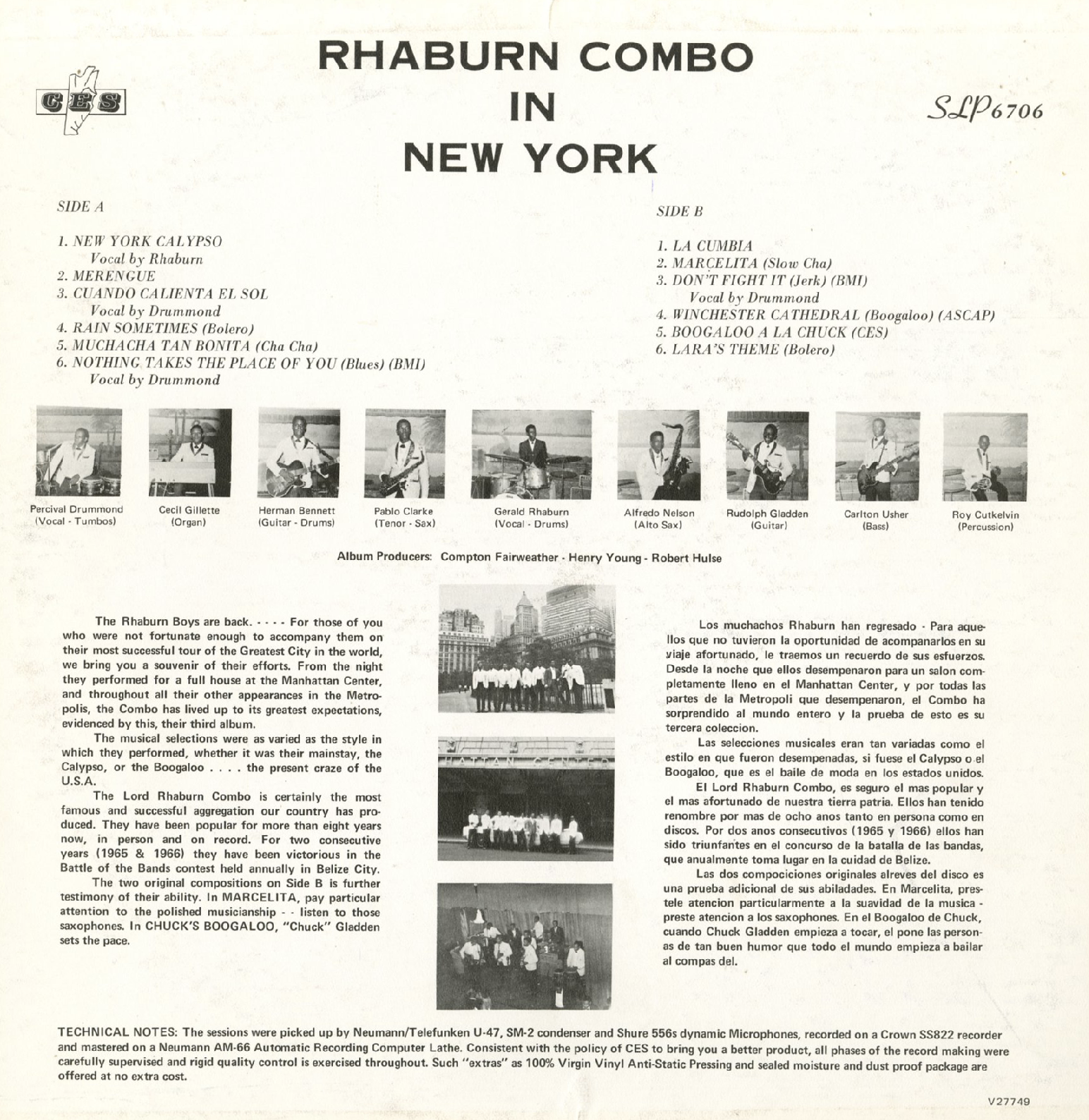
Rhaburn Combo In New York


Boogaloo A La Chuck

Rhaburn Combo In New York
Album Producers: Compton Fairweather, Henry Young & Robert Hulse
CES SLP 67806

Percival Drummond - Vocal & Tumbos
Ceil Gillette - Organ
Herman Bennett - Guitar & Drums
Pablo Clarke - Tenor Sax
Gerald Rhaburn - Vocal & Drums
Alfredo Nelson - Alto Sax
Rudolph  Gladden - Guitar
Carlton Usher - Bass
Roy Cutkelvin - Percussion

From the back cover: The Rhaburn Boys are back... For those of you who were not fortunate enough to accompany them on their most successful tour of the Greatest City in the world, we bring you a souvenir of their efforts. From the night they performed for a full house at the Manhattan Center, and throughout all their other appearance in the Metropolis, the Combo has lived up to its greatest expectations, evidenced buy this, their third album.

The musical selections were as varied as the style in which they performed, whether it was their mainstay, the Calypso, or the Boogaloo... the present craze of the U.S.A.

The Lord Rhaburn Combo is certainly the most famous and successful aggregation our country has produced. They have been popular for more than eight years now, in person and on record. For two consecutive years (1965 & 1966) they have been victorious in the Battle Of The Bands contest held annually in Belize City.

The two original composition on Side B is further testimony of their ability, In Marcelita, pay particular attention to the polished musicianship .. listen to those saxophones. In Chuck's Boogaloo, "Chuck" Gladden sets the pace.

New York Calypso - vocals by Rhaburn
Merengue 
Cuando Calienta El Sol - Vocal by Drummond
Rain Sometimes - Bolero 
Muchacha Tan Bonita - Cha Cha
Nothing Takes The Place Of You - Vocal by Drummond
La Cumbia
Marcelita - Jerk
Don't Fight It - Vocal by Drummond
Winchester Cathedral - Boogaloo
Lara's Theme - Bolero

Saturday, May 27, 2023

Bach: Chaconne - Andrés Segovia


Gavotte

Bach: Chaconne
Andrés Segovia, Guitar
And Other Works by Bach, Sort, Mendelssohn, Villa-Lobos & Rodrigo
Decca Gold Label Series DL  79751 & 9751 (1955)

From the back cover: (A Letter Written by Marc Pincherle for a Recital at Paris, June 4, 1935, by Andrés Segovia)

You ask, my dear Andrés, that I should present to the public your transcription of the Chaconne. It seems absurd, in reality, that a musician of your standing should be defended against a possible suspicion of disrespect to J. S. Bach. Grim zealots may rise to pro- test in the name of the old cantor – and seek to prohibit precisely what he, himself, would have been the first to approve.

I admire the Chaconne profoundly, yet I have seldom heard it played without a sense of discomfort. This dissatisfaction was wholly unrelated to the musical splendor of the composition itself, to its nobility and pathetic content which reveals itself, to its rich variety, its marvelous balance as well as its ingenuity in the treatment of the violin. In spite of all this, it is rare that a performance corresponds to our expectation, so great is the contrast between the frail resources of those four strings and the intensity of the truth which they must express, between the mondonic character of the violin-a pure soprano voice- and the orchestral fullness demanded by the composition.

A Joachim or an Ysaye, and a few other privileged artists since their day, could succeed in reconciling these contradictions but each time the impression given was that of a success permitted only to genius from which the ordinary honest interpreter of repertoire was necessarily excluded.

Something of this sort must have been in the minds of those fervent admirers of Bach: Mendelssohn, Ferdinand David, and Schumann, for when David played for the first time the recently discovered Chaconne in the winter of 1840-Mendelssohn rushed to the piano to lend it the support of an accompaniment which, later, he edited and published in London, 1847. Schumann followed suit in 1854, publishing accompaniments to the six Sonatas or Suites, while the piano accompaniments were enlarged by Wilhelm into orchestral scores.

Many other experiments were made in the desire to make the execution of the Chaconne accessible. F. Herman split the difficulties between the two violins without bass. Brahms made an arrangement for piano (left hand), the fifth of his Etudes pub- lished by Breitkopf. Raff made another arrangement, this time for two hands. Finally, we are familiar with the all-too-sumptuous arrangement of Busoni. It remained, however, for that master of the bow, Jena de Hubay, to dispossess his own instrument by giving us a transcription for full orchestra in which the various instru- ments divide among themselves the polyphony originally assigned to a single violin.

Those readers who may consider such liberties illegitimate, need only to be reminded of the practices customary among musicians at the time of Bach, and, indeed, of the casual way in which the master himself modified the destination of his works – changing an adagio in legato style from violin to harpsichord, transferring a prelude for solo violin to an organ accompanied by orchestra.

Among the instruments to which Bach devoted particular atten- tion was the lute, close relative to the guitar. Scholars (among whom N. D. Bruger and H. Neeman) have inventoried the works that exist in several instrumental versions, for violin solo with lute, for lute and violoncello but, in most cases, these researches have failed to reveal which of these versions was the original and which the transcription. Is it inconceivable that the Chaconne, perhaps, might turn out to be among the compositions with a double version and that further research might bring this fact to our knowledge?

Who can say that a direct connection with the guitar may not be brought to light? The very Key of D, in which the Chaconne is written, is the perfect tonality for the guitar; the entire harmonic "schema" is based on progressions that are typical of Andalusian popular music, a thing which is characteristic throughout the com- position but most striking in the whole of the last page. This Andalusian music is expressed traditionally on the guitar.

It is not unlikely, moreover, that the Iberian origin of the Chaconne might have suggested to Bach the idea of assigning it to a Spanish instrument, one which his universal curiosity could not ignore, since it had become the fashion in every country of Europe. Obviously, it is not on so frail a hypothesis that we can form a conviction. What really counts in the balance, the sole argument of weight likely to influence our opinion as to whether or not the Chaconne was composed originally for the guitar, is the clear evidence that the composer wrote as though he had no other instrument in mind. No rearrangement is required; everything springs out with amazing spontaneity. The chords, so laboriously sawed out out by the violin in arpeggio or closed present themselves here with a single stroke; the imitations retain their independence of line and color; the arpeggios provide a harmony of an even weave above which the melodic designs appear in full relief. Perhaps the violin can affirm its superiority in a few legato variations, in certain high passages where the strokes of the bow give vigor and poignancy to the phrase. Almost all the rest is better suited to the guitar which (in addition to its other advantages) can claim that of add- ing the lower octave under the written note, thus providing a deep bass capable of sustaining the majestic structure.

Enough said. The whole question is one of ear, or musical sensi bility, and your hearers will form their own judgment. My object has been simply to reassure those among them who have not studied these questions and who, not yet knowing you, might, in their distrust, be patient enough to read to the end what I have written. To these, I would say that the delight they will experience in listening to you is a legitimate delight...


1. PRELUDE

Side One

MARC PINCHERLE

J. S. Bach

Originally composed for the lute, this piece is published today in a collection of "Twelve Little Preludes" for piano. Mr. Segovia plays his own transcription of the work.

2. GAVOTTE

J. S. Bach

The "Gavotte" recorded here was originally part of a suite for lute. Bach then incorporated it into the E major suite for unaccom- panied violin. The so-called "purists" who object to the transcribing of pieces from one instrument to another have only to look to Bach for flagrancy in this respect! Vivaldi and Handel also wrote the same works for a variety of instruments.

3. CHACONNE

(See the letter by Marc Pincherle above.)

4. LOURE

J. S. Bach

J. S. Bach

The "Loure" which Mr. Segovia plays here was transcribed by him from the Unaccompanied Cello Suite in C Major.

1. MINUET IN C

Side Two

Sors

Ferdinand Sors is noted as both/guitarist and composer. Born in Barcelona in 1780, Sors was active in Paris, and from 1809, in London, where he made the guitar fashionable, appearing as solo- ist with the Philharmonic Society. His compositions include many valuable studies and pieces for the guitar. This Minuet is from a sonata with "a very un-sonata like form," which may have been the work to move the famous French musicologist Fétis to call Sors "the Beethoven of the guitar."

2. ANDANTINO

Sors

This is a very charming little work of Sors'. One notes the fresh- ness and innocence of Mozart in it.

3. MINUET IN D

Sors

This Minuet of Sors' is less Mozartian than the preceding piece. It reveals more of Sors' own personality, Sors travelled a great deal, even venturing as far as Russia; his work abounds in a variety of mood as a result of his own varied experiences.

4. CANZONETTA

Mendelssohn

The Spanish guitarist-composer, Fisea Tárrega, originally transscribed this work from Mendelssohn's String Quartet. Mr. Segovia has made certain alterations in the transcription to present the work as it is recorded here. The result is indeed a happy one. The central portion of the Canzonetta contains a succession of arpeggios that, when divided among four instruments, cannot begin to achieve the unity of performance as when played by only one.

5. PRELUDE

Villa-Lobos

Written in the style of Bach, this Prelude follows with persistence a repeated pattern of design throughout the entire last half of the piece. Villa-Lobos was himself a guitarist; everything he wrote for guitar was written with ample knowledge of the instrument. He has even invented a few new guitar techniques, including twelve studies for guitar, and a series of Preludes, from which collection this one was taken,

6. SARABANDA

Rodrigo

Rodrigo is at the moment engaged in the process of writing a suite for unaccompanied guitar. As the "Sarabanda" was written expressly for guitar, so was the Concierto de Aranjuez, for guitar and orchestra.

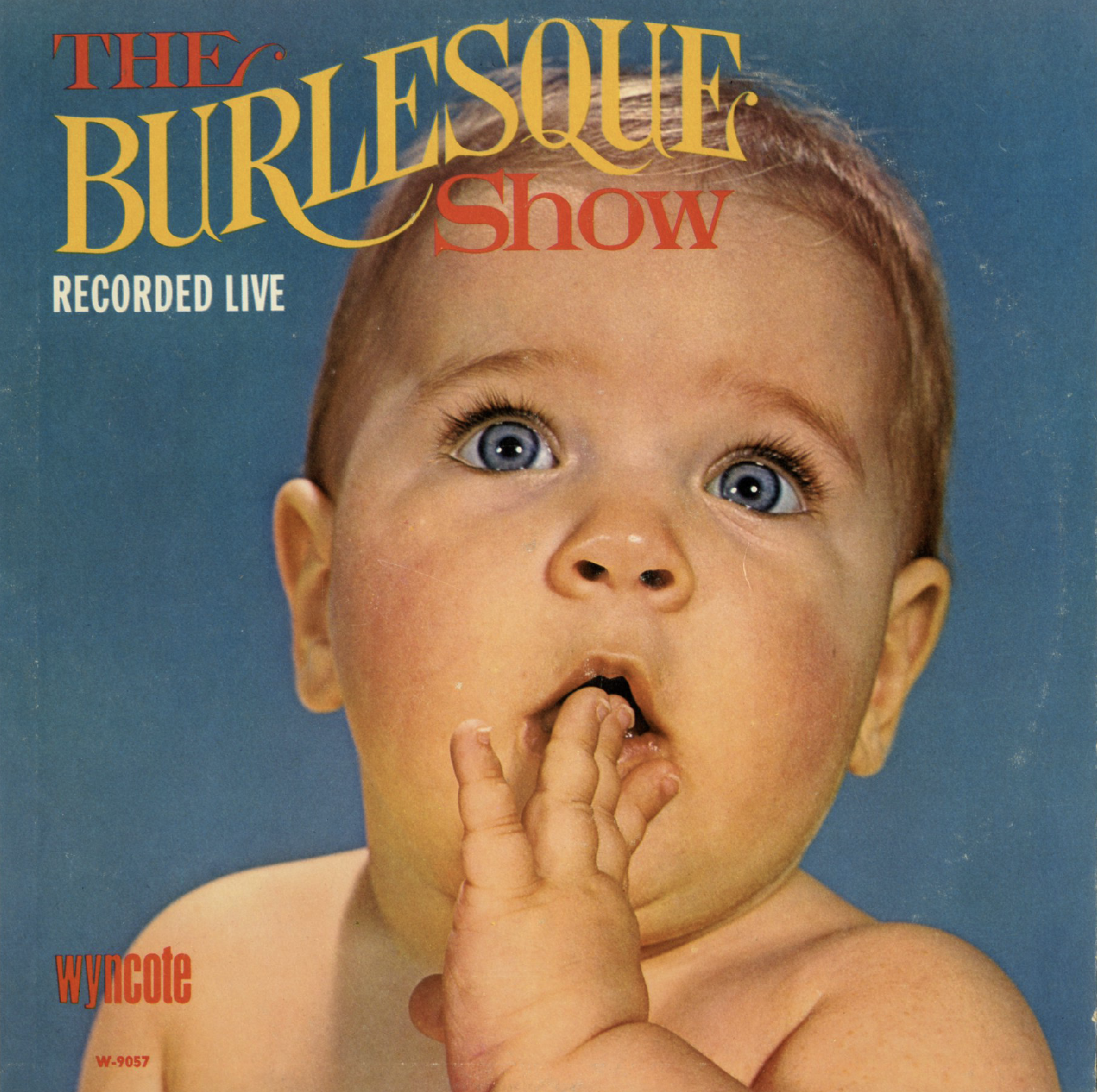
The Burlesque Show


The Burlesque Show

The Burlesque Show
Recorded Live
Wyncote W-9057
1964

Introduction
The Widow
Buck-Fifty
Husband And Wife

The Explosive Betty Reilly


Under The Pairs Skies

Quiéreme Y Veras

The Explosive Betty Reilly
Design: Cla Freeman / Cal-Art & Assoc.
Golden Tone Hi-Fidelity C4067
1960

The Saga Of Elvis Presley 
It Ain't Necessarily So
Under Paris Skies
Run Joe
Look To The Rainbow
When The World Was Young
Quiéreme Y Years
Quizas, Quizás, Quizás

Friday, May 26, 2023

Tijuana Sounds - Teddy Phillips & Colleen Lovett

Yesterday

Winchester Cathedral

Tijuana Sounds
Teddy Phillips & Colleen Lovett
And Their Mexicali Brass
Produced and Arranged by Teddy Phillips & Colleen Lovett
P&L Records - MST 10357

From the back cover: The fabulous "Tijuana Sounds" come to you in the colorful and unique style of Teddy Phillips and Colleen Lovett and their Mexicali Brass. Here is a group that has captured the mariachi style made so famous the past couple or yers by the Tijuana Brass. Add to the brass sounds the golden tones of Teddy Phillips' saxophone, the rich quality of the Colleen Lovett's voice and you have an exciting album that is truly unique in quality and sound.

Teddy and Colleen and their Mexicali Brass have played all the best clubs throughout the country in addition to State Fair appearances with stars like Bob Hope, Red Skelton, Jack Benny, Tennessee Ernie Ford, Eddy Arnold plus many others. Add to this many TV appearance on all the top shows, plus several million seller records, and you can easily see why the Mexicali Brass is such a popular group.

There is a must album fro any collector who enjoys good music – music with a beat and sound – all this, plus the unusual combination of Colleen Lovett and Teddy Phillips!

Tijuana Taxi
Georgy Girl
Shadow Of Your Smile
Boots
Medley: Spanish Flea / Born Free / Our Day Will Come / Somewhere My Love
Taste Of Honey
Spanish Flea
Yesterday 
More
Sunrise, Sunset
Lonely Bull
Winchester Cathedral

Tuesday, May 23, 2023

Jimmy McHugh In Hi-Fi - Urbie Green


Diga Diga Doo

Jimmy McHugh In Hi-Fi
Urbie Green His Trombone and Orchestra
Arrangements by Al Cohn and Irwin Postal
Produced by Fred Reynolds
Recorded in Webster Hall, New York, May 5, 9 and 12, 1958
Engineer: Ernest Delrich
RCA Victor LSP-1741

From the back cover: This album combines the talents of two superb musical giants – Jimmy McHugh and Urbie Green. To do full justice to McHugh's wonderful songs, Urbie has assembled some of the New York's finest sidemen. He sparks this big, wonderful band with is own great trombone. And Mr. Green's trombone-playing is widely conceded to be just about the best in the business.

This is Urbie's second album for RCA Victor, following on the heels of his successful "Tet's Face The music And Dance (LSP-1667). So here, in brilliantly recored sound, are many of your favorite songs in settings that are tops for listening and arrangements that are absolutely unbeatable for dancing.

Also from the back cover: After a command performance in London in 1951 the Queen of England, then Princess Elizabeth, said to Jimmy McHugh: "Mr. McHugh, you seem to have written all my favorite songs."

It is not by implied chance, however, that millions everywhere share her royal sentiment, or that the music of Jimmy McHugh holds suck a warm and large place in the heart of the world. Nor is ti by design.

The simple answer is that Jimmy McHugh writes about love with love. Far more than most men, he genuinely loves people. Not just the rich and successful, but al kids of people in every walk of life and circumstance of fourteen. It is reflected in every song he ever wrote. Recognizing it, men and women the world over have responded in kind.

In rich and deserved reward, Jimmy has been called American's greatest composer of love songs.

There is another actor, how er, which has bled an important part in the enormous popularity of jimmy McHugh's songs. It is simply this: whatever you mood of the moment may be – gay, sad, romantic, or bustling with bounce – there is a McHugh song to fit that mood. Moreover, in this music, there is something to appeal to every brow, be it high, low or medium; classics lovers and pop enthusiasts can walk side-by-side in enjoyment of his musical magic.

Every McHugh fan, of course, has his or her favorite McHugh song, usually identified with some highly personal memory. Maybe it was a social moon, a special dance, a social date that certain song recalls. Or maybe even a special quarrel with a sweetheart. Thus for some the favorite might be Don't Blame Me, Exactly Like You or I'm In The Mood For Love, while others might choose Lovely To Look At, On The Sunny Side Of The Street, Cuban Love Song, When My Sugar Walks Down The Street, A Most Unusual Day, or countless others on the fabulous list of McHugh song hits

Countless is the accurate word, incidentally, For Jimmy himself says he has lost track of the number of his songs since the first one, Emaline, was published in 1921. But considering that he has written the score for sixteen New York musicals and forty-five Hollywood movies (to say nothing of his prolific output of individual numbers), simple arithmetic sends the staggering total up in the hundreds!

To identify and cherish a song because of a romanic memory it recalls is as it should be, regardless of one's age; both are lively things meant to be cherished. There is one song must indelibly identified with Jimmy McHugh himself, and perhaps his most popular of all. It is the beloved I CAn't Give You Anything But Love. Two generations already have loved it and danced to its lovely strains, and generations to come will be doing the same thing. This is its thirtieth anniversary.

Written for the Broadway show "Blackbirds of 1928," it was one of the first hits of the team of Jimmy McHugh and Dorothy Fields. Even more exciting, the team had four smash success shows playing simultaneously on Broadway that year, all carrying the miracle tag, "Music by Jimmy McHugh – lyrics by Dorothy Fields."

The list of famous performers who have introduced Jimmy McHugh songs is almost as impressive as the number and variety of songs themselves. Staring with Maurice Chevalier in Ziegfeld's last "Midnight Revue" (the show which introduced Chevalier to America), the star-studded list includes such names as Helen Morgan, Lawrence Tibbett, Gertrude Lawrence, Lily Pons, Jan Pierce, Ethel Waters, Harry Richmond, Eddie Cantor, Mary Martin, Frances Langford, Shirley Temple, Carmen Miranda, Jane Powell, Deanna Durbin, Alice Faye, Perry Como, Judy Garland and Frank Sinatra, to mention but a few.

Jimmy McHugh also has been hailed as the most successful Irish-American composer since Victor Herbert. This pleases him, frankly and greatly because he is, as the sons of Erin say, "fightin' proud" of his Irish ancestry, and even coined a word, "Irishtocrat" to express it. In appearance hi is a big and handsome man, and looks like an Irishman is supposed to look. As his friends known,m he also has the temperament – great sensitivity and quick temper – the match, and is sympathetic to anyone in trouble.

Born in Boston, Jimmy well might have become a plumber if his plumber father had had his way. As it turned out, his mother, an accomplished pianist, had her way in supporting her son's determination bo become a musician, albeit he served a break apprenticeship in his father's shop.

Jimmy's first real job was as an office boy with the Boston Opera House. There he met such opera greats a Caruso, Tetrazzini, Puccini, Geraldine Farrar and Toscanini, and in their leisure moments back-stage often entertained them with unique McHugh improvisation on operatic arias. There is little doubt this early association had a great bearing later on the catholicity of his original compositions.

Next came a stint as traveling sungplugger for the Irving Berlin Publishing Company, and then McHugh struck out on his own in New York. Writing with various lyricists for the famed Cotton Club shows in Harlem he scored a number of hits, among them I Can't Believe That You're In Love With Me, which thirty years later became the theme song for the motion picture "Caine Mutiny."

Hollywood called McHugh and Fields in 1930, and thereafter the team alternated their highly sought service between the movies and Broadway. Throughout the years of World War II, however, Jimmy concentrated much of his time and energy along patriots lines, writing special songs at the request of Washington, and staging war bond drives. At one such rally he choked up the largest single sale of war bonds ever recorded – $28,000,000 worth!

There is another and lesser known side to Jimmy McHugh which was described by Dr. Jack Frederick Kilpatrick, Dallas Herald Times music critic and professor of music at Southern Methodist University, in these words: "It's like talking to the man who invented doorknobs, the chef who created bam and eggs. It's like meeting up with the fellow who first thought of shoelaces, to be introduced to Jimmy McHugh."

In other words – this is Jimmy McHugh, solid citizen affectionately known as "The Bishop of Beverly Hills" and honorary Mayor of that famous community. Also: active director and cast president of the Beverly Hills Chamber of Commerce; organizer and leading spirit of the polio foundation which has furnished thirty costly respirator to various hospitals and medical venters; composer of a Community Chat song, and worker-contributor in charities for every race, sect and reed; recipient to honorary degrees from two universities, and a half dozen awards for his effort in in behalf of youth; honorary life membership in the AAY for his interest in amateur swim champions, and designation as an honorary official of the 1948 Olympics. And most proudly, among other honors too numerous to mention, processor of a Presidential Citation, given by President Truman in recognition of valued services to the country.

Quite a guy, this Songwriter Jimmy McHugh!

P.S.: My favorite McHugh song? Naturally it's Louella.

– Louella O Parsons

From Billboard - November 10, 1958: Here is a tasteful, danceable package of Jimmy McHugh evergreens, which should enjoy particularly good sales on the West Coast where McHugh is active in civic affairs. Selections – all fine programming material for jocks – include "Louella," "Lovely To Look At," "I Can't Give You Anything But Love" etc. Liner notes by Louella Parsons, who has given package several solid plugs in her nationally syndicated movie column.

Louella
Cuban Love Song
Medley: I'm In The Mood For Love / Don't Blame Me / On The Sunny Side Of The Street / You're A Sweetheart / Where Are You? / Lovely To Look At / Candlelight And Wine / I Couldn't Sleep A Wink Last Night / Lost In A Fog / Blue Again
Rock-A-Bye Bluebird
I Feel A Song Comin' On
I Found Myself A Guy
Diga Diga Doo
I Must Have That Man
Medley: Exactly Like You / I'm Shooting High / I Don't Care Who Knows It / How Blue The Night / Thank You For A Lovely Evening / A Lovely Way To Spend And Evening / My, How The Time Goes By / When My Sugar Walks Down The Street / I Can't Believe That You're In Love With Me / I Can't Give You Anything But Love
Goodbye Blues

Monday, May 22, 2023

Basie Plays Hefti


Cute

Basie Plays Hefti
Produced by Teddy Reig
Cover Photo: Chuck Stewart
Roulette Bridled Series R-52011
1958

From the back cover: Some arrangers seem made to order for certain bands. Don Rodman and Benny Carter and Horace Henderson fitted a variety of organization in the twenties and thirties in this way. Billy Strayhorn was obviously born to write for the Duke Ellington band as Sy Oliver was to write for Jimmie Lunceford and Fletcher Henderson for Benny Goodman. And now it seems that Neal Hefti has found his band in Count Basie and Count is composer and arranger in Neal.

Like Fletcher's writing for Benny's musicians, Neal's suits the tastes and temperaments of the Basie men in every sort of entail. It provides settings for soloists which bring them out bar by bar, texture by texture, idea by idea as they rarely have been before. It is a style of scoring at least as much intuitive as it is instructed tin the sinking and playing procedures of these jazzmen. Somehow, either because of a similar set of likes and dislikes or because of his keen ear of considerably playing and writing experience, Neal knows the right figures to make Frank Wess blow his most forceful flute, Joe Newman his most swinging trumpet, Snookie Young his most soulful horn and Thad Jones his most elegant. One way or another, he has provided Marshall Royal with an adequate background for his large alto sound and given the Basie tenor men, Billy Mitchell and Frank Foster, a spacious alley in which to chase each other and found room for Al Grey's big, guttural trombone pushes and pulls. 

It's not a very complicated course of action, providing the Basie musicians with proper material. It does not involve tricky contrivances or writing in a notably obscure manner. It is, rather, a suiting of figure and temp, soloist and section, mood and mode so that it comes out Royal and Newman, Young and jones, Foster and Mitchell and Wess – in a word, Basie.

Has Anyone Here Seen Basie
Cute
Pensive Miss
Sloo Foot
It's Awf'ly Nice To Be With You
Scoot
A Little Tempo, Please
Late Date
Count Down
Bag-A' Bones
Pony Tail

A New Kind Of Love - Erroll Garner


Paris Mist

Erroll Garner With Full Orchestra
Plays Music From The Paramount Motion Pictures
"A New Kind Of Love"
With Orchestra Conducted by Leith Stevens
Introducing Four New Compositions by Erroll Garner
Photo - Garner by T. Williams
Photos - Miss Woodward and Paul Newman, courtesy Paramount Pictures
Octave Records / Mercury Records MG20859
1962

Instrumentation: 4 violas, 4 cellos, 1 bass, 1 harp, 6 wood wind artists with many doubles, 1 trumpet, 4 trombones, 3 percussion, 1 guitar and of course, 1 piano

From the back cover: Three orchestras worked from the blocked-out arrangements created by Garner, with Leith Stevens. Pete Rugolo developed the orchestrations if Mimi and In The Park In Parry, with exhilarating results. Jimmy Haskell orchestrated The Tease, and Nathan Van Cleave imaginatively orchestrated the remaining seven numbers. The piano parts, in al of the election herein, are unwritten. Garner improvised his parts on-the-spot at the actual recording sessions, intriguing even the most seasoned studio musicians on the dates with his daring inventions, different on each take.

Of Garner's spectacular ability to improvise the piano parts during the actual record with the orchestra, Stevens comments: "Erroll is a natural musical, born and brought up in the field of Jazz. He has a fantastic ear, a harmonic and melodic sense that won't stop, and a facile technique which will get him anywhere he wants to go. He had an electric effect on the entire orchestra with used performances to their peak. Most jazz performers play in one key throughout an arrangement on natter how long it is. Not Garner. He is pianistically at home and comfortable in any key. In fact, polytonality held no terrors for him. On several occasions we spread the orchestra through to tonalities sounding simultaneously, and his line never wavered – in truth, this exciting sound seemed to open up new vistas for him."

Garner, the pianist, as displayed here, is as strongly individual and unpredictable as ever. His sweeping piano within the large orchestra produces results that are bound to influence piano-with-orchestra, with Garner's new themes destined to take their place in the world of contemporary music, and his renditions of the film's standards giving vintage songs a new flavor.

You Brought A New Kind Of Love To Me
Lousie
Fashion Interlude - Erroll Garner
Steve's Song - Erroll Garner
Paris Mist - Erroll Garner
Mimi
Theme From A New Kind Of Love - Erroll Garner
In The Park In Parry
Paris Mist - Erroll Garner
The Tease - Erroll Garner