Search Manic Mark's Blog

Tuesday, June 21, 2022

Uniquely Mancini - Henry Mancini


C Jam Blues

Uniquely Mancini
Henry Mancini
Produced by Joe Reisman
Associate Producer: Al Schmitt
Music Arranged by Henry Mancini
Recorded in RCA Victor's Music Center Of The World, Hollywood, California
Recording Engineer: Jim Malloy
1963

Personnel:

Trumpets - Conrad Gozz (Lead), Frank Beach, Ray Triscari, Pete Candoli (Soloist), Conte Candoli (Soloist), Don Fagerquist (Flugelhorn Soloist)

Trombones - Dick Nash (Soloist), Jimmy Priddy, John Halliburton, George Roberts (Bass Trombone)

French Horns - Vincent De Rosa (Soloist), Richard Perissi, John Cave, Arthur Maebr

Woodwinds - Ted Nash (Alto & Alto Flute Soloist), Ronny King (Alto Flute Soloist), Harry Klee, Gene Cipriano, Plas Johnson (Tenor Sax Soloist)

Rhythm - Jack Sperling (Drums), Rollt Bundock (Bass), Bob Bain (Guitar), Jimmy Rowles (Piano), Larry Bunker (Vibes & Marimba), Bobby Helfer (Orchestra Manager)

Green Onions 
Stairway To The Stars
Night Train
Lullaby Of Birdland
Chelsea Bridge
C Jam Blues
Banzai Pipeline
Rhapsody In Blue
Cheers!
Lonesome
The Hot Canary
Moonlight Serenade

Someday My Prince Will Come - Miles Davis


Old Folks

Someday My Prince Will Come
Miles Davis Sextet
Produced by Teo Macero
Cover Photo: Columbia Records Photo Studio - Bob Cato
Back Cover Photo: Vernon Smith
Columbia Records CS 8456
1962

Personnel:

John Coltrane
Hank Mobley
Wynton Kelly
Paul Chambers
Jimmy Cobb

From Billboard - January 20, 1962: The top-selling modern jazz trumpeter has another fine set here which should draw healthy sales. The group is in the most successful Davis mold with extended choruses by Miles, and tenor saxist Hank Mobley and John Coltrane. The Coltrane name, incidentally, should add to the pulling power of the set. It was with Davis that he first gained widespread recognition. Pianist Wynton Kelly is another fine performer on the album. Besides the title tune, the groups plays "I Thought About You," three originals, and "Old Folks."

Someday My Prince Will Come
Old Folks
Pfrancing
Drad-Dog
Teo
I Thought About You

Monday, June 20, 2022

Hot Pennies - Red Nichols


Row, Row, Row

Hot Pennies
Red Nichols
Capitol Records T775
1957

From the back cover: For 30 years, Red has been recording the music he loves most dearly – American jazz. He was a famous leader at 16, and at 19 was the trumpet-tooting boss of men like Glenn Miller, Tommy and Jimmy Dorsey, Benny Goodman, Artie Shaw and other hot virtuosi of eminence.

Nichols' famed "Five Pennies" waxed scores of hit records, his orchestra played in the pits of a dozen memorable Broadway musical shows, and radio broadcasts throughout the 1920's and 1930's further established the skilled horn man from Ogden, Utah, as an international favorite. Red's abrupt decision in 1942 to abandon music, take a welding job in the Oakland shipyards an remain under the same roof every night with his polio-stricken daughter, is a story that is perhaps without equal in American popular music.

Millions were stirred by the story in October, 1956, when Red was the subject of a "This Is Your Life" program. And in December of the same year, Paramount began the motion picture production of the Nichols story at a cost of $3,000,00.

Here, in "Hot Pennies," Red is showcased in a long-play album recorded in true hi-fi for the first time in his career.

Surrounding the leader are Bob Hammack,  piano; Abe Lincoln, King Jackson and Moe Schneider, trombones' Joe (Blizzard Gizzard) Rushton and his bass saxophone; Billy Wood and Heinie Beau, clarinets; Wayne Songer, alto saxophone; George Van Eps, guitar; Jack Ryan, string bass; Al Stevenson, piano (rhythm); and Rollie Culver, drums. There are no vocals. All selections were recorded in the Capitol Tower on September 7 and 10, 1956.

The tunes are all particularly identified with Nichols and his bright Pennies – have been for years. But essentially, this is a Nichols package, dominated by his punching trumpet and inspiring personality.

From Billboard - February 23, 1957: Nichols' film bio is on the way, and it figures to create interest in this package. Most of the numbers included here are famous Nichols vehicles from the Five Pennies' heyday in the late 1920's, and they've been updated somewhat. The style now may be called a modified Dixieland, with Nichols' cornet sparkling, and sounding better than ever in hi-fi. His colleagues aren't particularly distinguished as soloists, but the ensembles are okay. Dixie fans and nostalgic old-timers constitute your market. "Louisiana" and "Peg O' My Heart" are samples.

Louisiana 
Mood Indigo
Maple Leaf Rag
Peg O' My Heart
Marchin' With The Saints
Mama's Gone, Goodbye
Ida
Farewell Blues
Blues At Midnight
Row, Row, Row

Sunday, June 19, 2022

Sonny Rollins Brass


What's My Name?

Sonny Rollins Brass
Sonny Rollins Trio
Verve V6-8430
1962

Personnel on Side One: Sonny Rollins, tenor saxophone; Nat Adderley, cornet; Clark Terry, Reunald Jones, Ernie Royal, trumpets; Billy Byers, Jimmy Cleveland, Frank Rehak, trombones; Dick Katz, piano; Rene Thomas, guitar; Roy Haynes, drums; Henry Grimes, bass; Ernie Wilkins, conductor and arranger; Don Butterfield, tuba. Recorded in New York City, July 11, 1958, at Metropolitan Studios

Personnel on Side Two: Sonny Rollins, tenor saxophone; Charles Wright, drums; Henry Grimes, bass. Recorded in New York City, July 10, 1958, at Beltone Studios. Supervision Leonard Feather

From the back cover: In the chapter devoted to the story of the tenor saxophone in The Book Of Jazz I describe Sonny Rollins as "one of the most influential figures since Getz, fashioning his own work from a blend of Lester Young, Charlie Parker and possibly Coleman Hawkins.

It now appears that I was a trifle conservative. Theodore Walter Rollins is the most influential young figure in his field today; I believe he is a source of inspiration for even more young tenor saxophonists than was Sam Getz at the height of his influence (around 1950, the year after Stan left the Woody Herman band and began to win the music magazine polls). And the "possibly" qualification concerning the relationship between Rollins and Hawkins is expendable. There can be no doubt that the fully animated style and sanguine, coursing Rollins tone found some of its impulse in the work of that earliest of the tenor giants.

Rollins is a dedicated artist who discovery of a personal voice in jazz was the outgrowth of several years of concentrated, calculated experimentation. His first records, with Bats Gonzales in 1948 (only two years after he had switched from alto to tenor) reveal a degree of fluency commendable and at that time unusual for a 19-year-old. The later combo dates with Art Blakey and Gadd Dameron in 1949-50, with Bud Powell and Miles Davis in 1950-51, show a firmer, more confident sound and a great technical control of the horn. When he joined the combo led jointly by Max Roach and the late Clifford Brown, in January of 1956, Sonny found himself established for the first time in a setting that offered a perfect propulsive background, a rhythmically stimulating framework for which he now mature personality was strikingly well suited.

Rollin left Roach in the summer of 1957. By this time the word had spread; the brush-fire enthusiasm that rapidly gains fervor among jazzmen when a new talent is recognized had convinced him that he was ready for the role of leader.

Because he demands nothing less than complete sympathy from those working with him, and because the intense desire for self-expression sometimes is thwarted when he becomes merely one of the convention of soloists, Sonny soon found that the quintet format, no matter how valuable it had been during his days as a sideman with Roach, was not compatible with his desires as a leader. After a couple of weeks fronting a quintet he dropped the trumpet player; a week later he let the pianist go. Since that time he has worked almost exclusively with a trio, only occasionally letting down his defenses and admitting a pianist into the entourage. A bassist who walks the right notes with a firm, crisp tone can supply him with all the harmonic suggestion he needs, at the same time leaving him greater freedom to say anything he cares to on the horn without fear of contradiction.

For his first session Sonny decided to retain, on one side of his initial LP, the trio setting in which he has worked for the past year; on the other side he arranged to offer a contrasting session that would display his sound, for the first time, with a large orchestra.

The bassist on both sessions, trip and Big Brass, was Henry Alonzo Grimes. Born November 3, 1935 in Philadelphia, he is a member of an all-musical family; a twin brother plays tenor, his mother is a pianist and father a former trumpeter. Grimes studied at Juilliard, toured for a while with rhythm and blues bands, and in the past two years has gigged with Rollins, Tony Scott, Gerry Mulligan, Charles Mingus and with the Benny Goodman band at Newport.

Charles "Specs" Wright, drummer on the trio date, also a Philadelphian, born in 1927, and heard in 1949-50 with the Dizzy Gillespie band; in recent years he has toured with Earl Bostic, Cannonball Adderley and Carmen McRae.

The rhythm section on the big band date includes Dick Katz, who played in Sonny's quartet at Birdland; Roy Haynes, the drummer from Boston best known as part of Sarah Vanghan's accompaniment since 1953; and Grimes. Functioning occasionally as section and  but more significantly as soloist is the Belgian-born guitarist Rene Thomas, who now lives in Montreal but was in the U.S. in 1957 playing in a Rollins combo in a Philadelphia night club. Thomas is the favorite guitarist not only of Rollins but of many who heard him during their European travels before he emigrated to Canada a couple of years ago.

The personnel of the brass section is so strong is distinguished names that no elaboration is required here here. Though the men function solely as a backdrop, their musicianship is of a caliber that assured the kind of teamwork necessary for an interpretation of Ernie Wilkin's moving arrangements.

Wilkins, a member of the Hines, Basie and Gillespie saxophone sections until the demands for his services as an arranger made him too busy to play, was born in 1922 in St. Louis and arranged for the bands of Basie, Tommy Dorsey, Harry James, and for innumerable New York record sessions. Since Rollins had never previously been served by orchestrations this was of course Ernie's first opportunity to write for him, an association welcomed by both participants and brought to fruition after extensive consultations on the size, shape and nature of the setting Sonny had in mind for his big-band bow. – Leonard Feather

From Billboard - April 28, 1962: This album, originally issued on the metrojazz label in 1958, should do well as a result of all the new publicity on Sonny Rollins' return as a performer. The set features Rollins almost at the peak of his career in a flock of free-wheeling performances, including "Body & Soul," "Who Care?" and "Love Is A Simple Thing," both with trio and full ork. Good blowing here and good wax for the current market.

Who Cares?
Love Is A Simple Thing
Grand Street
Far Out West
What's My Name
If You Were The Only Girl In The World
Manhattan
Body & Soul

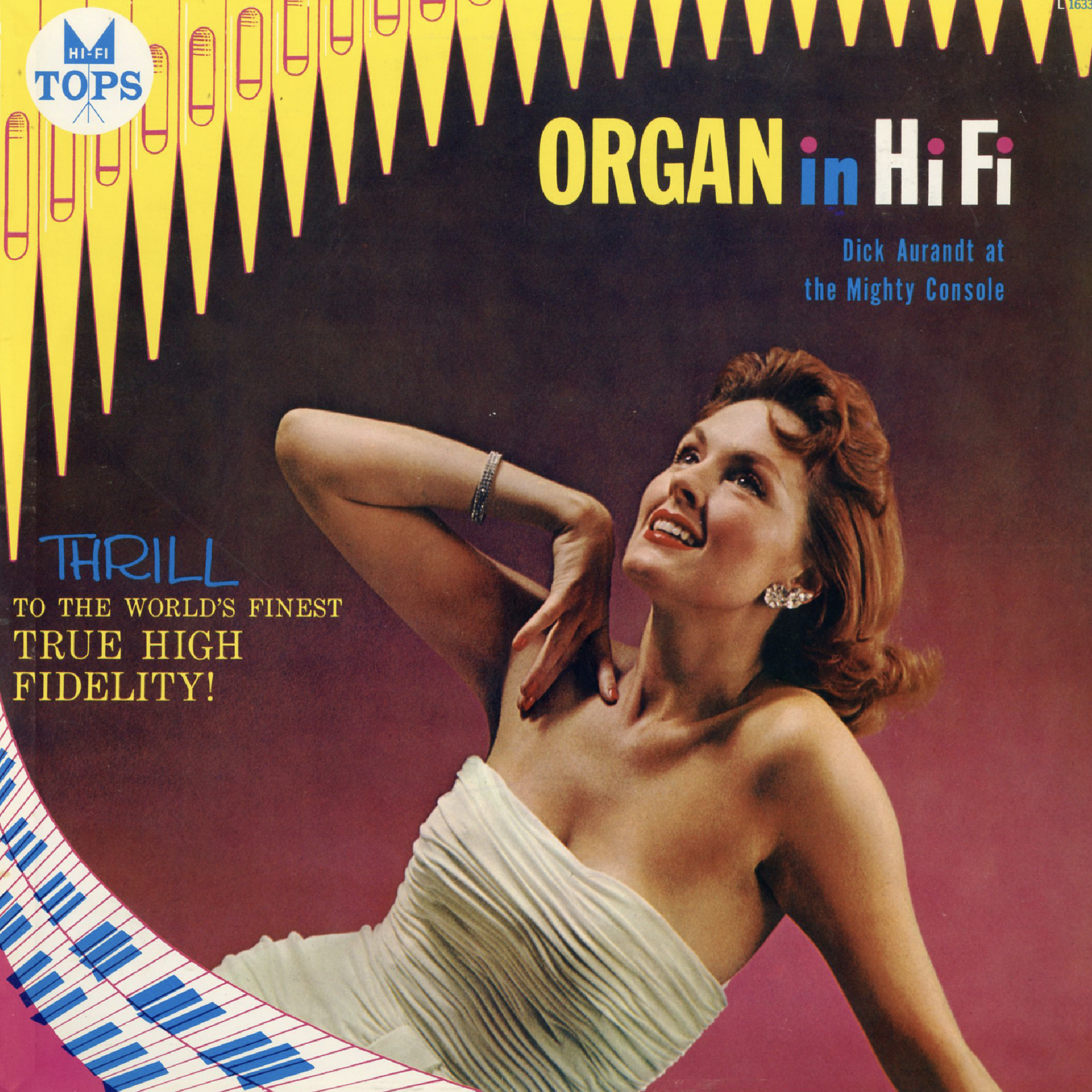
Organ In Hi Fi - Dick Aurandt


Stormy Weather

Organ In Hi Fi
Dick Aurandt At The Mighty Console
TOPS Records L1633
1959

From Billboard - April 6, 1959: Good listening package of organ music ably performed by organist Dick Aurandt. Tunes include such favorites as "I Surrender Dear," "Moonglow," "Fascination" and "Stormy Weather." Good rack material.

When It's Sleepy Time Down South
I Surrender Dear
I Can't Give You Anything But Love
Moonglow
Dancing Fiddles
Fascination
Smoke Rings
Mama Inez
Pyramid
Stormy Weather

Today's Hits In Jazz - Dave Pell


One Note Samba

The Dave Pell Octet Plays
Today's Hits In Jazz
An S. W. Production
Engineer: Bones Howe
Cover Design and Photography: Studio Five
Liberty Records LST-7298
1963

Meditation
Cast Your Fate Into The Wind
Walk Right In
Desafinado
A Taste Of Honey
One Note Samba
Love For Sale
Fly Me To The Moon
Little Bird
Our Day Will Come
I Wanna Be Around
Days Of Wine And Roses

Dixie In Hi Society - Barney Richards


Oh, Lady Be Good

Dixie In Hi Society
Barney Richards and His Rebels
Mercury Records MG 20508
1960

From the back cover: Each tune in this album is truly a product of years of working over. Richards never uses an arraignment on an engagement, but each time they play the number, Barney feels there's some refurbishment made and an improvement occurs. He personally feels this is the cream of over 400 tunes the band does regularly.

Oh, Lady Be Good
I Found A Million Dollar Baby
Mountain Greenery
You Took Advantage Of Me
Mournin' Blues
Bill Bailey Won't You Please Come Home
'S Wonderful
The Blue Room
Thou Swell
Someone To Watch Over Me
Just In Time
C'est Magnifique

Michelle - Caravelli


Michelle

Michelle
a la Caravelli and His Magnificent Strings
Cover Photo: Herb Brever
Columbia Records CL 2524
1966

If I Had A Hammer
Michelle
What Now My Love
Cuando Calienta El Sol
Calcutta
Desafinado
Yesterday
What's New Pussycat?
I Wish You Love
Dio, Come Ti Amo!
Marionettes

Do-It-Yourself - Peter Barclay


Alone

Do-It-Yourself
Music For Gracious Living 
Peter Barclay And His Orchestra
Photograph: Hedrich-Blessing
Columbia Records CL 698
1955

From Billboard - October 15, 1955: There rarely comes a series that invites display as does this one. The covers are full color photos of a type right out of "Better Homes And Gardens," each dealing with a form of modern home entertainment and avocation. On the back of each jacket is useful, easy to follow information – recipes for snacks, drinks, patio planting, dance music suggestions and remodeling hints. The music itself is standard background music, the usual "mood" or "dinner" music, consisting of standards, and very well recorded. The packaging is bound to call attention to the entire series, and the music, while interchangeable, is perfectly suitable for background for all of the above functions.

Alone
Because
The Stars Will Remember
Villa
Parlez-moi d' amour
Anniversary Waltz
Masquerade
Forever And Ever
My Hero
I'm Falling In Love With Someone
You Belong To My Heart
Indian Love Call

Saturday, June 18, 2022

Cloud 7 - Tony Bennett


Give Me The Simple Life

Cloud 7
Tony Bennett
Featuring Chuck Wayne
Columbia Record Productions
Special Products - Special Reissue CL 621
1955

Personnel:

Guitar - Chuck Wayne
Trumpet - Charles Panely
Piano - Harvey Leonard
Sax - Davey Schildkraut & Caesar DiMauro
Drums - Ed Shaughnessy
Bass - Clyde Lombardi

From the back cover: From the moment of his debut on records, Tony Bennett has had the magic touch that has hailed his listeners out to Cloud 7 with a single release. An audition record of Boulevard Of Broken Dreams won him an immediate contract with Columbia Records, and a new version of this old favorite served as his first release. Now, a revival of an old song by a new singer rarely makes much of a stir, but while Tony's record was only a moderate hit, measured against his later smashes, it was sensationally successful when those factors are considered. His next impression was made with Because Of You, which sailed easily past the million-record mark, followed in close order by Cold, Cold Heart, Rags To Riches and Stranger In Paradise, all of which rang the same gong. In 1951, the first year of Tony's popularity, he won no less than seventeen awards, including "The Cash Box" Award as 'best male vocalist,' which was ample testimony to his popularity on the juke boxes. He has done equally well ever since, and in 1954 won the "Make Believe Ballroom" poll as 'best vocalist'.

This is an unusual spot for a would-be artist to find himself in. Tony started out to become a commercial artist, studying at the High School of Industrial Arts after early training in Astoria, NY, grade schools. After graduation, however, he was called into service, where his distinctive singing style won him invitations to sing with army bands. He was so warmly received that he decided to abandon one form of art for another, and upon receiving his discharge, he attended the American Theater Wing's professional school for veterans. A series of bookings in local night clubs followed, with occasional radio programs, and his first big break came when Bob Hope caught Tony's act and invited him to appear with him during an engagement at the Paramount Theater. Shortly thereafter he made the demonstration record, and his career began in earnest.

I Fall In Love Too Easily
My Baby Just Cares For Me
My Heart Tells Me
Old Devil Moon
Love Letters
My Reverie 
Give Me The Simple Life
While The Music Plays On
I Can't Believe That You're In Love With Me
Darn That Dream