Search Manic Mark's Blog

Friday, January 28, 2022

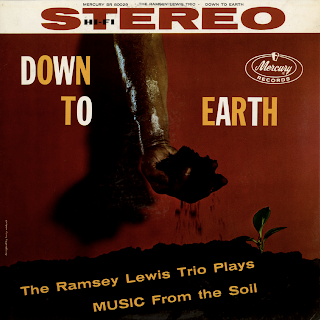
Down To Earth - Ramsey Lewis


Soul Mist

Down To Earth
The Ramsey Lewis Trio
Plays Music From The Soil
The Ramsey Lewis Trio appears by arrangement with Argo Records
Supervision: Jack Tracy
Cover Photography and Design: Leroy Winbush
Recorded at Tel-Mar Recording studios in Chicago, Nov. 6 and Dec. 4, 1958
Mercury SR 80029
1959

Personnel:

Piano: Ramsey Lewis
Bass: El Dee Young
Drums: Red Holt

From the back cover: Most "trios" are really nothing of the sort. They usually consist of a piano soloist who hires a bassist and drummer to keep time for hime and gives each of them one solo to mollify their egos.

The Ramsey Lewis Trio is the genuine article.

It is made up of three men, each of whom has a vital role in contributing to the overall sound and feeling of the group. Should any one of them leave, the organization would take on an entirely different musical appearance and would be virtually unrecognizable save for some obvious surface qualities.

This is the course that Lewis, El Dee Young, and Red Holt have chosen to follow ever since they decided they wanted to play together late in 1956. They worked a series of Chicago night clubs for more than two years, always polishing, honing, and patting the group into the unified entity they sought before going out on the road at the beginning of 1959 for a successful opening in New York at Birdland.

For a time the influence of the Modern Jazz Quartet could strongly be heard in the performances of Ramsey, El Dee and Red. The group in fact subtitled itself "The Gentle Men Of Jazz." Their Music was quiet, under firm control, and swung softly.

But gradually the group began to undergo a change. There was a constriction implied in the "Gentle Men" cognomen that kept them from digging in and snarling should they feel like it.

And so when this album was being plotted, the first point established was that there was to be no holds barred. The trio could play exactly as it wished on the material selected and forget about gentleness.

Dark Eyes
Come Back To Sorrento
Soul Mist
John Henry
Greensleeves
We Blue It
Sometimes I Feel Like A Motherless Child
Suzanne
Billy Boy
Decisions

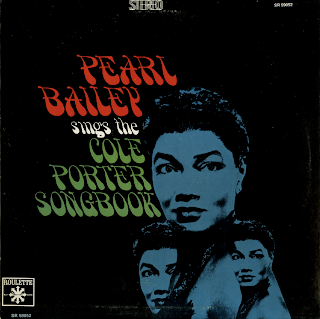
Pearl Bailey Sings The Cole Porter Songbook


I've Got You Under My Skin

Pearl Bailey 
Sings The Cole Porter Songbook
Album Design: Forlenza Venosa Associates
Roulette Records SR 59052

I've Got You Under My Skin
Love For Sale
Never Give Anything Away
Nobody's Chasin' Me
Mr. & Mrs. Fitch
I Hate Men
Josephine
I Loved Him
Always True To You Darling In My Fashion
The Laziest Gal In Town

Swing Sessions - Eiji Kitamura


Avalon

Swing Sessions
Eiji Kitamura and His All Stars
Producer: Fumimaru Kawashima
Musical Director: Hiroshi Isaka
Engineer: Eiji Uchinuma
Technical Coordinator: Takeo Niimi
Lathe Operation: Mitsuo Yamaguchi
Lathe Operators: Shizuo Nomiyama & Kohei Nakamura
Disc Plating & Pressing: Record Division, Victor Company of Japan, Ltd.
Recording Date: April 21, 1978
Recording Location: Iruma City Auditorium, Saitama Pref., Japan
Recording Supervisor: Terry Isono
Album Releasing Coordinator: Yutaka Horikoshi
Album Cover Design: Katsuhiko Iida
Front Cover Photo: Yasuhisa Yoneda
Other Photos: Masami Hotta
Liner Notes Translation: David Ball, FLC Inc.
Crisis  Service: Ichiro Okuno, President, RVC Corp.
A production of RVC Corporation, 1-7-8 Shibuya Tokyo 150 Japan:
affiliated with RCA Records and Victor Company of Japan
STEREO Limited Direct-To-Disc Edition
RCA RDCE-10 STEREO (JPL 1-1349)

Personnel: 

Eiji Kitamura: Clarinet
Lchiro Masuda: Vibraphone
Yoshitaka Akimitsu: Piano
Yukio Ikezawa: Bass
Hiroshi Sunaga: Drums
Judy Anton: Vocal

From the jacket notes: 

Eiji Kitamura (cl) was born in 1929. As an undergraduate at Keio University in Tokyo he devoted himself to clarinet playing. His hobby is fishing an listening to Japanese classical comic stories. He electrified the audience at the 20th Anniversary Jam Session of the famous Monterey Jazz Festival held on the West Coast of U.S., in September 1977. To the Japanese jazz press which traditionally tends to favor modern jazz, Kitamura's participation caused a sensation. He had made a deep impression on his fans through his rich playing on his regular TV program, and by taking part in this world famous event, he made a giant leap into prominence. 

Ichiro Masuda (vib) is the leading vibes player. Before becoming a jazzman, he was a proponent of Hawaiian music and had a group, the Coconut Islanders and it was then that he became interested in the electric guitar. Masuda has also been a well-known audio critic 20 years. He was born in 1933. He was already working as a professional while still an undergraduate of Meiji University in Tokyo.

Yoshitaka Akimitsu (p) is the leading swing piano player, but he has not made many recordings with Kitamura. This was because Kitamura first recorded with Day Wilson, although he knew Akimitsu. He was born in 1929. As an undergraduate of Musahino Music University in Tokyo, he devoted himself to jazz, working under Shin Matsumoto and Misao Ikeda. He was the leading player in the Rhythm Aces and also performed widely with his combo.

Ikuo Ikezawa (b) is a senior member of Kitamura's regular group. At a time when Kitamura's group was not so famous as today, Masuda and Ikezawa most often accompanied Kitamura on local tours. He was born in 1931. A graduate of Meiji University. He has been with Kitamura for the past 20 years. His hobby is baseball and drinking cold sake. He is a fashionable dresser and on the recording day he wore a brown shirt and beige pants.

Hiroshi Sunaga (ds) is the 2nd bandsman of the Kitamura group. He also favors brown color but with a downtown taste. He was born in 1932, and he turns professional when he was still a student at Musashino Music University in Tokyo. Later, as one of the members of a big band called Blue Coats he established a reputation as the leading drummer. There is no one his equal in swing music. His hobby is fishing and listening to comic stories. He is very keen on developing talent among the younger generation, and Yuki Haraguchi of Seishi Okumura's Quartet was his first pupil.

Judy Anton (v) adds a special charm to the album. She was born in U.S.A. on March 18th, 1949. Her mother is a singer and her father was big band fan, in particular, of Benny Goodman. She came to Japan with her father, a professor who came to teach at Tokyo and Kyoto University. She studied at Aoyama University, Notre Dame Women's College, and Waseda University. She has once worked as a TV personality when she met Yuzuru Sera, a jazz pianist, who encouraged her to take up singing. She has developed as a leading singing talent with her feeling that her roots are indeed in the country of her birth. Her favorite singers are Mildred Bailey and Martha Tilton.

Avalon
Body And Soul
I Hadn't Anyone Till You
Memories Of You
Shine
Petiti Fleur
What A Little Moonlight Can Do
Good-Bye

Thursday, January 27, 2022

Pete Kelly At Home - Jack Webb - Pete Kelly's Big 7


Sweet Eloise

Pete Kelly At Home
Jack Webb
Pete Kelly's Big 7
RCA Victor LPM-1413
1957

Personnel:

Trumpet: Dick Cathcart
Trombone: Abe Lincoln
Clarinet: Matty Matlock
Saxophone: Jack Chaney
Piano: Ray Sherman
Bass: Jud DeNaut
Guitar & Banjo: George Van Epps
Drums: Nick Fatool

From the back cover: The last time Pete Kelly's Big 7 cut an album it was a Sunday. There's a rumor jazz was set back a generation. This time it was done Saturday night – a jazzman's Saturday night, which means nobody goes home until Sunday. And nobody did.

The only formal thing about the album is that it's on tape. Otherwise, it follows the same pat formula jazz has always known, from Storyville down, to wit: pretty much what you make it.

Somebody asked me one day at lunch to list the twelve songs Pete Kelly and the group might do at home. I did. Next thing, we were in Ray Heindorf's living room in Encino and it seemed like this was the only musical place in the world to me.

If Pete Kelly was ever at home, this was home – with Mother to boot. Besides being a palace, Ray's living room has tonal characteristics of sheer magnificence. Plus his taping an playback gear. The sum: Outer Space.

The boys began playing at six p.m. And, with one exception, they didn't stop until Ray's rooster came in for a chorus about dawn the next day. The exception was a boatload of pastrami and pickles, on a raft of rye. It was expressed up Ventura Boulevard by Wolfie's Delicatessen about midnight to keep the crew from caving in.

If the songs here are unforgettable, to me the session that put them in this album is more so. It reminded me of the day, almost too long ago, when 35th and Calument in Chicago was the center of the universe. And when the boys got set at 35th and Calumet, it was just a case of every tub on its own bottom.

The riders are the same who brought in the Pete Kelly's Blues album, except that Jack Chaney pinch-hits for Eddie Miller on tenor and Abe Lincoln takes over the slide for Elmer "Moe" Schneider on trombone. They are a gang who know P.K. since his radio days and they haven't let him down yet.

Matty Matlock is back on clarinet, blowing like the days at the Jam Club on 52nd Street, but with a refinement; he puffed a piccolo for the "Dixie" bit. The cornet is Dick Cathcart (who else?), an old Air Force pal of min whose expression and comment in brass are flawless. Lincoln on trombone emancipates about every note in the dictionary. Chaney's tenor comes through with some of the loveliest inflections ever played. Ray Sherman learned the alphabet on the family's piano at the College Inn in the old jazz days. George Van Eps plays guitar and banjo and they just stay played. Nick Fatool's drums and Jud DeNaut's bass give the unified attack a gusto which is not lost in the precision parts. Matlock and Cathcart arranged. – Jack Webb

Over There
Manday
They Can't Take That Away From Me
Collegiate 
Sweet Eloise
O Solo Mio
La Cucaracha 
Do You Know What It Means Miss Orleans
Dixie
You Came Along (Out Of Nowhere)
Old Pigeon-Toed Joad
Fight On (for Old S. C.)

Solo Mood - Paul Weston


Body And Soul

Solo Mood
Hi-Fi From Hollywood
Paul Weston and His Music From Hollywood
Columbia Records CL 879
1956

Featuring: Joe Howard, Matty Matlock, Babe Russin, George Van Epps, Clyde Hurley, Paul Smith, Eddie Miller, Bill Schaefer, Barney Kessel, Stanley Wrightsman, Ted Nash & Ziggy Elman

From the back cover: The extraordinary success of Paul Weston's "Mood For 12" collection (on LP CL 693 or Extended Play set B-525) was the basis of this new garland of fine popular songs. His initial experiment in this direction succeeded musically, with the critics, and with the public, and moreover proved Paul's idea that mood music could still have a distinct character and flavor along with its well-known soothing qualities. With that in mind, he rounded up twelve of the finest soloists working on the west coast, gave them superior songs and accompaniments, and set them to work at their own improvisations. Anyone who has heard the excellent results will know what to expect in this new presentation, and those who missed it should hurry out and rectify that error.

Paul Weston was among the first arranger-conductors to present the fine old songs in ear-caressing arrangements, and has had notable success with his ideas. Among other factors that contributed to his present eminence was the constant presence of a soft ideal for listening or dancing, thus pleasing two groups at once. Another was his uncanny knack for the right song – lovely ballads that never attained full popularity, or others that had become displaced by newer songs. But now he uses the same frame-work to present, in addition to the songs, some of the finest soloists this country boasts, and to give a new dimension to the music through the contrast of a variety of solo instruments and a variety of individual approaches.

Rockin' Chair: Trombone solo by Joe Howard. A member of the original Stan Kenton orchestra, he has also appeared as soloist in a concert conducted by Igor Stravinsky, and has played with Woody Herman, Ray Noble and Artie Shaw

A Foggy Day: Clarinet solo by Matty Matlock, one of the most active studio men in California, playing regularly for the movies, television and records. He started with the Beasley Smith orchestra, joined Bed Pollack in 1930, and in 1935 helped organize the Bob Crosby orchestra, with seven other musicians.

Body And Soul: Tenor Sax solo by Babe Russin, another perennial in California studio groups. Earlier, he was star soloist with Benny Goodman, Glenn Miller, Tommy Dorsey and Jimmy Dorsey in the great days of swing.

Sweet Lorraine: Guitar solo by George Van Epps, recently featured in the movie "Pete Kelly's Blues." A busy free-lance artist since 1936, he played with the Smith-Ballew orchestra in 1929, later joined such other orchestras as those of Benny Goodman, Freddy Martin and Ray Noble.

When It's Sleepy Time Down South: Trumpet solo by Clyde Hurley, another alumnus of the Ben Pollack group. Having played with Glenn Miller, Tommy Dorsey and Artie Shaw, he played with the MGM Studio Orchestra for six years, and is currently on the staff of NBC.

Lullaby In Rhythm: Piano solo by Paul Smith, who appears through the courtesy of Capitol Records. Best known as the leader of the Paul Smith Trio, one of the coast's most popular groups, he as also been heard with Tommy Dorsey and Les Paul.

A Hundred Years From Today: Tenor Sax solo by Eddie Miller, star soloist with Bob Crosby and his Orchestra from 1935 to 1943. Currently he is heard on television and has done staff work at the 20th Century Fox Studios.

Dancing On The Ceiling: Trombone solo by Bill Schaefer. Starting with the Francis Craig Group, he then worked for Ray Noble and is now busy with recording and television assignments.

Autumn In New York: Guitar solo by Barney Kessel, appearing through the courtesy of Contemporary Records. He has been heard with Benny Goodman, Artie Shaw, Charlie Parker, Oscar Peterson and Norman Granz, in addition to free-lance radio and motion picture work.

Honeysuckle Rose: Piano solo by Stanley Wrightsman, who is also heard of Columbia Records as a member of the Rampart Street Paraders. Universal and Warner Bros. are among the studios for which he has worked in films.

You Are Too Beautiful: Alto sax solo by Ted Nash; noted for his high-note playing. For years the star alto sax soloist with Les Brown, he has lately settled in Hollywood for film and television work.

The One I Love: Trumpet solo by Ziggy Elman, enduringly famous for the composition and performance of And The Angels Sing with Benny Goodman. He has also played with the Tommy Dorsey orchestra and led his own group for recording and dance dates.
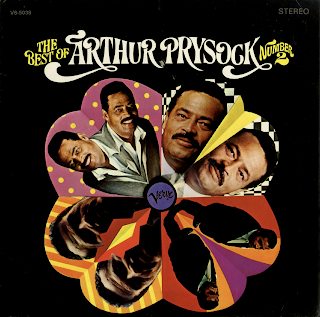
The Best Of Arthur Prysock - Number 2


Fly Me To The Moon

The Best Of Arthur Prysock
Number 2
Produced by Hy Weiss
Director of Engineering: Val Valentin
Cover Art: Ralph Keefe
Cover Design: Acy R. Lehman
Verve STEREO V/V6-5038
1967

From the back cover: Randall's Island, August 12, 1967, saw and heard a jazz concert notable for two impressive features: an audience who ranged in age from teenagers to well beyond middle age; and the long, enthusiastic, sincere ovation they gave to a singer whose style reached out to all of them. It is the magic of Arthur Prysock to cut across age groups – to have something personal to communicate to the young who have barely had time to discover him, to the fortunate older who have had time to be enchanted by the intimate warmth of that beautiful baritone delivery.

Full Moon And Empty Arms - Arranged and Conducted by Mort Garson)
My Funny Valentine - Arranged and Conducted by Mort Garson)
In The Still Of The Night - Arranged and Conducted by Mort Garson)
Let It Be Me - (Arranged and Conducted by Charlie Calello)
Fly Me To The Moon - (Arranged and Conducted by Herb Gordy)
Let There Be Love - Arranged and Conducted by Mort Garson)
The Very Thought Of You
I Just Want To Make Love To You
For Your Love - Arranged and Conducted by Mort Garson)
All Or Nothing At All - (Arranged and Conducted by Johnny Richards)
He - Arranged and Conducted by Mort Garson)

Hollywood Sessions - HS-099


Disco Truck Wash

Americanism

Cheer Up

Hollywood Sessions
Sunrise Records, Inc.
HS-099
1986

So Close - Jimmy Aronis
So You Think Love Is A Game - Avis D. Stafford
The Pay I Receive - Lydia Thibodeau
Picture Of My Dad - Birtie L. Douglas
Some Other Time - Edna (Eddy) H. Vail
Truck Wash - Joseph Pate
The Ladies Man - David J. Nesler
Freedom In The Forest - Freedom Everywhere - Muriel Daniels
Second Nature Blues - Faye Halveson & Fabio Turchetti
Americanism - Alex Nwigbo
Cheer Up - William V. Whittington
Yes - Barbara Rosser
My Honky Tonk Girl - Arthur J. Scharinger
Don't Take Me For A Ride - S. M. Ndeley
It's Just Like Paradise - Marie Emerson

Electric Flowers - Ivan Tcherepnin


Overture / The Ghost Violin

Electric Flowers
Music Of Ivan Tcherepnin
Composer-Supervise Recording
Produced by Carter Harman
Associate Producer: Carolyn Sachs
Art Director: Judith Lerner
Cover: Judith Lerner
Drawing by Edward Lear from "The Complete Nonsense Of Edward Lear" Dover Publications, Inc., N.Y. 1951
CRI - Composers Recording, Inc.
CRI SD 467
1982

From the back cover: Ivan Tcherepnin (b. 1943, Paris) comes from a family of Russian musicians. He grew up in Chicago, where he received early training in music from his father, composer Alexander Tcherepnin, and his pianist mother, Ming. He graduated from Harvard University, where his principal teacher was Leon Kirchner, and taught at the San Francisco Conservatory and Stanford University before being named an assistant professor of music and director of the electronic music program at Harvard. He is active in the U.S. and Europe as a conductor and performer of his own compositions. In his live-electronic work, Ivan has been aided by his brother, Serge, who since 1970 has designed and constructed an impressive array of devices used in Ivan's performances.

Flores Musicales calls for oboe, psaltry and violin, all of whose sounds are processed and transformed (sometimes imperceptibly, sometimes radically) by a veritable armada of electronic modules. The work received its first performance on November 29, 1979, at Boston University.

Also from the back cover: The performers on Flores Musicales are all soloists in their own right. Peggy Pearson is a member of the Emmanuel Wind Quintet, winner of the 1981 Naumburg competition, and teaches at Wellesley and the Longy School Of Music; Wilma Smith, a native of the Fiji Islands, is first violinist of the Lydian Quartet and has been concert master of the Harvard Chamber Orchestra. Marion Dry began music studies after graduating from Harvard. She has been a soloist in the Boston area and across the country and is a successful voice teacher. Jean-Pierre Dautricourt earned his Ph.D. in composition at Harvard and teaches at the University of California at Riverside, where he also directs the electronic music studio.

Five Songs was commissioned by WFMT-FM in Chicago as part of a project initiated by author/ critic Karen Monson on the twentieth-century art song. The premier took place in March, 1979, on WFMT, with Marion Dry as soloist. A review of the work in Chicago Magazine noted that "The songs' format and texts explore the border zone between sense and nonsense, truth and deception, comedy and tragedy... the area in between categories, where life mostly takes place."

Flores Musicales (1980)
Overture (P'tite P'tite)
The Ghost Violin
Grand Fire Music
Concatenations

Peggy Pearson, oboist; William Smith, violinist; Ivan Tcherepnin, psaltery and organ player, electronic processor

Five Songs (1979) for voice, flute and digital and tape delay with associated electronics
Do-Mi
Apres le Do-Mi
Pfft!
Queues
After The Queues (Tales)

Marion Dry, contralto; Jean-Pierre Dautricourt, flutist; Ivan Tcherephin, electronic processor

Wednesday, January 26, 2022

The Inspiration I Feel - Herbie Mann


Drown In My Own Tears

The Inspiration I Feel
Herbie Mann
Arranged and Conducted by William Fischer
Produced by Nesuhi Ertegun & Joel Dorn
Album Design: Haig Adishian
Cover Portrait: Dimitrie Berea
Recording Engineer: Adrian Barber
Atlantic STEREO SD 1513
1968

From the back cover: 

Ray Charles
After a long night 
In the slow quiet of an early day 
There is only one thing.
I don't want to hear surface
but center.
Ray Charles
Above all – I believe him
He is – the inspiration I feel

– Herbie Mann

Lonely Avenue
Drown In My Own Tears
Sticks and Stones
I Got A Woman
Come Rain Or Come Shine
Georgia On My Mind

Stan Getz With Guest Artist Laurindo Almeida


Maracatu-Too

Stan Getz With Guest Laurindo Almeida
Laurindo Almeida appears through the courtesy of Capitol Records, Inc.
Produced by Creed Taylor
Cover Design: Acy R. Lehma
Cover Art: Alberta Hutchinson AKM
Director Of Engineering: Val Valentine
Recorded At Webster Hall, March, 1963
Verve V6-8665
1966

Personnel:

Stan Getz - Tenor Sax
Laurindo Almeida - Guitar
George Duvivier - Bass
Edison Machado, Jose Soorez & Dave Bailey - Drums
Luiz Parga & Jose Paulo - Latin Rhythm

From Billboard - December 3, 1966: Another winner for Stand Getz. With Laurindo Almeida (guitar) an a superb group of Latin specialists, the popular saxophonist surges through six swinging Brazilian tracks. Attractively packaged an beautifully produced, this album should do very well in the pop-jazz market.

Minina Moca (Young Lady)
Once Again (Outra Vez)
Winter Moon
Do What You Do, Do
Samba, Da Samba (Sahra's Samba)
Maracatu-Too