Search Manic Mark's Blog

Saturday, December 1, 2012

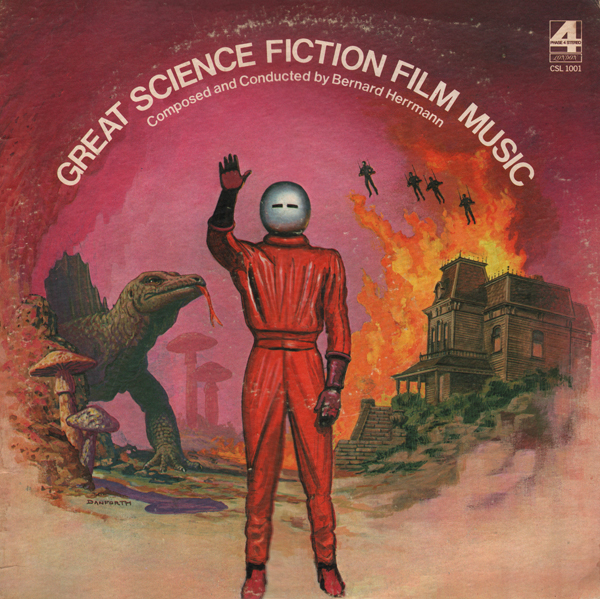
Great Science Fiction Film Music - Bernard Herrmann


Great Science Fiction Film Music
Composed And Conducted By Bernard Herrmann
Phase 4 Stereo London CSL 1001
Produced for the Science Fiction Book Club by London Records Special Products
Jim Danforth jacket illustration
1974

This is an interesting album compilation album that consists of four tracks, made up of select segments from four movies.

Each track is broken down (in the jacket notes) as originally titled. However, in each of these tracks, the segments flow together so seamlessly that the track(s) play like a single piece of music.

The engineering between tracks is consistent and so good that each of the four tracks flow into one another.  You can just close your eyes and enjoy the entire album as a single, dramatic presentation.

The approach is completely orchestral and presented artfully without the standard sic-fi electronic fireworks.  I love the theremin... but Herrmann didn't need a lot of tricks to get his point across.

This is a surprisingly good record.

Side one

The Day The Earth Stood Still
Psycho

Side 2

Journey To The Center Of The Earth
Fahrenheit 451

And The Beatles Go On And On - Hits Of The Beatles

Beatles Go On And On


And The Beatles Go On And On
Hits Of The Beatles
Created and Narrated by Ambrose Brazelton
Arranged and Conducted by Edward Shanaphy
Produced by KBH Productions
Recored at A&R Studios, NYC
Engineered by Richard Mays
Cover Design by Sid Kent
Production Supervisor: Bob Kimble
Kimbo Educational Records
LP 8080 Elementary
1971

From the back cover: The structured exercises of this record are not sacred. It is the intent of the creator that teachers and pupils innovate "their own thing" utilizing the melody-only side after experience with the designated routines.

About The Author

Ambrose Brazelton has been Supervisor of Elementary School Physical Education, State Department of Education, Columbus, Ohio for the past five years. Prior to this, he taught elementary physical education in the Akron Public Schools for fourteen years. He has also lectured at the University of Akron for the past three years.

Mr. Brazelton received his B.S. Degree at the University of Akron in 1952, his Master's Degree at Kent State University in 1960. He was the recipient of the Valley Forge Freedom Foundation Teacher Award in 1963. He is a member of AAHPER, OAHPER, Midwest AHPER, Ohio State Education Assn., National Education Assn., Society of State Directors of Health, Physical Education and Recreation.

He travels extensively throughout Ohio and the nation as a consultant lecturer and demonstrator. He has demonstrated again and again his ability to make children enjoy and participate in physical education programs.

Internalization of Rhythmic Beat, Body Coordination - Music: Ticket To Ride
Mastery of Five Locomotor Movements - Music: Eleanor Rigby
Gallops and Slides - Music: Ob-La-Di
Body Control Through Slow Motion Movements - Music: Something
Endurance, Coordination and Rhythms - Music: Got To Get You Into My Life
Balance - Music: With A Little Help From My Friends

Salute To Stan Kenton - Maxwell Davis

Artistry In Rhythm

Salute To Stan Kenton
Members Of The Stan Kenton Orchestra
Arranged & Conducted by Maxwell Davis
Crown Records CLP 5093
1959

Bud Shank, Mahlon Clark - Alto
Bill Holman, Bob Cooper, Vido Musso - Tenor
Chuck Gentry - Baritone
Conte Candoli, Pete Candoli, Al Porcino, Conrad Gozzo, Ollie Mitchell - Trumpet
Milt Bernhart, Frank Rosolino - Trombone
Milt Raskin - Piano
Laurindo Almeida - Guitar
Don Bagley - Bass
Mel Lewis - Drums
Chico Guerrero - Bongos

From the back cover: From the almost unknown town of Balboa, Calif., there came in 1943 the sounds of a new and exciting concept in big-band sounds. People listened and regardless of their likes or dislikes they couldn't help but be impressed by this band.

Stanley Newcomb Kenton... Stan Kenton... was on his way. The band featured great and strong "block chords" from this mighty brass section of six trumpets and five trombones. As with Duke Ellington, Stan Kenton's piano work is of much less importance than the sound of the band and the musical effects they were working for.

Stan started his band at the Rendezvous ballroom in Balboa in 1941 and recorded for Decca that same year. But it wasn't until his theme "Artistry In Rhythm" was released on Capitol in 1943 that the band reached national prominence.

In addition to the block-chords mentioned above the early band featured a staccato-type sound in the reed section, liberally sprinkled with Stan's driving piano chords. The little recognized piano was best noted in "Painted Rhythm" that also featured Vido Musso's tenor.

The path of the Kenton bands has never run quite smoothly. The band has always been rich in the center of a constant controversy. Stan has bout tougher and broken up many bands. The success of these bands has largely been the result of the arrangers. Such men as "Shorty" Rodgers, Jerry Mulligan, Bill Holman, Pete Rugolo and several others have all written for the band and had a hand in its success.

In this "Salute To Stan Kenton", Crown Records has assembled the finest group of musicians available and almost all of them alumni of various Kenton bands. These are the men that rose to fame in their own rights with Stan Kenton and each of them a fabulous musician in his own right. Just read the personnel above.

And this is the band. The very finest. And each playing a tribute of his own to the band that started most of them... a "Salute To Stan Kenton". – Pat Evans

From March 23, Billboard: Several former members of Stan Kenton's various crews are featured in this set on tunes that are given similar treatments to those as when first introduced by Kenton. Low-price tag is a lure and the set could move on the racks and in the chains.

Artistry In Rhythm
Peanut Vendor
Intermission Riff
Come Back To Sorrento
Dark Eyes
Estrellita
Elegy
Martha
See With Your Ears - NuTone Music

Let The Sunshine In
See With Your Ears
A Special Album to demonstrate the sound capabilities of NuTone Musicom
NuTone - Cincinnati, Ohio
Columbia Special Products
1970

Narration and excerpts from:
New York Philharmonic
Leonard Bernstein, Conductor - Copland: Fanfare for the Common Ma\n
Andre Kostelanetz - Sousa: Semper Fidelis
Leonard Bernstein - Young People's Guide to the Orchestra
Percy Faith Strings - Yesterday
Flatt & Scruggs - I Walk The Line
Gary Puckett & The Union Gap - The Beggar
Miles Davis - Summertime from "Porgy & Bess"
Peter Nero - Let The Sunshine In from "Hair"

Michelle - Bud Shank

Sounds Of Silence
Michelle
Bud Shank & Chet Baker
Arranged & Conducted by Bob Florence
World Pacific/Liberty Records
WP-1840

From Billboard July 2, 1966: During this first year under the direction and influence of the pop music independent, one of Bock's two labels, World Pacific has gained a stronger identity. The advantages as Bock sees them now of Liberty ownership are that Bub Shank was re-established as a leading saxophonist resulting from his peppery playing on several pop tunes; trumpeter Chet Baker gained national awareness for his playing with Shank on Michelle and for his Mariachi Brass albums.

Viva Tijuana! - The Fiesta Brass

Michelle
Viva Tijuana!
The Fiesta Brass
Arranged and Conducted by Chuck Anderson
Cover Photo: Otto Stupakoff
Harmony/Columbia HS 11183

From the back cover: These days, it's just about impossible to find anything as exhilarating as the popular Tijuana Sound, which is the liveliest, happiest sound in music today. But this album, VIVA TIJUANA, achieves the near impossible and comes up with a hit-filled collection of brand-new versions of Tijuana Sound successes that are greater than ever!

VIVA TIJUANA features gigantic hits like Tijuana Taxi, Whipped Cream and the song that started it all, A Taste of Honey. Included too are songs that haven't, until now, been given the famous Tijuana treatment: current hits like Michelle, Spanish Eyes and 1-2-3-and more!

Chuck Anderson arranged and conducted this album in Mexico using some of Mexico City's finest Mariachi musicians. The Fiesta Brass features trumpets, trombones and marimba. On several songs, strings, voices and a reed section have been added.

All you have to do is hear this superb album just once, and you'll be shouting Viva Fiesta Brass! VIVA TIJUANA!

Tijuana Taxi
Spanish Eyes
Whipped Cream
Spanish Lace
Theme from "Zorba The Greek"
A Taste Of Honey
Spanish Harlem
I'm Getting Sentimental Over You
Michelle
1-2-3

Flamenco - Laurindo Almeida - Jose Barroso

Malaguena
Flamenco
Music Composed By Laurindo Almeida
Played By Jose Barroso
Crown Records StereOdiscs
CST 141

Fun Crown packaging featuring translucent red vinyl. Music is a more laid back variety of Flamenco.

Check out this later Almeida light pop example: Classical Current

From the back cover: Jose Barroso studied cello and has played with the Mexican City Symphony Orchestra and the Seattle Symphony. He started on the guitar when he was 39 years old! Coming to Los Angeles for studio work, Jose's haunting guitar performance was featured in the throbbing score "For Whom The Bells Tolls."

Farruca
El Vito
Soleares
Serenata Espanola
Nostalgia
Tanquillo
Malaguena
Cuadros En Aagon
Pagina Romantica
Soleares Opus 10
Fandanguillos
Tango Espanol

Thursday, November 29, 2012

The De Castros Sing

At Last
The De Castros Sing
Music Arranged And Conducted by Billy May
Produced by Dave Cavanaugh and Curley Walter
Capitol Records T1402
1960

From the back cover: Babette, Cherie and Olga have come a long way since they were born in Havana, Cuba, New York City, and Chihuahua, Mexico, respectively. The De Castros did most of their growing up in Havana, where Papa De Castro owned a sugar plantation. When they broke into show business, but good, at New York's Copacabana, the Sahara in Las Vegas, the Cocoanut Grove in Los Angeles, and other leading nighteries across the U.S., they wisely remembered to hang on to their Latin-American heritage.

From Billboard July 11, 1960: The De Castro Sister's first Capitol LP is a strong deejay programming package. The girls are in exuberant vocal form and Billy May supplies exciting swinging backing. The Sisters sing both in English and Spanish on a group of standards; while May interprets them with dynamic effect, aided by bongos, maracas and marimbas.

The Trolly Song
Love Letters
Mañana
Flores Negras
Careless
Yes, We Have No Bananas
Tiger Rag
At Last
Always
You Came A Long Way From St. Louis
What A Difference A Day Makes
Music! Music! Music!

You Gave Me A Mountain - Margie Singleton

Mr. Walker, It's All Over
You Gave Me A Mountain
Margie Singleton
Hilltop Records - A Product of Pickwick International
Pickwick/33 JS 6077

You Gave Me A Mountain
Y'All Come
Have I Told You Lately That I Love You?
Dust Till Dawn
Bright Lights Downtown
Mr. Walker It's ll Over Now
Dark Moon
Burning Old Love Letters
I Knew I Would See Him Again
Shake My Hand, And Kiss Me On The Cheek

Poznanski Zespol Perkusyjny


Poznanski Zespol Perkusyjny Poznan Percussion Ensemble
Directed by Jerzy Perkusyjny
Musa Polskie Nagrania SXL 0809
Made in Poland

Jozef Raszyński
Tadeusz Deputat
Grzegorz Markiewicz
Rajmund Nowicki
Jerzy Skrzypczak
Wiktor Szmanda

From the back cover: RYSZARD GARDO  – TRIPTYCH FOR PERCUSSION

Ryszard Gardo, born in Poznań in 1923, studied composition at the State Higher Music School in that city under T. Szeligowski. His teacher in musicology was A. Chybiński. Ryszard Gardo was presented musical awards in Kalisz and then of the city of Poznań. Over the last years he has been musical director of Poznań dramatic theatres. His main compositions are: Prelude and Rondo for piano, Sonata for piano, Suite for orchestra, Pantomime Music and Vocal Scenes, Miniatures for baritone and orchestra, Ballades and Romances for children's choir, strings, piano and percussion, "Phantasmagoria" for 2 flutes. strings percussion. "Musica per archi 22". In vocation for symphony orchestra, Percussion Quintet, choral pieces, incidental music for theatre.

Triptych for Percussion is dedicated to the Poznań Percussion Ensem- ble and was first performed at the Poznań Musical Spring in 1968. This is a three-movement piece, designed for a wide range of percus sion instruments. Movement I allegretto giocoso makes use of instruments of undefined ranges, in its rhythm structure prevail groups of triplets. Movement II moderato giorcoso consisting of three sections, makes use mainly of melodic instruments, such as xylophone, vibraphone, marimba. Movement III allegro espressivo is for all instruments. Freely developing themes lead to an effectful coda.


BARBARA NIEWIADOMSKA – TINTA E RITMO

A woman composer, born in Lublin. She studied composition at the State Higher Music School in Warsaw under P. Perkowski. Her main composition is "Sypanie ziarna" (spilling of grains).

Tinta e Ritmo was first performed in 1965. In accordance with its title the piece's structure consists in the contrast of two elements: tone colour and rhythm. So, respectively. Movement I displays colour quali ties of a wide group of percussion instruments and of two prepa red pianos, whereas Movement II is mainly concerned with rhythm. JERZY BAUER DIVERTIMENTO

Jerzy Bauer was born in Łódź in 1936. He completed his musical stu dies in three fields: theory, conducting and composition, in the State Higher Music School in that city. His works include: Overture, Intro duction and Three Prayers for Peace for string orchestra, Three Con- ceptions for string orchestra, Medieval Sculptures for choir and or chestra.

Divertimento for percussion instruments and two pianos (or piano for 4 hands) was written in 1965 and consist of three traditionally contrasting movements. Movement the piano part creates a background to the solos of percussion instruments, especially of xylophone. Movement la cantilena of the vibraphone and bells over a chor dal accompaniment. Movement III a free three-sectional movement is integrated by a uniform articulation of the piano.

FRANCISZEK WOZNIAK - SYMPHONY FOR PERCUSSION

Franciszek Woźniak was born at Rawicz in 1932. He graduated in composition which he studied under T. Szeligowski in the State Higher Music School in Poznań.

His main compositions include: Sonata for piano, Music for strings. piano and percussion, 12 Etudes for piano, Concertino for trumpet and orchestra, Piano Concerto, Cello Concerto, "Recreations" for flute and percussion (for the Wroclaw Pantomime), "Cadenza" for violin and a chamber ensemble, cantatas, etc.

The Symphony for Percussion (1970) was inspired, similarly to "Rec- reations" by the activity of the Poznań Percussion Ensemble. Movement achieves the climax through various complications of the rhythmic structure and a graduation of dynamics. Movement II brings to the fore the tone colour. Here the prepared piano plays the leading part. Movement III the opening, distinctly imitational motive leads, by giving up bar lines, to a final aleatoric improvisation.

The Poznań Percussion Ensemble was formed in 1963 on the initiative of Jerzy Zgodziński, teacher of percussion at the State Higher Music School in Poznań and member of the local Philharmonic. This was the first group of this kind in this country, along with similar ones in the United States and very few ones in Europe. The regular line-up of the group (percussionists and a pianist) is some times extended, according to the demands of a score, to include strings and winds.

Originally the played American compositions. In time, however, the Group managed to get interested a number of Polish composers, which widened the Polish repertory of percussion pieces.

The Poznań percussionists, apart from appearances in this country (platform concerts, Festivals of Contemporary Music, RTV, recordings for theatres and the Wroclaw Pantomime) have also scored notable successes abroad. They gave concerts in Denmark (1965), Czechoslo- vakia (1967), the Soviet Union (1969), Rumania (1970). Everywhere they were warmly applauded and won favourable notices of the critics. Their participation in the Festival of Contemporary Music (Berlin 1973) brought them a reward of the music critics.

Ryszard Gardo - Tryptyk Perkusyjny (Triptych For Percussion)
Barbara Niewiadomska - Tinta E Ritmo
Jerzy Bauer - Divertimento na 2 fortepiany i perkusje (Divertimento for 2 pianos and percussion) instruments
Franciszel Woźniak - Symfonia na perkusje (Symphony for Percussion)