Search Manic Mark's Blog

Friday, February 7, 2025

Dinner In Mexico City - Pablo Marin


Dinner In Mexico City

Dinner In Mexico City
"Orquesta Tipica" of Mexico City
Director: Pablo Marin
RCA Victor LPM-1018
1954

From the back cover: The visitor to Mexico City is constantly reminded that three great cultures have gone into the molding of Mexico – the Indian, the Spanish, and the modern, post-Revolution Mexico. It is a comfortable stroll from the Paseo de la Reforma – a street eight miles long and 200 feet wide which has been called the most beautiful boulevard in the world – to the Alameda, a charming new park developed on the spot which for 300 years was the "burning ground" of the Spanish Inquisition, and thence to the Zocalo, a great square which has been the hub of Mexico's life since Aztec times and where the offices of the President of Mexico are now located.

Dinner in Mexico City can be equally varied. It might be taken in the modern splendor of the 1-2-3 Restaurant; at the Prendes Restaurant, reputedly the oldest in the city; or on the roof of the Hotel Majestic with its commanding view of the snow-capped and ageless mountains which have looked down with great impartiality on Aztec, Spaniard and Mexican.

The music that is Mexico's is indelibly marked by the history, the geography and the people of the country. Some of the selections in this album are mementos of the Mexican Revolution. Cielito Lindo, for instance, which is one of the most widely-known of Mexican melodies, was extremely popular with the men of the Army of the Revolution, particularly in the northern sections of the country. At the same time and in the same region, the gay and happy rhythms of the polka, Chuchita en Chihuahua, had enormous popular appeal.

The spirit of certain sections of Mexico is caught in some of this music. La Bamba is a "son jarocho," typical of the cheerful dance music of Vera Cruz. The lyrics have an especially bright wit. It is usually sung and played by a group including harp, guitars and violins.

Totally different is the slow and doleful Oaxacon melody, La Zandunga. When it is danced by a woman of Oaxaca, dressed in a costume typical of the province, she conveys the impression of a prayer being offered, sweetly and sorrowfully.

The Mexican countryside in general is evoked by La Feria de las Flores. In both words and music, it offers a vivid description of that varied scenic beauty that is pre-eminently Mexican. Something of this buoyant feeling for the countryside is also to be found in Las Bicicletas (The Bicycles), a polka with a beautiful melody and carefree rhythm which was written for and dedicated to the Cyclists Club of Mexico in the days when cycling was one of the best ways to see the country.

Such bygone days and the customs of the past are memorialized again and again in Mexican music. The waltz, Ojos de Juventud, is reminiscent of that older era whose songs were noted both for their musical beauty and the elegance of their lyrics. Another waltz, Cuando Escuches Este Vals, also harks back to the romantic period of Mexico when young men traditionally filled the night with the delicate and sweet melodies of their "serenatas," sung at the windows of their lady loves. Cuando Eschuches Este Vals has shown a particularly enduring quality for it is still used by present day lovers intent on serenading in the small hours.

There is more than romance to be conjured up by these long-cherished melodies, however. High spirits have always been typical of Mexico and a high spirit is the dominate mood of Danzas Calabaceadas, an old and cheerful popular melody which is played for both listening and dancing at intimate celebrations.

There is also a philosophical attitude inherent in Viva Mi Desgracia, or Hooray For My Misfortune. This waltz serves to remind people of their bad luck and, if their emotions are properly stirred, they either cry or yell in response to it.

Both the old and the new in Mexico music are blended in Maria Elena, a waltz based on a romantic melody with a modern treatment which was widely popular in the United States a decade or more ago.

El Faisan, a folk song about a young lover who is under the guidance of a good fairy, is particularly appropriate for this collection for it was written by Miguel Lerdo de Tejada, one of the most prolific writers of Mexican songs and the founder of the "Orquesta Tipica" of Mexico City which plays these selections.

When the "Orquesta Tipica," or Typical Orchestra, was organized in 1929 by Maestro Lerdo, it was an adjunct of the Police Department and was known as the Typical Orchestra of the Federal District Police. Since then it has come under the jurisdiction of the Director General of Social Action of the Department of the Federal District and its name has been changed to the Mexico City Typical Orchestra.

Among the elements which make this orchestra "typical," in addition to the music it plays, is its instrumentation, for, besides the customary strings, brass and bas, its members play marimbas, "salters," "mandalas" and "banjos sexton."

The orchestra is conducted on these recordings by Pablo Marin who became its director after the death of Miguel Lerdo de Tejada. Maestro Marin was co-founder of the orchestra and is widely known as a composer in the Mexican idiom. – Notes by John S. Wilson

Cielito Lindo
Las Bicicletas
Danzas Calabaceadas
Ojos De Juventud
Cuando Escuches Este Vals
La Bamba
Maria Elena
Las Feria De Las Flores
La Zandunga
Viva Mi Desgracia
Chuchita En Chihuahua

Music To Make Your Heart Sing - Gene Bianco


Spring Is Here

Music To Make Your Heart Sing!
The Rainbow Sound Of Bianco, His Harp and Orchestra
Produced by Herman Diaz, Jr.
Recorded in Webster Hall, New York City
Engineer: Bob Simpson
RCA CPM-115
Selected by The Editors of Reader's Digest Music Guide


Over The Rainbow
Mendelssohn's Spring Song
When The Red, Red Robing Comes Bob, Bob, Bobbin' Along
Spring Is Here
Rustle Of Spring
It's A Big Wide Wonderful World
April Showers
Narcissus
Look For The Silver Lining
Come Rain Or Come Shine
Chopin's Raindrop Prelude
Zing! Went The Strings Of My Heart

The Beatles Album - Percy Faith


Lucy In The Sky With Diamonds

The Beatles Album
The Percy Faith Strings
Arranged and Conducted by Percy Faith
Produced by Irving Townsend
Engineering: Jack Latin & Bill Driml
Cover Photos: Brian Hennessey
Design: Virginia Team
Columbia STEREO C 30097
1970

Soloists:

Buddy Childers - Flugelhorn 
Dick Nash - Trombone
Ted Nash - Alto Saxophone and Flute
Erno Neufeld -  Violin

Let It Be
Here, There And Everywhere
Norwegian Wood
Michelle
The Ballad Of John And Yoko
Something
Elanor Rigby
Because
Lucy In The Sky With Diamonds
Yesterday
The Fool On The Hill

Thursday, February 6, 2025

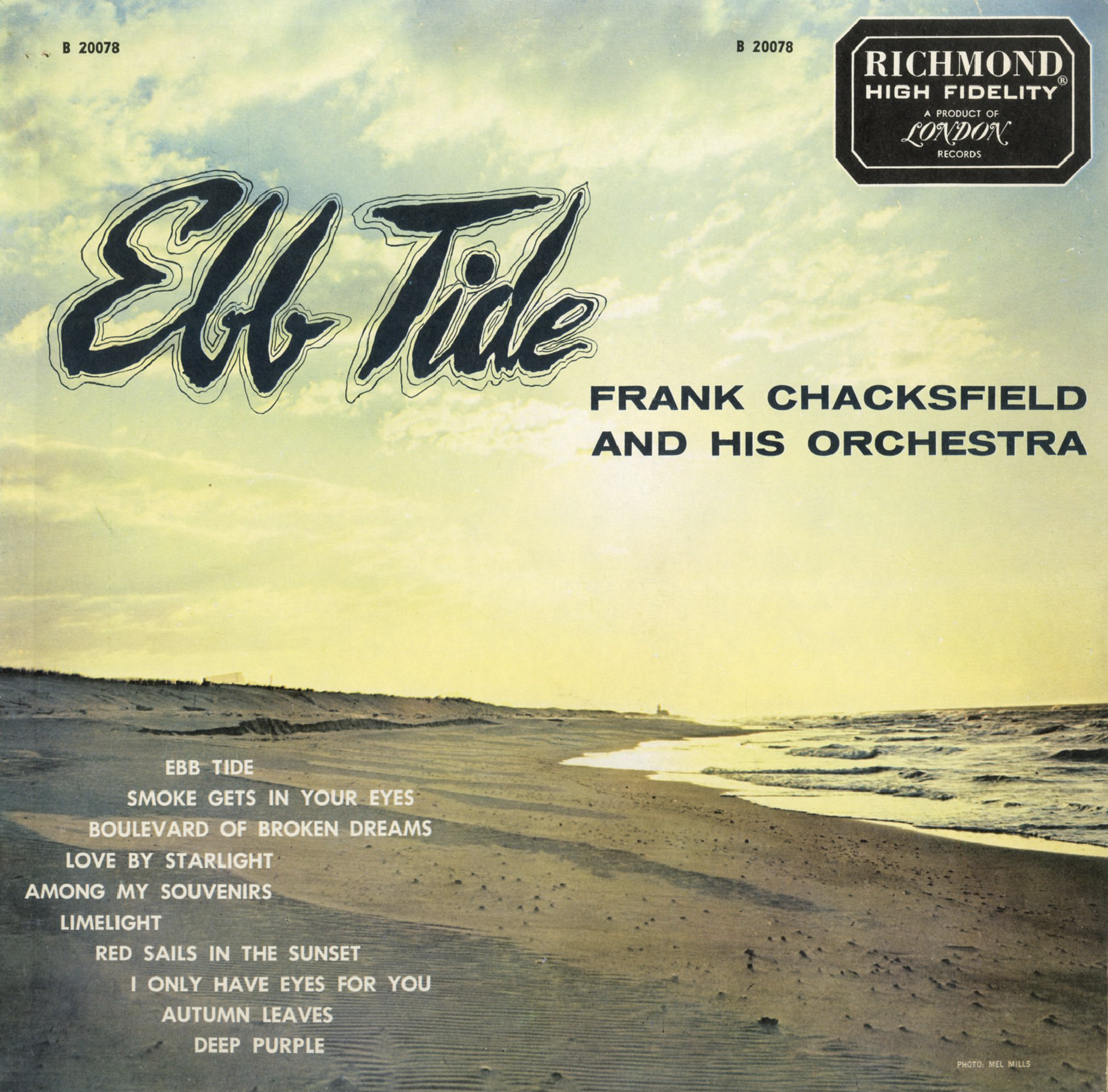
Ebb Tide - Frank Chacksfield


Ebb Tide

Ebb Tide
Frank Chacksfield and His Orchestra
Richmond High Fidelity
A Product Of London Records B 20078
1960

Ebb Tide
Smoke Gets In Your Eyes
Boulevard Of Broken Dreams
Love By Starlight
Among My Souvenirs
Limelight
Red Sails In The Sunset
I Only Have Eyes For You
Autumn Leaves
Deep Purple

Wednesday, February 5, 2025

Star Wars - Ferrante & Teicher


Main Title from "Star Wars"

Star Wars
Ferrante & Teicher
Arranged by Ferrante & Teicher
Album Produced and Conducted by Nick Perito
Engineer: Frank Kulaga
Recorded by National Recording Studios, New York
Mastered at United Artist's Recording Studio, Los Angles, California
Musical Advisor: Frank Hunter
Ferrante & Teicher play Baldwin Pianos
Art Director: Bill Burks
Album Design: Stan Evenson
Photography: Larry du Pont, Richard Avedon, NASA/After Image
United Artist Music and Records 
1978

Theme From Star Trek
Swinging On A Star
Claire Disco Lune
You Are My Lucky Star
Star Eyes
Moonshine Sonata
Stairway To The Stars
Moon Beams
Stars Fell On Alabama
When You Wish Upon A Star
Main Title from "Star Wars" (from the 20th Century Fox Motion Picture)

Ferrante & Teicher - Phillips & Burns Play At The Twin Pianos


African Echoes

Ferrante & Teicher
Phillips & Burns 
Play At The Twin Pianos!
And selections by Phillips and Shaffitz with The Metropolitan Strings
Guest Star Records MONO G 1410
1964

African Echoes
Falling In Love With Love
All The Things You Are
Mississippi Boogie
So In Love
High, High, High (Jai, Jai, Jai)
My Romance
Speak Low
Boogie Express
You'll Never Walk Alone

Tuesday, February 4, 2025

The Thomas Crown Affair - Michel Legrand


Playing The Field

The Mirisch Corporation Presents
Steve McQueen, Faye Dunaway in
A Norman Jewison Film
The Thomas Crown Affair
Co-Starring Paul Burke, Jack Weston
Written by Alan R. Trustman
Produced and Directed by Norman Jewison
Music Composed and Conducted by Michel Legrand
Main Theme – The Windmills Of Your Mind sung by Noel Harrison
Lyrics by Marilyn and Alan Bergman
United Artists UA-LA295-G
1968

Theme from The Thomas Crown Affair (The Windmills Of Your Mind)
Room Service
A Man's Castle
The Chess Game
Cash And Carry
His Eyes, Her Eyes (vocal by Michel Legrand
Playing The Field
Theme from The Thomas Crown Affair (The Windmills Of Your Mind)
The Boston Wrangler
His Eyes, Her Eyes
The Crowning Touch

Hang 'Em High - Hugo Montenegro


Theme For Three

Hang 'Em High
Hugo Montenegro
His Orchestra and Chorus
Musical Arrangements by Hugo Montenegro
Produced by Joe Reisman
Recored in RCA's Music Center Of The World, Hollywood, California 
Recording Engineer: Mickey Crofford
RCA Victor STEREO LSP-4022
1968

From the back cover: Back in the '50's "background" or "mood music" was the rage. Today, background music has moved to the foreground thanks to the popularity of talented arranger-conductor-composers like Hugo Montenegro. The Montenegro musical credits are most impressive: staff arranger for Andre Kostelanetz, conductor-arranger for Harry Belafonte, important film-scoring assignments ("Hurry Sundown") and extensive TV work ("I Dream Of Jeannie," "The Outcasts" and "Here Comes The Brides").

His first hit album for RCA was Music from "The Man From U.N.C.L.E." followed up by the enormously successful music from "The Good Bad And The Ugly." His new release, Hang Em' High, is an extension of the Montenegro "young sound" which turned music from "The Good, The Bad And The Ugly" into a top seller. Indeed, Montenegro has developed a unique musical identity that makes his vibrant orchestrations instantly recognizable. This new collection is a stunning showcase of contemporary pops excitingly performed by the Montenegro orchestra and chorus along with the unique talents of Muzzy Marcellino and Jack Keller. For years Marcellino has whistled themes for motion pictures and records. His most notable job was "The High And The Mighty." This is "The Whistler's" second album with Montenegro. Hugo would like to give special thanks to Jack Keller for his assistance in developing My Love and Wish I Knew into songs. (They were originally composed as television cues.) The effect is bold, fresh and bracing. These are sounds for right now – for this very moment.

With selections like theme from "Valley Of The Dolls," "In The Heat Of The Night," theme from "The Fox" and the new hit "Hand 'Em High," this Montenegro album runs the gamut from romantic rock through raunchy blues, brassy mariachi and the bright, lyrical western orchestral settings that made the music from "The Good, The Bad And The Ugly" such a smash. Here, then, is more of the Montenegro magic – imaginative, modern, entertaining and distinctive. – John Lissner

Hang "Em High
Theme from "The Fox"
Theme from "Valley Of The Dolls"
Wish I Knew
Theme For Three
Bandolero!
In The Heat Of The Night
Tomorrow's Love
For Love Of Ivy
My Love
Bitter Love
Keystone Kop

Saturday, February 1, 2025

Voices And Instruments - Wernick / Boros


Jacket includes the sheet below as well as the business card-sized "Erratum" (corrections) note
Voice And Instruments

Voices And Instruments

Richard Wernick
Haiku of Basho
Neva Pilgrim, Soprano
Contemporary Chamber Players of The University Of Chicago
Richard Wernick, Conductor
Moonsongs From The Japanese
Neva Pilgrim, Soprano

David John Boros
Anecdote Of The Jar
Piano Interlude (The Pleasures of Merely Circulating)
Martin Boykan - Paino
Alan Nagel - Bass
David Satz - Bass Clarinet
Brandels Chamber Chorus - James Olesen, Conductor
Yet Once Again
Constance Boykan - Flute
Wedding Music
George Fisher - Piano

Produced by Carter Harman
Art Direction: Judith Lerner
Cover Concept: Harley Gaber
Cover Painting: Portrait of Daruma by Ekaku Hakuin - Courtesy of the Smithsonian Institution, Freer Gallery of Art, Washington, D.C.
Haiku - Presser (ASCAP): 10'34" - Recorded by Richard Mintel: May 23, 1977, Chicago
Moonsongs - Presser (ASCAP): 6'12" - Recorded by Marc Aubort; January 25-7, 1977, New York
Anecdote and Interlude - MS: 10' 45"
Yet Once Again - MS: 7'35"
Wedding Music - MS: 6'55"
Boros recorded by David Hancock; May 1, 1977; Waltham, Massachusetts
American Contemporary 
CRI 379 STEREO
1977

Each year, the American Academy-Institute of Arts and Letters bestows awards upon four young composers for achievement, and a recording of their music on CRI is part of their prize. Richard Wernick was a 1976 winner. The memorial recording of music by the late David John Boros was made possible any the generosity of his family, friends and colleagues here and abroad.

From the back cover: Richard Wernick (b. Boston, 1934) attended Brandeis University where he studied composition with Irving Fine and Harold Shapero, and received his M.A. degree from Mills College where he studied with Leon Kirchner. Since 1957, when he served as musical director and composer-in-residence of the Royal Winnipeg Ballet, he has received many awards and grants – including the 1977 Pulitzer Prize in Music and the award of the American Academy-Insitute of Arts and Letters tha made this recording possible. Wernick has been a faculty member of the University of Buffalo and the University of Chicago, and became Professor of Music at the University of Pennsylvania in 1968. He writes: "The HAIKU OF BASHO is a setting of five haiku by and (in one instance) about Matzuo Basho (1643-94), generally acknowledged to be the foremost writer of this form of Japanese verse. The first four poems of the cycle are fine examples of how Basho was able to capture the essence of seemingly inconsequential moments of vignettes and, with the must frugal means of literally expression, communicate to the reader a sense of the timeless and eternal. The fifth poem, written a century later, is more in the nature of a 17-syllable one-line-joke, a play on the word 'basho' which means 'banana leaf.'

"There are no programmatic connections between the haiku and the music, nor is there any attempt at word painting. There relationship of the music to the words is rather one of attitude attempting through an economical and tightly woven means of abstract musical expression, to create sound images similar to (or analogous to) the poetic images evoked by the haiku. The attitude is perhaps best summed up by Basho's own admonition to his pupils: "Do not seek to follow in the footsteps of the men of old; seek what they sought.'

"The melodic and harmonic aspects of the score are derived from on tone row which appears throughout the piece in several forms. There is a departure from conventional 12-tone technique in that the rows are used only as the basis for harmonic and melodic materials which are then subjected to more or less standard procedures of development and variation. The improvisational qualities of the HAIKU are partially achieved by the use of metrical modulation in which the conjunction and the superimposition of even and uneven metrical units generate continuous changes in the speed of the music. Apart from a few places where the speed may vary at the discretion of the conductor or one of the instrumentalists, the relationship of rhythm to speed is directed by the composers notation, and is intended to provide a feeling of freedom without the composer abdicating control of the music."

Moonsongs From The Japanese was composed in the spring of 1969, not long after the first performance of HAIKU OF BASHO.

"This piece was written in response to a request from Neva Pilgrim for a work that would 'travel lightly,' i.e. one that could be done without piano accompaniment. This led to the conception of a work for 3 voices the outer two being pre-recorded and the middle one being performed live. Although it is conceivable that the MOONSONGS could  be sung by three different sopranos, no performance of this version has yet taken place.

"The idea of composing a 'sequel' to the HAIKU OF BASHO (in the sense of writing another group of haiku settings) seemed a natural one to me at the time. I had enjoyed immensely the challenge of setting that uniquely spare and evocative poetric genre.

"The time when I began to work on the piece coincided with the final preparations for the first moon landings, and it seemed more than appropriate to select a group of haiku about the moon. Aside from the excitement which most of us felt about this great achievement, I also had tinges of regret that the moon would never again be quite the same after it had been 'stepped on.' The very fact of human contact, by its nature, would detract from the mystery and romance which for thousands and thousands of years had surrounded this ever-changing celestial body. Thus the selection of these affectionate and evocative poems.

"Both the HAIKU OF BASHO and MOONSONGS FROM THE JAPANESE are dedicated to Neva Pilgrim."

The music on the other side of this record is the work of a composer who died young. David John Boros was 31 years old in 1975. The tragic automobile accident that killed him and his wife, Emidia Meloncelli, cut short the career of a very gifted composer, a highly unusual spirit whose energy and imagination promised continued creativity and the years to come.

He was born in 1944. He received a B.A. degree from the University of California at Berkeley in 1966 and an M.F.A. degree from Brandeis University in 1970. His teachers included Seymour Shifrin, Arthur Berger, Marin Boykin, David Lewin and Henri Lazarof. He spent 1968-69 in Rome on a Fulbright-Hayes ground, studying with Petrassi. At the time of his death he was on the faculty of Brandeis University.

Between 1970 and 1973 he lived in Rome, working as a pianist in an American gospel group that toured Italy, Switzerland and Austria. Jazz and gospel music played an important role in his life and their influence is always present in his music, although not explicitly until the unfinished piece he was working on at the time of his death.

Wedding Music, written in 1968, is the earliest of the pieces presented here. This solo piano piece was written for a specific occasion, the marriage of a lifelong friend. Yet Once Again is a solo flute piece, written in 1970 for Constance Boykan, who performs it here. This is perhaps the piece which most strikingly reveals his outstanding gift for melodic line. An extended opening section employs only three notes, playfully resting on one and then the next. Rapidly the piece opens up into a long and flowing aria.

The unfinished choral piece based on poetry of Wallace Stevens is the most ambitious of the pieces. It was to consist of two movements, the first of which, ANECDOTE OF THE JAR, is in its finished and complete form. In the second movement, The Pleasures of Merely  Circulating, the entrance of the chorus is preceded by a long introduction in the piano. This introduction was conceived of as a piece in itself. For that reason it is included on this recording, even though the eventual entrance of the bass clarinet and the double bass strongly suggests continuation. The choral movement which was to follow exists only in sketch, and is unfinished, even in that form.

The poem pits order against disorder, rationality against what Stevens called the squirming facts of life. The poem that the two remain in constant competition from which neither can triumph. This duality is portrayed metaphorically in the poem in the images of the clear, round jar and the slovenly wilderness. In the music it is suggested by contrasting, sometimes conflicting, musical elements.

The piece is divided into three sections. In the first, the chorus is unaccompanied and the writing tends to be polyphonic. The second section consists of a long interlude for the bass clarinet and the double bass. The jazz influence is apparent here, a kind of stylized jam session. When the chorus re-enters at the star of the third section, the instruments continue. They do not accompany the voices, but rather, as is suggest by the poem, they maintain melodic and rhythmic freedom, even though they have lost the wildness of the middle section.

The unfinished choral setting of The Pleasures Of Merely Circulating was a conscious attempt to integrate some of the materials and feeling of gospel music into the language of contemporary music. Some of that material is present, in a more disguised form, in the piano introduction. The is particularly apparent in the parallel chords heard at the opening. It is an intensely felt and moving piece, and when, at the end of it, the other instruments enter to prepare for the movement that will not follow, there is a dramatic sense of promise which will not be fullfilled. – Notes on Boros by Edward Cohen

Nevan Pilgrim is known and admired throughout the country for her performances of contemporary music. She has appeared with major orchestras and groups including the Chicago Symphony, Speculum Musicae and the Contemporary Chamber Players of the University of Chicago, and many composers besides Wernick have written music for her. She also appears on CRI SD245 in Murray Schafer's Requiem For A Party Girl and Rochberg's Songs In Praise Of Krishna on CRI SD 360.

The Contemporary Chamber Players of The University of Chicago is one of the foremost groups of its kind. Its music and that of it founder-conductor, Ralph Shapey, are to be heard on several CRI records. The members on this recording are: Elliott Golub, Terry Applebaum, Stanely Davis, Michael Geller, Marie Moulton, Edward Poremba and Andrea Swan.

James Olesen is conductor of the Brandeis Chorus and director of the Early Music Ensemble. George Fisher played the first performance of Wedding Music as a freshman at Brandeis. A student of Robert Helps, he is at present a graduate student at SUNY (Stony Brook). Constance Boykan is a free-lance flutist who has appeared extensively as a soloist, and with such chamber music groups as Seraphim. Martin Boykan reached at Brandeis; his music may be heard on CRI SD 338.

Members of the Brandeis Chorus on this recording are: Carolyn Arend, Majorie Cohen (soloist), Karen Komar, Susan Larson (soloist), Barbara Marcus, Barbara Winchester, Ivy Anderson (soloist), Mary Sego, Kathy White, Bruce Fithian (soloist), Edward Nowacki, Charles Walker, Allen Anderon (soloist), Matthew Dooley, Keith Kibler, Howard Treibitz.

Chamber Concerto For Cello & 10 Players - Charles Wuorinen


Chamber Concerto / Ringing Changes

Chamber Concerto For Cello & 10 Players (Side One)
Charles Wuorinen, Conductor
Fred Sherry - Cello
The Group For Contemporary Music

The Group For Contemporary Music:
Fred Sherry - Cello
The Group Fro Contemporary Music
Harvey Sollberger - Flute
Josef Marz - Oboe & English Horn
Jack Kreiselman - Clarinet & Bass Clarinet
Donald MacCourt - Bassoon
Jeanne Benjamin - Violin
John Graham - Viola
Alvin Brehm - Double-Bass
Robert Miller - Piano
Raymond DesRoches, Richard Fitz, Claire Heldrich - Percussion


Ringing Changes, For Percussion Ensemble (Side Two)
Charles Wuorinen, Conductor
The New Jersey Percussion Ensemble
Raymond DesRoches, Director 

The New Jersey Percussion Ensemble
Raymond DesRoches, Director
Joseph Passaro - Vibraphone & Timpani
Marty Martini, Louis Oddo - Vibraphone
Dean Poulsen, Eugene McBride - Piano
Ken Hosley, Donald Mari - Drums
Matthew Patuto - Brakedrums
Doreen Holmes - Almglocken
Michael Moscariello - Cymbals
Vincent Potuto, Jr. - Tamtams
James Pugliese - String Drums & Chimes

Coordinator: Teresa Sterne
Art Direction: Robert L. Heimall
Cover Art: Herb Tauss
Cover Design: Paula Bisacca
Engineering: Marc J. Aubort, Joanna Nickrenz (Elite Recordings, Inc.
Mastering: Robert C. Ludwig (Sterling Sound, Inc.)
A Dolby-system recording
Nonsuch Records H-71263
1971

Form the back cover: Charles Wuorinen (b 1938 in New York) has to date composed nearly 100 works of all genres, and he is also active as performer, conductor, teacher, and writer. He holds degrees from Columbia University and an honorary doctorate from Jersey City State College and has taught at Columbia and Princeton Universities, the New England Conservatory, University of Iowa, Manhattan School of Music, and the University of South Florida.

In 1970, Wuorinen received the Pulitzer Prize for Music for his electronic work Time's Encomium. Other distinctions have included the Lili Boulanger Memorial Award, BMI-SCA Awards, Bearns Prize, Brandels University Creative Arts Award Citation in Music, Alice M. Ditson, and Guggenheim Fellowships; commissions from the Ford Foundation, Berkshire Music Center, Koussevitzky, and Fromm Music Foundations; and he has been honored by the American Academy of Arts & Letters.

Works by Charles Wuorinen have been issued in recordings by Acoustic Research, Advance, Cambridge, CRI, Golden Crest and Nonesuch. Time's Encomium was composed to a Nonesuch Records commission (H-71225, released July 1969).

In 1962, Charles Wuorinen, together with fellow Columbia University students Joel Krosnick and Harvey Sollberger, founded the Group for Contemporary Music. The motivation for its formation was the desire on the part of composers to exercise more direct control over the performance of their music and the conditions under which it was to be presented; the Group was the first of the active contemporary-music ensembles directed by composers who also played and conducted. With Sollberger and Wuorinen as co-directors, its first nine seasons of concert-giving were presented at Columbia University's McMillin Theatre, in cooperation with the Columbia-Princeton Electronic Music Center. The Group also preformed frequently in major concert halls and on other campuses, as well as in numerous radio broadcasts and television appearances throughout the U.S.A. Since its inception, it has presented hundreds of new works – many of them world premieres and first New York performances.

Beginning with the 1971 - 72 season, the Group for Contemporary Music has become affiliated with the Manhattan School of Music. The Group has recorded for Acoustic Research, CRI, Epic, and Vox. This album marks its first appearance on Nonesuch.

Fred Sherry (b. 1948) has been associated with many of the principal new-music performance ensembles, including the Group for Contemporary Music, New York Composers Forum, Contemporary Chamber Ensemble, and the recently formed Speculum Musicae (of which he is a founding member). He was a student of Leonard Rose at the Juilliard School of Music and made his New York recital debut in 1969. Mr. Sherry has performed abroad, including appearances in France, Italy, and Hawaii with the Juilliard Ensemble, and with Charles Wuorinen and Harvey Sollberger, presenting contemporary American music in a U.S. State Department tour of Cyprus and Greece. He has participated in recordings for CRI, Columbia, Philips, RCA Victor, and Nonsuch.

Raymond DesRoches (b. 1934) was a student of Paul Price at the Manhattan School of Music, where he received his Master of Art degree. A leading percussionist, he has been active as a member of the Group for Contemporary Music, the Contemporary Chamber Ensemble, and virtually every East-coast organization devoted to the presentation of new music. He has recorded for CRI, Columbia, Desto, Vanguard, and Nonesuch.

In 1968, DesRoches formed the New Jersey Percussion Ensemble, consisting of students from William Paterson College, Rutgers University, and Jersey City State College (where he has been a member of the teaching faculties). In its first season, the Ensemble was invited by the Group for Contemporary Music to perform Varése's Ionisation in one of their programs at McMillin Theatre. Following this highly acclaimed debut, the Ensemble made return appearances in full concerts in the Group's 1970 and 1971 series, and it has presented an annual series of programs in the New Jersey colleges. Ringing Changes was composed for the New Jersey Percussion Ensemble, and this recording of the work represents the Ensemble's record debut.