Search Manic Mark's Blog

Monday, August 14, 2023

Mozart - The Fine Arts Quartet


Mozart

Mozart
The Fine Art Quartet
Quartet in D Minor, K. 421
Quartet in C, K. 465 • "Dissonance"
Concert-Disc CS-227
1961

Leonard Sorkin - Violin
Irving Ilmer - Viola
Abram Loft - Violin
George Sopkin - Cello

Quartet in D Minor, K. 421
 1. Allegro Moderato
 2. Andante
 3. Menuetto: Allegretto
 4. Allegretto Ma Non Troppo

Quartet in C, K. 465 • "Dissonance"
 1. Adagio – Allegro
 2. Andante Cantabile
 3. Menuetto: Allegretto
 4. Allegro Molto

The Dave Brubeck Quartet In Europe


My One Bad Habit Is Falling In Love

The Dave Brubeck Quartet In Europe
Columbia CL 1168
1958

From the back cover: A Conversation with Dave Brubeck by Dave Brubeck

Time: May, 1958
Place: 7th Ave, at 52nd, New York City (Two men pass each other and do a "double take." Their conversation follows.)

Hey, Dave! Where you come from?
Yeah? Where you come from?
Baghdad.

Where you goin' from here?
Dallas.

How long you been travelin'?
Too long.

Got any new records out?
(Dave hands man a record album)

"The Dave Brubeck Quartet in Europe." Say, did you record this on tour?
This is a concert in Copenhagen.

When?
March 5th. The next day we went behind the Iron Curtain. That's how I can remember.

Who's on the record?
The same guys. Paul. Joe. Except for Gene Wright. He replaced Norman.

What happened to Norman Bates?
He just decided he didn't want to be away from his family for four months.

Four months?
We played two weeks in England, Scotland and Wales. Then we flew to Germany–

Did you play in East Berlin?
No, we played the Sports Palace in West Berlin and the East German kids came in droves. Our concert was the first one they were allowed legal entry. They would have sneaked over anyway so they figured they might as well let them come legally.

Where else did you play?
Amsterdam, Brussels. No, the Fair hadn't opened yet. Three cities in Sweden, then down to Copenhagen.

Are the Swedes really as hip as they say?
I guess per capita there is a higher percentage of jazz fans there than any place in the world. But the audiences were great wherever we okayed. I can't say one country has a monopoly on good audiences.

The audiences in Europe knew what was happening, huh?
They sure did. you can hear the Copenhagen audience on the record. When they were enthusiastic they clapped in rhythm. It was a swingin' audience.

What tunes did you record?
"Tangerine." "My One Bad Habit Is Falling In Love." "The Two Wright Groove." "Like Someone In Love." "Watusi Drums." Wonderful Copenhagen."

How did you find time to get a new album together?
It's not easy. It's hard to find rehearsal time when you're playing a difference city every night and traveling all day. "Tangerine" has been part of our book for quite a while. It's a stone that Paul likes to play on. "My One Bad Habit Is Falling In Love" is a tune that I wrote about six months ago and we just decided to try it that night. "The Wright Groove" was written by Eugene as a feature number for bass and we programmed it in every country to introduce Gene as the newest member of the Quartet. When we were trying to choose new material for recording Paul remembered the ballad "Like Someone In Love." It's a tune how's always wanted to play on and we ver got around to it until the day before our Copenhagen concert. Just before we left on tour I had written a number for Joe Morello, based on rhythmic ideas I had heard then years before on a African recording. We originally called it "Drums Along The Thames,"  because it was first performed in London at the Royal Festival Hall which is on the Thames. When we went to Poland it acme "Drums Along The Oder" or the "Vistula" or whatever river happened to be running near the town. Later, in Iraq I heard the same recordings from Africa I had heard years before, and discovered the source – the Watusi tribe. Se we changed titles to give credit were credit is due. The last tune is a natural to lay in Copenhagen. Frankly, I didn't have the nerve to suggest "Wonderful Copenhagen" to the other guys. It was a relief to hear Paul suggest that we play it as a  waltz against 4/4 as we did on "Someday My Prince Will Come" in the Disney album. So at Gothenburg, Sweden, I asked the audile for permission to rehearse a tune that we wanted to play the next night in Copenhagen. You can hear on the record the that Danes were very amused by our choice.

Did you record anywhere else on your tour?
Yes, we recorded a concert in Amsterdam, but I haven't listened to the tapes yet.

Why not?
It's a long story.

What happened?
If y9ou remember, at the end of February all of Northern Europe was hit by a blizzard. We were in Berlin and ground the day of the Amsterdam concert. Since Berline is an island surrounded by the Soviet zone, the only way in or out is to flu, unless you have a transit visa, which we did not. We hung around Templehof airport waiting for a break in the washer, and finally got a plane that was going as far as Dusseldorf. Once in Dusseldorf we were lucky, would get us into Amsterdam just in time for the concert. at the train station in Dusseldorf we learned that all trains were from two to six hours late, but there was a pissibilyt that our train, which originated in Vienna, would be on time. To get this information we had to comb the entire station to find someone who could speak English. We finally found an English-speaking employee in the baggage room. He sent us blocks underground through tunnels until we come out to the station platform where our train would pull in. He explained that we could eat an d stay warm in a little cubicle on the platform, which was about the size of a bus and rapidly filling up with stranded travelers. Our instruments and luggage were piled up outside on the platform and pull noticed that his typewriter was gone. Since all the other trains are hours late, Paul figured ours would b, too, and set out to retrace his steps through the tunnel. As soon as he left – you know what happened. The train pulled in exactly on time – our one and only hope of making the Amsterdam concert – and Paul wasn't there. I told Joe and Gene to ask the conductor to hold the train and I would find Paul. The conductor could speak only German, so communicating was hopeless. I was frantically gesturing the toe stain master in his little glassed-in cubicle that I wanted to speak on the p.a. system. Desmond was in the heart of the cavernous main station, when he calls hearing in resounding, pleading tones – "Desmond. Desmond. Come quick. The train is leaving." He said the entire station froze at the sound of English over the loudspeaker. He turned and ran out of there as fast as he could and caught the last car of the train as it was pulling out of the station. We arrived at the Concergebouw in Amsterdam a half hour late and played to a patiently waiting packed house. We were too beat to try to play new material for an album. And besides we wanted to give the audience a good program after their long wait. Someday I'll listen to the tapes. In circumstances like that you sometimes surprise yourselves.

Where else to you play, Dave?
For the State Department we toured Poland for two weeks; then we went in to Turkey, India, Pakistan, Ceylon, Afghanistan, Iran and Iraq – ten weeks altogether on the President's special Cultural Exchange Program.

Are you going to do a sequel to the "Jaws Impressions of the U. S. A.?
Yes, I've already written compositions inspired by the music of the various countries we visited. It will be issued by Columbia soon.

Gee, I'll bet you guys are glad to be back home. By the way, did Paul ever find his typewriter?
Yeah, he did, as a matter of fact. A Pan-American public relations girl, who had escorted us to the bus at the airport in Dusseldorf happened to see the typewriter in a little shop near the train station after she got through work. She recognized it as part of the luggage that belonged to those crazy American jazz musicians she had helped get to the next gig. The typewriter caught up with Paul in Stockholm.

So, everything had a happy ending, after all. 
If you like the record, it sure has.

Wonderful Copenhagen
My One Bad Habit Is Falling In Love
Tangerine
The Wright Groove
Like Someone In Love
Watusi Drums

Mas Exitos De Jose Feliciano


Con Su Blanca Palidez

Más Éxitos De José Feliciano
RCA Victor LPV-7638 (LPM)
Producido y Distribuido por Kelvinator Sales Of Puerto Rico, Inc.

Un Poco Tarde
Las Nieves de Mis Anos
Obsesion
Dios En Tus Ojos
Con Su Blanca Palidez
Boda Gris
Tu Me Haces Falta
El Dia Que Esta Noche
Ya Se Fue
La Visita
Odiame

Organ Fascination - Dave Stephens


Song Of India

Organ Fascination
Dave Stephens
Wyncote Records STEREO W 9083
1964

Fascination
Dance Of The Hours
Two Guitars
Song Of India
Reflections
Beyond The Horizon
El Choclo
Northern Lights
Barcarolle 
In Old Madrid

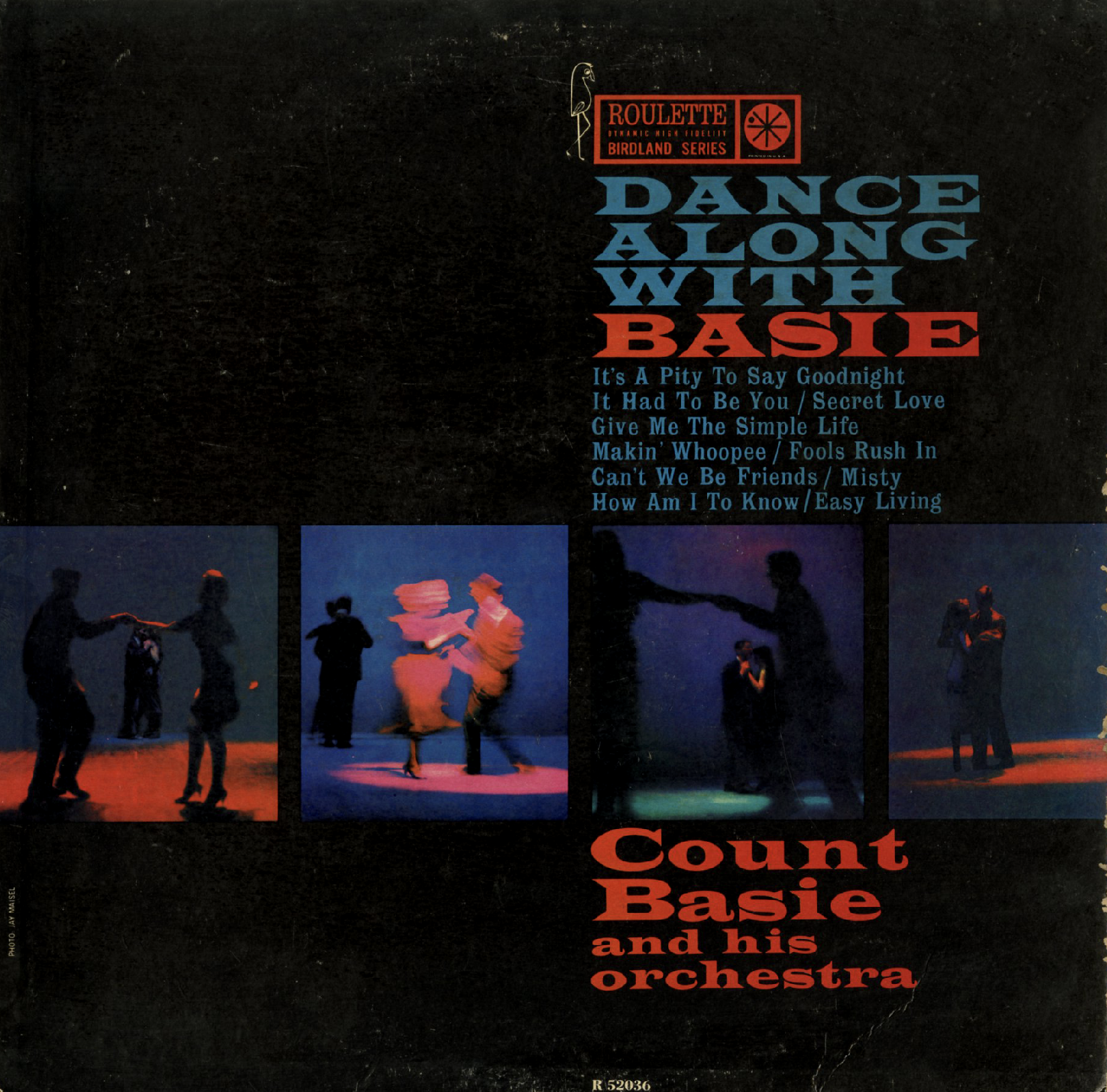
Dance Along With Basie - Count Basie


Give Me The Simple Life

Dance along With Basie
Count Basie and His Orchestra
Produced by Teddy Reig
Roulette Birdland R 52036
1960

Count Basie - Piano
Freddie Green - Guitar
Sonny Payne - Drums 
Eddie Jones, Jr. - Bass
Thad Jones, Joe Newman, John Anderson, Snooky Young - Trumpets
Marshal Royal, Frank Foster, Wille Mitchell, Charlie Fowkes - Saxophones
Frank Wess - Saxophone and Flute
Henry Coker, Benny Powell, Al Grey - Trombones

It Had To Be You
Makin' Whoopee
Can't We Be Friends
Misty
It's A Pity To Say Goodnight
How Am I To Know
Easy Living
Fools Rush In
Secret Love
Give Me The Simple Life

Saturday, August 12, 2023

The Late, Late Show - Dakota Staton


Summertime

The Late, Late Show
Dakota Staton
Capitol Records DT 876

From the back cover: George Shearing says, "Dakota is dynamic! To hear her sing for the first time is to joyously discover one of the finest jazz singers of our day." And wherever she appears, audiences wholeheartedly agree.

Dakota's distinctive vocal stylings are sometimes blues-like with an unusual misty quality, sometimes swinging with a light, refreshing beat. In each performances, the Staton wound creates new meaning for familiar lyrics, turning old favorites into fresh and exciting musical experiences.

Born in Pittsburgh, Pennsylvania, the young lady responsible for such wide acclaim began her career at seven, signing with two sisters. When her sisters married and the trio dissolved, Dakota went on as a "single," attending high school by day and performing in a Pittsburgh night club in the evenings. This was the beginning of a long series of sensational night-club engagements that has broth Dakota to the outstanding entertainment centers of the country.

Here, singing her favorite songs for "The Late, Late Show," she is accompanied by such soloists as Hank Jones, piano, and Jonah Jones, trumpet. And a stirring background, conceived and conducted by Van Alexander, with an assist by Hank Jones, enhances delightfully the bright new sound of Dakota Staton.

Broadway
Trust In Me
Summertime
Misty
A Foggy Day
What Do You See In Her?

The Late, Late Show
My Funny Valentine
Give Me The Simple Life
You Showed Me the Way
Moonray
Ain't No Use

Ethel Ennis


Blue Willow

Ethel Ennis
Pickwick/33 PC-3021

From the back cover: Ethel Ennis only has a few things in her favor – youth, beauty and an enormous amount of talent. One of the sparkling song stylists to emerge in recent years, Ethel is now rapidly ascending to stardom to join a select company of artists like Billie Holiday, Ella Fitzgerald and Sarah Vaughan.

Traces of Billie, Ella and Sarah may be found in Ethel but, like all genuine artists, she ultimately goes her own way. Ethel's individuality lies in her light-textured voice, her airy beat, her lyrical sensitivity and her relaxed embrace of each song.

Ethel is a Baltimore girl. She studied piano and voice there but made her professional debut in Philadelphia in 1950 on the Paul Whiteman Amateur Show. Success did not come immediately or easily. It was not until 1958, when Benny Goodman selected her as the vocalist to tour Europe with his all-star band, that she found a firm footing. Back in the U. S., Ethel spread her wings as a solo thrush in some of the country's top night clubs.

The album reveals Ethel's distinctive way with a ballad on a group of interesting songs that have no t generally been overworked on records. Ethel gives a secret caress in her renditions of "Dreamer, Dreamer," "Lullaby For Losers" and "You Better Go Now," and then is ready to break your heart in "Say It Ain't So, Joe" and "Blue Prelude." When Ethel is up at bat, everything is a hit. – Herman Schoenfeld - Music Editor of Variety

Blue Prelude
Dreamer, Dreamer
Off Shore
Casually
Hey Jacques
You'd Better Go Now
Lullaby Of Leaves
Say It Ain't So Joe
Blue Willow
Bon Voyage

Meeleven Leed's Hawaiian Country


Honolulu Blue And Green

Melveen Leed's Hawaiian Country
Accompanied by the "Super Pickers"
Bradley's Barn, Nashville & Jerry Byrd in Hawaii
Produced and Arranged by Charles Bud Dent
Art  by Tom Rixford
Recorded in Nashville at Bradley's Barn & in Hawaii at Sounds Of Hawaii
Remixed and Mastered in North Hollywood by Lee Herschberg
Lehua Records 7019
1975

From the back cover: It is only natural that Melveen Seed, the part-Hawaiian country girl from Molokai, is the singer leading the way in bridging the gap between Hawaiian and Country music. The two forms of musical expression have so much in common and Melveen is at home in both fields.

She handles th Island songs with ease – whether they are in Hawaiian of English. Blending English lyrics with Hawaiian or Hawaiian words with songs written originally in English seems natural to her.

In this album, the first of its kind ever produced, the songs are of old and new Hawaii and the accompaniments are straight from Nashville county, with the exception of the lovely "sweetening" by Jerry Byrd and his Hawaiian Steel Guitar. – Keith Hague - Honolulu Star-Bulletin

Nashville Super Pickers

Grady Martin - Lead guitar
Ray Edenton - Rhythm guitar
Harold Bradley - Guitar
Bobby Moore - Bass
Harris Robbins - Piano
Bobby Thompson - Banjo
Buddy Harmon - Drums

Ka Makani Kaili Aloha
The Music Of Hawaii
The Hawaiian Wedding Song
Haole Hula
Paniolo Country
Honolulu Blue And Green
Walk Through Paradise / Jesu Meke Kanaka Waiwai
Hiilawe
Baby Pakalana
Hanohano Molokai
The Green, Green Grass Of Home
My Little Grass Shack
Me Oe Eay E Hele Pu (Closer Walk)

Thursday, August 10, 2023

The Classical Brazilian Guitar - Maria Livia Sao Marcos


Nesta Rua

The Classical Brazilian Guitar
Maria Livia Sao Marcos
Guitar with Chamber Ensemble
Produced by Giveon Cornfield
Cover Design and Photography: Edwin Francis
Everest Records 3248
1969

From the back cover: "The Classical Brazilian Guitar", the first records of Maria Livia Sao Marcos, has won the award of "Best Records Of The Year" from the music critics affiliated to the Sao Paulo Association of Theatrical Critics. A most deserved award, as we must add to the great artistically talent of the soloist the importance of the repertory, consisting of compositions recorded for the first time, such as "Concerto For Guitar And Small Orchestra" by Vivaldi, "Brazilian Scenes" completed by Isaias Save, "Mode Paulista" by Osvaldo Lacerda.

Born in Sao Paulo, Brazil, Maria Livia Sao Marcos began playing in concerts at the age of thirteen. She won the Villa Lobos award in a contest sponsored by the Departamento Municipal de Cultura de Prefecture de Sao Paul in 1960. She studied guitar under the direction of her father, Prof. Manoel Sao Marcos, and musical theory and composition with Professors Arthur Hartman, Domino Cozzella, Rossini Tavares de Lima, J. C. Caldeira Filho and Osvaldo Lacerda. She was distinguished with the following awards; "Best Young Artist" from Asociacao Paulista de Critics Tetras and with the Gold Medal for "Best Concerts" from "Asociacao de Artists Brasileiros" from Rio de Janeiro.

Requebra Morena (Isaias Savio)
Impressoes De Rua (Isaias Savio)
Mazurca (Villa Lobo) 
Nesta Rua (Isaias Savio)
Pobre Cega (Dinorah de Carvalho)
Valsa (Osvaldo Lacerda)
O Mar (Manoel Sao Marcos)
Vivaldi: Concerto For Guitar And Strings
a) Allegro Non Molto
b) Larghetto
c) Allegro
Isaias Reusner: Pierces For Lute
a) Courrante
b) Sarabande
c) Alamanda
Anon. XVII Century: Largo
Maria Livia Sao Marcos, Guitar with Strings Ensemble

The Harmonicats


Fantasie Impromptu

Harmonicats
RKO Records ULP 131
1958

From the back cover: It is easy to understand, after listening to  this album, that the harmonica, once considered merely a tour, was lifted to its rightful place among musical instruments by this group, under the leadership of Jerry Murad. Jerry Murad is not lonely one of the great harmonica players in the world, but he is also one of the few people in this country who makes, repairs and designs harmonicas. Jerry was born in Turkey, but his family migrated to Chicago, Illinois when he was six. He learned to play the harmonica as a young boy– and when he was in his twenties, he was hired by Torah Minnevitch to play with his famous Harmonica Rascals. After a few years, when Jerry decided to strike out for himself, he opened in Chicago and soon became the toast of the city. His record, "Peg O' My Heart", sold over two million copies and resulted in world-wide interest in the harmonica.

The two other members of The Harmonicats, Al Fiore and Don Les, were also once with the Harmonica Rascals. Al Fiore, who weights 265 pounds,  is the comic of the group, and his performance with a thirty-inch harmonica is a highlight where ever The Harmonicats appear. Don Les, who was born blind and regained the use of his eyes at the age of 12, is rated one of the best jazz harmonica players in the world. He creates miracles in sound on a plain fifty-cent harmonica!

With Jerry Murad playing the lead harmonica, Al Fiore playing chords and Don Les playing the bass or doing solo turns, The Harmonicats are making musical history with a long string of disc hits already to their credit. – Notes by Elise Bell

I'm Confessin' That I Love You
Tea For Two
September Song
Rhapsody Boogie
If I Had My Way
Dardanella
Valse Bluette
Ritual Fire Dance
Peggy O'Neil
You Are Always In My Heart
Dance Of The Comedians
Cat's Blues
Fantasie Impromptu