Search Manic Mark's Blog

Saturday, June 24, 2023

Songs Of The Old West Sung By Ed McCurdy


The Dying Cowboy

Songs Of The Old West
Sung By Ed McCurdy
Production Supervisor: Jack Holzman
Back cover photo: Lawrence Photo
Elektra Corporation EKL-112
1961

Sacramento
Hoosen Johnny
Great Grandad
Trail To Mexico
Sally, Let Your Bangs Hang Down (Hoedown)
Buffalo Skinners
State Of Arkansas
Jesse James
The Cowboy's Dream
Little Old Sod Shanty
Brown-Eyed Lee
Chuck A Little Hell (Hoedown)
The Dying Cowboy

1940 That Wonderful Year - Garry Moore


Hawaiian War Chant

1940 That Wonderful Year
Garry Moore
Cover Photograph: Bill Schropp
Warner Bros. Records 1282
Produced for Warner Bros. Records, Inc. by Eastern Productions, Inc., in conjunction with Bob Banner Associates, Inc.
1959

From the back cover: Anybody over 20 years of age is an old foof. Or maybe eve anybody over 18. Let's put it this way – if you're old enough to look back with pleasure to a song, a name or a place, you're an old foof. And that's who this album is for. Us old foofs.

On my television show we inaugurated a weekly feature called 'That Wonderful Year." An idea by Arnold Peyser. And each week we exhume the songs, the sayings, the news events of some given year. And all over the country, we are told, folks sit in front of their TV sets and say, "Oh, yes! Remember that?" or "Hey! I'd almost forgotten!" I ever heard of one case where a man leaned over and kissed his wife. But that's probably a wild rumor.

We hope that this will be the first of many albums ab out "Those wonderful Years." I chose the year 1940 for our first one mainly, I guess, because it was such a nice year for me: married just the year before, our first baby, etc.

And it was a pretty happy year for most everybody in the U.S. A. (To be sure there was the threat of war but we didn't really think we'd get mixed up in it. Altho we had the first Draft Act in our shivery, the men in the camps were singing songs like "Goodbye, Dear, I'll Be Back In A Year.")

In England, of course, it was different. They were already in it – so they drafted Winston Churchill. And he told them, "I have nothing to offer but blood, toil, tears and sweat."

But in America – nylon stockings first appeared and the women were thrilled.  They put them on and went to the movies to swoon over Leslie Howard and Clark Gable in "Gone With The Wind." Or they'd sit there and weep buckets over Ginger Rogers as Kitty Foyle... Shirley Temple felt she was getting too old to work so hard, so she retired. After all, she was eleven.

The real America – (the part between New York and Hollywood) – were happy because the Cincinnati Reds beat the Detroit Tigers for the World Series. And Joe Louis was holding up pretty good – he beat Arturo Godoy to retain his title. Again.

In the field of pop music, a young trumpeter by  the name of Harry James left the Benny Goodman band to for his own outfit. And he hired a real unknown singer with his band – name of Sumatra. Or Sonata. Or something like that; his first name was Frank.

In radio rokus were running their dials to Major Bowes, The Aldrich Family,m One Man's Family, Kay Kyser  The Kate Smith Hour – and couple of hot newcomers called Fibber McGee And Molly.

The cost of living was going up then, too. A pound of coffee cost 21¢ and they charged you 12¢ for a quart of milk, delivered!

Well – there are mountains of memories from 1940 – the last happy year before VJ Day in 1945.

So let's live again. Let's lower the needle, lower the lights, sit within kiss-throwing distance of someone special and go back to the That Wonderful Year.

That Wonderful Year / Imagination 
You Are My Sunshine
There's A Small Hotel
Intermezzo
Hawaiian War Chant
The Last Time I Saw Paris
How High The Moon
Johnson Rag
Cabin In The Sky
Takin' A Chance On Love
Dance With The Dolly
When You Wish Upon A Star / That Wonderful Year

Tuesday, June 20, 2023

Moonraker - John Barry


Flight Into Space

Moonraker
Roger Moore - James Bond 007
Music Composed by John Barry
Title Song Performed by Shirley Bassey
Lyrics by Hal David
Album Design: Roy R. Guzman
United Artists UA-LA971-1
1979

Main Title - Moonraker (Vocal by Shirley Bassey)
Space Lazer Battle
Hiss Goodhead Meets Bond
Cable Car And Snake Fight
Bond Lured To Pyramid
Flight Into Space
Bond Arrives In Rio And Boat Chase
Centrifuge And Corrinne Put Down
Bond Smells A Rat
End Title - Moonraker (Vocal by Shirley Bassey

Tribute To Duke - The Newport All Stars


Day Dream

Tribute To Duke
The Newport All Stars
Recored Live in Basel, Switzerland
Recording Director: Willi Fruth
Engineer: Rolf Donner
Recorded October 29th, 1969 in concert at Stadt-Casino Basel, Switzerland
Liner Photos: J. Becker, H. Harzheim, F. Hügel & S. Werkmeister
Cover Photography and Graphic Work: Heinz Bahr
BASF MPS STEREO 20717
1972

The Newport All Stars "Tribute To Duke" was conceived for Berlin Jazz Festival 69 which, in its entirety, was dedicated to Duke and therefore subtitled  "Duke 70". However, for technical reasons, it was recorded on week ahead of the festival in Basel, Switzerland at a concert which was co-produced by Germany's Suedwestfunk (Southwestern German Radio and TV Network Baden-Baden) and Switzerland's Radio Basel and Organized by Géard Lull.

From the inside cover: The really constant factor in the 10-year history of the Newport All Stars is the fact that they have pledged themselves to jazz as a swinging music – and not a particular jazz style. That's why musicians of so many divergent directions can play together as the Newport All Stars and make up a truly compatible unit. It is a pleurae and an hour for us to be album to pay tribute to the Duke in this, his seventieth year. – George Wein

Ruby Braff

Around the middle of the fifties my record collection was complete as far as trumpeters were concerned, and I was beginning to ask myself whether the great trumpet men like Armstrong, Eldridge, Clayton, Davison, Hackett, Shavers, etc. would continue to play forever, since, among the younger generation, there was not a single new trumpeter I liked. Then we heard the name Ruby Braff.

Finally came the first "Vanguard" LP's. Well, how was this possible? In a time when only hard bop or revival jazz were in demand, in a time when Roy Eldridge wasn't allowed to sit in at jam sessions, a young trumpeter had taken all the great ones in this field as his model and shaped himself a swing style of his own.

This was of course financial suicide. Ruby Braff didn't make much money. Ruby Braff made no concessions.

Ruby Braff does not play what is fashionable. Ruby Braff hates pop. Ruby Braff doesn't play loud. All disadvantages, these! But there are also advantages for Ruby: the "grand old man" of swing and Chicago jazz adept this "weirdo" with open arms, and many beautiful records are made by him and Pee Wee Russel, Bud Freeman, Freddie Green, Buck Clayton, Vick Dickenson, Jo Jones, Nat Pierce, Jack Teagarden, Lucky Thompson, Buddy Tate and... the Newport All Stars – Oscar Klein

Joe (Giuseppe) Venuti

Even today the violin is a rare instrument in jazz, more soften just tolerated than loved. And yet the violin was frequently found particularly in the earliest jazz bands – although it usually had the task of playing the less jazz-oriented tunes. With the appearance of the "sweet string sounds" of the larger orchestras the violin ultimately became the incarnation of an instrument unsuitable for jazz. The only shred of truth in this is that it takes such longer and is much harder for a violinist to achieve a jazz-like quality in his playing than for a horn man. On the other hand it is the violinists who had infused jazz in the early years with stylistic elegance and chamber-music-like finesse.

Joe Venuti was the first outstanding violinist in the history of jazz. He became famous in the years 1925 to 1933 through his close association with the guitarist Eddie Lang. Venuti and Lang played jazz of a chamber-music-like intimacy one before this trend became fashionable. Nevertheless they didn't lose a certain healthy vitality – a vitality, by the way, which still makes Venuti play like a young man at an age where others retire.

The comb-back of Joe Venuit is one of the most pleasant occurrences in jazz in recent years. Wherever the Newport All Stars appeared in Europe – particularly at the Berlin Jazz Days which followed this concert at Basel by a few days – Vent's playing provided the climax. – Bruno Spoerri

Red Norvo

Rex Stewart: "We always brought up Norco's name whenever somebody said ofays couldn't swing."

In those years – 1930 to 1934 – the fist xylophone/marimbaphonist in the history of jazz jeopardized the schmaltzy dance music of the Paul Whiteman Orchestra with his cocky manipulation of the beat. His transparent, springy playing incorporated the essence of the heady atmosphere of Chicago's South Side and Harlem – places which little Kenneth Orville, born 1908 in Beardstown, Illinois , couldn't have imagined. Grown up with small-town square dances, under the watchful eyes of a violin-playing father, at the bosom of a doting mother, Red is the living proof that swing is a social, a cultural phenomenon – not an inherited characteristic. Norco's career touted many bases and is a reflection of the musically motivated instability and restlessness which gripped many musicians after the old improvisatory polyphony had been replaced by arranged section work and the emancipation of the soloist. Red has been lading numerous small groups, played with the elite of swing, with Goodman, later with Woody Herman, with Tony Scott. His open, supple spirit manifests itself perhaps most impressively in his trios with Cal Barlow and Charlie Mingus, and later with Jimmy Rainey and Red Mitchell. – Urs Ramseyer

Barney Kessel 

Barney Kissel is 46 years old now. For thirty of them he has been playing guitar. Cal Barlow even claims that he takes it to bed with him. At ay rate Cal likes to relate how he was visiting Barney one night and how Barney was waving at hime with his left hand. In his right he was holding the guitar.

At age twenty Barney was "in". That was in 1944, when Norman Granz has asked him to participate in the movie "Jamie' the Blues".

Barney was the only white man on the scene. Things could have gone differently, though. But Charlie Christian didn't make it any more. He had died in 1942, hardly 26. His legacy was enormous. To this day, Barney Kissel probably is the most important representative of this style. Not many have kept their roots to this degree. No doubt Barney belongs among the most popular jazz guitarists. Proof: Charlie Parker, Oscar Peterson, Mahalia Jackson, Ella Fitzgerald, Benny Goodman, Charlie Barnet, Artis Shaw, etc. were working with I'm. Even the South American Baden Powell calls barney his first inspiration.

Eight year  ago Barry started to write a book. It is available now. Under the modest tile "The Guitar" it presents the experiences of a virtuoso. – Sammy Nuesch.

Kenny Burrell

The Basel concert of the Newport All Stars holds a special attraction because of the participation of a second guitarist – Kent Burrell. Born in 1931, he hails from Detroit a defrost came to the public's attention through hi work with Dizzy Gillespie at the beginning of the 50's. Like Barney Kissel he, too, belonged to the Oscar Peterson Trio, even if only for a short time. Burrell's unaccompanied solo treatment of Duke Ellington's "Just A-Sittin' And A-Rockin' " is a master -piece. Are jazz musicians can swing so intensively as Burrell does on this piece – on the other hand it demonstrates that Kenny has studied classical guitar. – J. E. B.

George Wein

Already in his formative years (he was born on October 3, 1925 in Boston, Mss.). George Wein was strongly interested in jazz, and soon after leaving school he was playing piano with well-known Dixieland groups. His name, however, became a household work through is managing and organizing all the great jazz festivals of international note. There are Newport (since 1954), Ohio Valley (since 1962), Pittsburgh Catholic Youth Organization Festival (since 1964) or the Longhorn Jazz Festival in Austin, Texas, which took place for the first time in april 1966. George Wein also is the founder of the Newport Folk Festival, which has been taking place annually since 1963,

But outside the United States he hs also promoted many remarkable jazz events, for instance the various Thelonius Monk tours, or the participation in many European jazz festivals, or even the "World Jazz Festival 1964", which brought together in Japan musicians from all ofver the world.

The fact that George Wein – in spite of all his activities as impresario – still finds time to play the piano with this group, shows how close his ties to jazz have remained. The "jazz business" would be in better shape if there were more impresarios and managers who could feel like a musical. – Gerard Lull

Larry Ridley

Larry Ridley was born on September 3, 1937 at Indianapolis. At Indiana University he studied violin with Michael Krasnopolsky, but soon acquired a reputation as an outstanding swing bassist. His first jobs were with Freddie Hubbard, James Spaulding and its Wes Montgomery. Between 1960 and 1965 he took part in extensive ours with Slide Hampton, Philly Joe Jones, Lou Donaldson, Randy Weston, Barry Harris, Coleman Hawkins, Art Farmer, Jim Hall, Sonny Rollins and particularly Horace Silver – K. T. Geier

Don Lamond

The "dot over the i" in every well organized "swing-in" is Don Lamond on drums. Who doesn't know him, Donald Douglas Lamond, born August 18, 1921 in Oklahoma, a drummer who counts himself among the young – now as ever, a drummer much in demand, who really knows how to swing a jazz group without using himself in the foreground. It would be superfluous to enumerate all the great soloists whom he has accompanied in the course of his extraordanrly active career – be it in concerts, on records or on tour. Watch this exceptional musical, I waosuld say, and you will know what I mean wthe I say: a jazz group is only as good as its drummer. – Pierre Favre

It was the idea of the liner notes that all the main people of Basel's Jazz-Scene should participate in them – each one in the field he nows get. So trumpet player Oscar Kien writs on Ruby Braff, bassist G.T. Geier on Larry Ridley, drummer Pierre Favre on Don Lamond.... etc. – and even impresario Gérd Lull on his famous colleague George Wein.

From Billboard - October 14, 1972: Recorded live in Basel, Switzerland, the All Stars pay a rousing tribute to Duke Ellington. All Stars they are, with the likes of Kenny Burrell, Red Norvo, Barry Kessel and Larry Ridley. Kessel's solo of Ellington's "Day Dream" is an outstanding performance, as are renditions of "Sitting And A'Rockin'" and "Sweet Georgia Brown." A welcome addition to any jazz collector's shelf.

Sweet Georgia Brown
Undecided
Sophisticated Lady
Day Dream
I've Got It Bad And That Ain't Good
Sitting And A'Rockin'
Deed I Do
If I Could Be With You
Things Ain't What The Used To Be
Rose Room

Music For Courage And Confidence - The Melachrino Strings


Oh, What A Beautiful Morning

Moods In Music
Music For Courage And Confidence
The Melachrino Strings
RCA Victor LPM-1005
1953

You'll Never Walk Alone
Oh, What A Beautiful Morning
May The Good Lord Bless You And Keep You
I'll See You Again
Smilin' Through
Ah! Sweet Mystery Of Life
Through The Years
Because
Bells Of Evening
Pennies From Heaven

Monday, June 19, 2023

Infinity In Sound - Esquivel


Harlem Nocturne

Infinity In Sound
Esquivel and His Orchestra
Produced by Neely Plumb
Recorded at RCA Victor Music Center of the World, Hollywood, California on January 20, February 2, 23, 25 and March 2, 1960
Recording Engineer: John Norman
RCA Victor LPM-2225

From Billboard - August 8, 1960: Here is a collection of songs featured by the big swing bands of yesterday and today, encompassed in bright modern arrangements that make them light attractive listening. The arrangements are by Esquivel, who also leads the large ork here. Sound is superb and the set should appeal to the whole new group of "sound" album fans. Tunes include "Frenisi," "Marie," "So Rare" and "My Reverie."

Softly, As In A Morning Sunrise ("Quedo")
Music Makers
Johnson Rag
Harlem Nocturne
Take The "A" Train
Macarena (Ls Virgen de la Macarena)
Autumn Leaves
Ferns
Marie
Let's Dance
So Rare

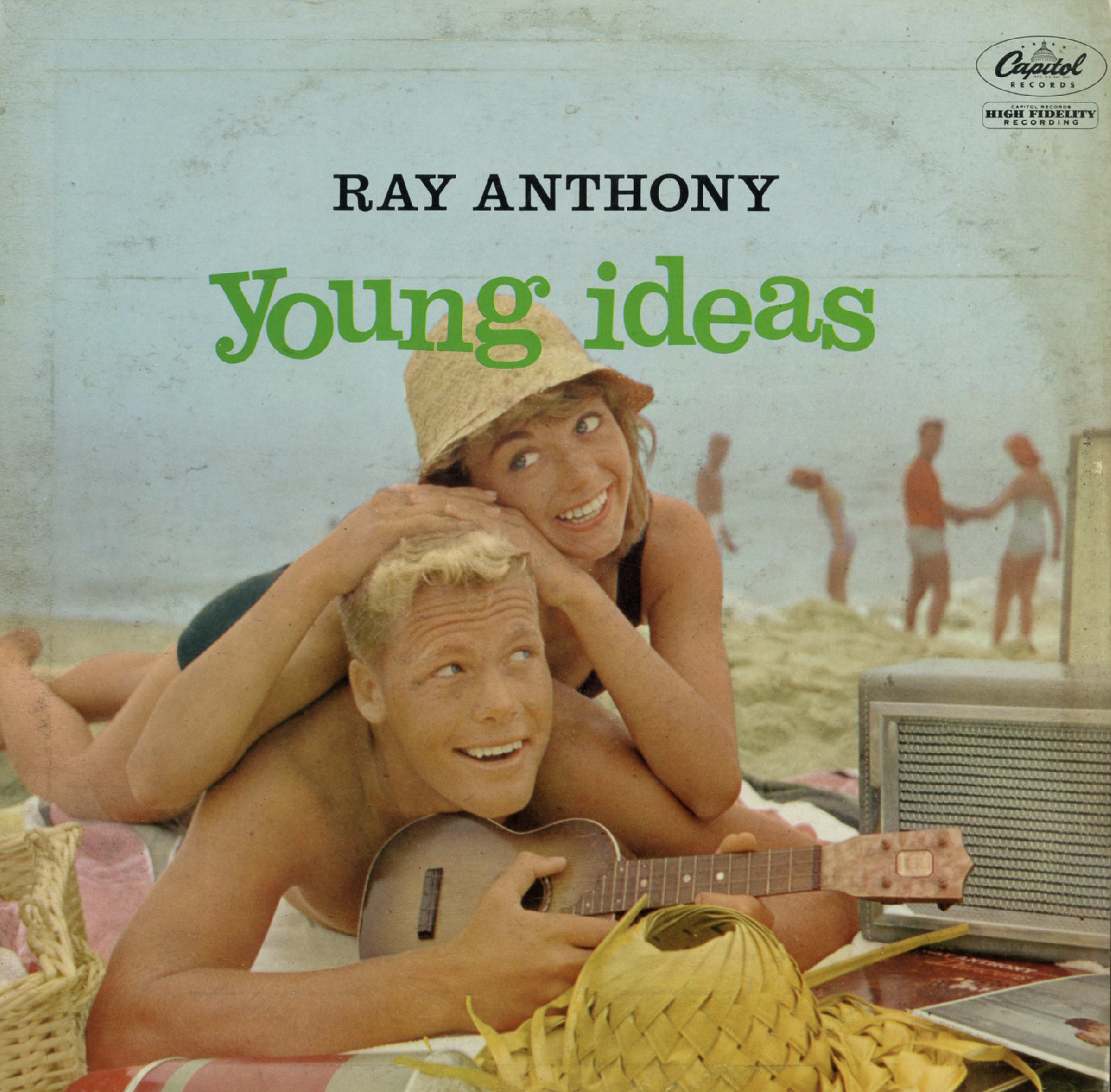
Young Ideas - Ray Anthony


I Love You

Young Ideas
Ray Anthony
Capitol Records T 866
1957

Moonglow
Why Do I Love You?
I Love You
Nice Work If You Can Get It
Lonely Night In Paris
Button Up Your Overcoat
You Turned The Tables On Me
Just One Of Those Things
That Old Feeling Coquette
Wrap Your Troubles In Dreams
Young Ideas

Saturday, June 17, 2023

All Time Hits Sung By Rusty Draper


When Its Sleepy Time Down South

All Time Hits Sung by Rusty Draper
With David Carroll and His Orchestra
Mercury Wing MGW 12103

From the back cover: Altho Rusty Draper is better known for his exuberant, driving vocal style, his versatile performance on this long play record offers conclusive proof that he also handles a ballad with tenderness and moving sincerity. The tall, attractive redhead radiates heart and general song-savvy on four swingy, sentimental tunes from the twenties, "I'll Get By", "After I Say I'm Sorry", "If I Had You" and "Cherry"; Kurt Weill's poignant "September Song" from 1938's legit click "Knickerbocker Holiday"; the provocative "Tangerine", wistful "The One I Love Belongs To Somebody Else", and the beguiling sweetness of "Skylark" from the early forties.

In addition to his standout ability, Rusty Draper is a talented composer and musician. Altho he lacks a formal musical education, the star is an accomplished electric guitar player, and also performs expertly on the electric ukulele, banjo and mandolin. Born in Kirksville, O., Rusty mastered the guitar at 10 and had his own weekly radio program on KTUL, Tulsa, Oklahoma, by the time he was 12. The Oklahoma station, incidentally, was also responsible for giving another Mercury star – Patti Page – her first break in show business.

Tangerine
After I Say I'm Sorry
September
Song
If I Had You
When It's Sleepy Time Down South
Coquette
Skylark
I'll Get By
The One I Love (Belongs To Somebody Else)
Tiger Lily
Are You Satisfied
Cherry

Hi-Fi Harmonica Over Broadway - Stan Fisher


Oh, What A Beautiful Mornin' 

Hi-Fi Harmonica Over Broadway
Stan Fisher
Dean Franconi and The Soundstage Orchestra
Design Records DLP 129

From the back cover: The inexplicable "something" which yielded a strong desire to make music came out early in Stan Fisher whose brilliant harmonic offering can be heard here.

At the age of three he made it quite evident, by beating on the cherished household silver with improved drumsticks, that music and its rhythmic patterns would play an all important part in his life. However, this potential musicianship failed to manifest itself, until one day, while rummaging with his faithful dig, Stan unearthed a rusty mouth organ and shortly proceed to master this corroded instrument. His parents possible persuaded by the discordant emission of their son's find, soon decided to buy him a shining new, pitch-true harmonica.

After the usual run of amateur contests and "kiddy clubs," Stan Fisher quickly worked himself to a degree of proficiency that netted him #$20 per week plus his room and board. It was while playing in one of these smily "saloons" that Stan was discovered by Garry Moore, who was then featured with Jimmy Durante in a Broadway show. Moore gave youthful Stan a spot on his "hiJinx" radio program broadcast from WBAL, Baltimore. It was from there that the harmonica virtuoso branched out as a featured artist in Baltimore's top night spots. Soon thereafter, he left his hometown to fill bookings in leading hotels, theaters and clubs in the United States and Canada. These were Stan's first long, important strides towards his ultimate position of unchallenged eminence as the greatest young harmonica find in the nation.

As it had its effect on the careers of most entertainers, the war also put a temporary halt to Stan Fisher's progress.

At its outbreak, he immediately enlisted in the Aviation Cadets where he earned his wings and was commissioned First Lieutenant. As a pilot, he flow 35 combat missions over Germany from his base in England; crashed four times, and won the Distinguished Flying Cross, the Air Medal with three oak leaf clusters, the E.T.). ribbon with two battle stars and the Presidential Unit Citation.

This young artist's versatility ranges from "Bach to Boogie" with a slight presence for the former. Stan realized on of hie life's ambitions when he performed as a soloist with a full symphony orchestra conducted by David Rose.

Stan Fisher can also count himself among the tennis champions. He won the Florida Racket Club doubles championship, when he played with Bobby Riggs.

Love, Look Away (Flower Drum Song)
Get Me To The Church On Time (My Fair Lady)
Some Enchanted Evening (South Pacific)
The Surrey With The Fringe On Top (Oklahoma)
There Is Nothin' Like A Dame (South Pacific)
Sunday (Flower Drum Song)
On The Street Where You Live (My Fair Lady)
A Wonderful Guy (South Pacific)
Oklahoma (Oklahoma)
Oh, What A Beautiful Mornin' (Oklahoma)

The Fabulous Dorseys In Hi-Fi


Moonlight In Vermont

Stereophonic

The Fabulous Dorseys In Hi-Fi
Back cover painting: Tom Allen
Columbia Records C2L-8/L2 (2-Record Set)
1958

From the inside cover: Not long ago Tommy Dorsey outlined ideas for his next three albums. It was late on a summer night, and he was drinking up the Merritt Parkway from his home in Greenwich to mine in Westport, Conn. talking and driving fast. He had just finished telling me of the prospects of a stock he planned to buy the following day and explaining how the air conditioner in his car worked Now he switched to music and told me that the three kinds of music he wanted in his next three albums were (1) the sweet songs, the ballads that so many people asked him to play on the bandstand at the Statler Hotel, where he and the band were spending six months each year filling the famous Cafe Rouge to capacity, (2) swinging spirituals of the ind he had always had luck with over the years, and (3) an album of original twin tunes by the great arrangers he so much admired. I was beginning to plan the recording session necessary to get all the done when Tommy, with a characteristic laugh, told me they were already recorded. "Come over tomorrow and well play'em," he said as he delivered me at my door.

And it was true. The same great Dorsey band, with brother Jimmy and Buddy Rich and Charlie Shavers and Lee Castle and fourteen more Dorsey-picked sidemen you heard at the Staler and on the Jackie Gleason show, had made enough records for albums of Tommy's three ideas; He couldn't wait to sign a contract with a recording company, so he simply made them and paid for them himself. The recording was doen on the newest of his-fidelity equipment, and the performances were perfect, as you would expect them to be, and Tommy had all the tapes stored in a closet in Greenwich. At that time, we both thought it was only the beginning of a new flock of great albums by the Dorsey band of the 50's, sounding the way a great band can in these days of improved recording techniques. As it turned. out, these are the last records made by the fabulous Tommy Dorsey Orchestra, featuring Jimmy Dorsey. But thanks once more to Tommy's impatience to get things done, they were done, and in this album are the first twenty-four sides.

This think is the lat, the modern chapter pin the Dorsey brother's recording career, which began, after the boys had gained experience with the Scranton Sirens, with such notable groups as Red Nichols' Five Pennies; Paul Whiteman's orchestra, then sporting such stars as Bix Beiderbecke, Eddie Lang and Joe Venuit; Andre Kostelanetz' orchestra, making his earliest records of what was later to become such a popular style; and with pickup groups which included Benny Goodman and many other young jazz players. The Dorsey Brothers orchestra, recording in the 20's and early 30's, seasoned Tommy and Jimmy for leadership in the great swing era of the late 30's when the brothers went their separate ways with orchestras of different sounds, yet similar in that both groups consistently came up with hit records in both the sweet and swing fields. The two brothers continued their two bands into the 40's, but in the 50's they gained each other again to complete their lives together.

The musicians and singers whose careers were helped off made entirely by their experience in the Dorsey bands in long. It includes instrumentalists such as Bud Freeman, Dave Tough, Bunny belgian, Sy Oliver, Ziggy Elman, Buddy Rich, Paul Weston and Charlie Shavers It also includes Jo Stafford and Frank Sinatra, The Tied Pipers and Jack Leonard, Connie Haines and Dick Haymes. And with Brother Jimmy, of course, Glenn Miller, Ray McKinley, and later Jimmy's famous vocalist Bob Eberly and Helen O'Connell. All of these an many more learned the musical art from the Dorseys, for both men were disciplined, yet imaginative musicians.

The biography of Tommy and Jimmy, sparkling with tributes and successes, is not unfamiliar to most of us. nor essential to enjoying this album. But the kind of men they were, I believe, is. For the music they played was always consistent with their personalities.

So, perhaps, as ou listen first to the velvet sound of Tommy's trombone on There Are Such Things and This Love Of Mine and Moonlight In Vermont, for example, you'll remember Tommy as a guy whose greatest pleasure seemed to be to feed somebody a good dinner or decorate a pretty guest room for his mother or play with his children. He loved his home and his comfort, and he was proud of them, as he had a right to be. He liked to take friends on a tour of his home, a tour that lasted a couple of hours and more, if he included the grounds around the house. He lied to be liked, and to the gentle people he knew he was a gentle as they. He has been justly called a taskmaster, a tough boss, but he was also a short, a friend, and a father to many, and no one can tell me that the man who played the warmest sound ever heard in American music wasn't the same way himself. He once flew with me to Miami, where he was appearing at the Saxony Hotel on Miami Beach. and when he discovered that I had never been to Florida before, he left business behind to take me from the airport on a long tour of the beach, pointing out landmarks, recalling th shady history of the restaurant, the cat of that hotel. He was interested in everything, and he liked to make everything a little more interesting to other people.

He worried about tother people's troubles, found doctors for them or money or other help. In spite of this squabbles with Jimmy off an don in their careers, he went to Jimmy's aid whenever he was needed and managed, by his own amazing will power, to improve both his own health and his brother's He played great songs with such feeling because such feeling was inside him. It takes more than trombone lessons to sound that way.

And while you listen to Peace Pipe and Do It Yourself and Heaven Help Us – aggressive, impatient, driving music– you'll also remember Tommy as a guy who couldn't wait to get things done, who loved to eat and laugh, who built furniture and spent money and played hard. He started a music publishing company before most bandleaders through of such a thing. He published a music magazine because he didn't like the ones he read. He was about tot open a popcorn factory. He loved baseball and prize fights and steaks, especially if he had a group of friend with him.

Tommy neve thought of himself as a jazz trombonist, but throughout the swinging sides in this album he poles jazz with forcefulness an with the jazzman's spontaneity. He was so perfectly at home as a musician that he could be discussing his latest investment at a table near the bandstand, hear the musical cue for his chorus, stride swiftly to the front of the band and play the first high note of Moonlight In Vermont as if he'd been waiting all evening to play that one note. At fifty-one he outstripped every younger trombone player who tried to play like him, and when he stood with the band snapping his fingers, everybody else played better than he ever thought he could.

And then, just a few years ago, "The brother," as Tommy called him, joined the band, adding his delicate obligatos to Tommy's solos, leading the reed section, sailing on alto saxophone and clarinet on the swinging tunes they played, Jimmy was loved by everyone who knew him, and everybody in show business knew him. He as quiet, the more reserved brother, generous and warm and understanding. And he played the two kinds of music Tommy played, flawlessly and with so much success that his name was at the top of the best-selling record lists when he died. Jimmy was a friend of Jackie Gleason's, and when Gleason suggested the brothers unite for a summer replacement for his potiphar television show, the Dorsey brothers were back on the same bandstand again. Jimmy joined Tommy's band and brought to it a success few dance bands have enjoyed in this decade. Jimmy, at the older brother, was a much the musical stylist as Tommy, and while most of the arrangements in this albums are in Tommy's band style, Jimmy's playing is as always unique and exciting. Their musical roots are the same" jazz with a flavor of Dixieland and sweet music with a lyricism that needs no lyric to create the mood of the song. 

The Ballads

The number of hits by Tommy Dorsey over his long career has been about equally divided between sweet and swing songs. and so this album off his newest music is divided that way to please veery Dorsey fan. And despite th many other stars who have helped to make Dorsey ballads immortals it has belays been that opening trombone chorus soaring above the reeds that set couples to dancing and sighing. Tommy know how, better than anyone else, to set a romantic scene, and he enjoyed doing it for all who would listen. He wanted a new, beautifully played albums of these nostalgic standards, and he proved one. And the finals touch of perfection to these ballads is Jimmy. This for millions of us in the Dorsey magic, multiplied by twelve as follows:

Nevada 
Yesterdays
It Started All Over Again
I Dream Of You
This Love Of Mine
Rain
Do Do Do
I Should Care
Moonlight In Vermont
There Are Such Things
Autumn In New York
Melancholy Serenade

Most of the ballads, such as I Dream Of You, There Are Such Things, This Love Of Mine, I Should Care, and It Stated All Over Gain have been identified with Tommy for years. But Jerome Kern's Yesterdays, Vernon Duke's Autumn In New York, and Gershwin's Do Do Do suit the style and the mood. Neil Hefti's arrangement of Moonlight In Vermont completes the ballad portion of the set.

The Spirituals 

Another of Tommy's album ideas grew out of his fondness for swinging arrangements of spirituals. No other band has played spirituals so often and with such success as the Dorsey band, although no American music seems a more logical choice for big-band sorting. for this part of the plan Tommy called Dean Kincaid to write original compositions based upon spiritual. dean, who contributed such past Dorsey success as Hawaiian War Chant and Swing Low, Sweet Chariot, wrote six numbers for the slab, including We've Crossed The Widest River, How Far Is It To Jordan, This Is What Gabriel Says, Judgement Is Coming, Where Is That Rock And Heaven Help Us. Wagon Wheels, A Sy Oliver arrangement, although not a spiritual as such, provides an effective transition for the ballad portion of the album to the spiritual portion. It was one of Tommy's favorites too, particularly where the key change occurs at this final trombone entrance. Buddy Rich is the featured drummer on all of the spirituals except Wagon Wheels, which stars Cliff Lehman, and This Is What Gabriel Says, where Louis Bellson in the drummer. On the latter Charlie Shaver is the trumpet soloist.

The Swing Set

And when it came to swing Tony admired Count Basie above all others. He proved it by trading arrangements and arrangers with Basie, by going to hear him whenever the two were in the same town, and by taking as his third idea a set of Basie-like original composition by Ernie Wilkins, who has written so many great numbers for Basie. You'll recognize the Basie touch in many of these sides. You'll also recognize the Dorsey drive sparking his great band. Flagler Drive honors Tommy's Greenwich, Connecticut, address. 

Ernie Wilkin's swinging numbers for the Dorsey band Are: 

Peace Pipe
Skirts And Sweaters
DO It Yourself
Flagler Drive
Stereophonic

On most of the spirituals and swing numbers Jimmy's choruses are a feature, along with Tommy's virile trombone.

Tommy Dorsey died in his sleep at his Greenwich home in November, 1956. Six months later Jimmy followed him after a long illness. The Dorsey band, under the able direction of Warren Covington, continues to play for dancers everywhere, and these, the last records the brothers made, attest to the vitality and modern sound the Dorsey band of the 50s' has. In paying tribute to Tommy, among a host of his friends, Jackie Gleason said, "Tommy Dorsey symbolized an era in poplar music. He was the Pied Piper of the jazz-swing era, and to millions of popular music devotees – and professional musicians – he was a key factor in the band business."

– Irving Townsend

From Billboard - April 21, 1958: Before the tragic deaths of Tommy and Jimmy Dorsey last year they had recorded scores of sides with the Dorsey Brothers band. Columbia bought these tapes and has now released 24 of the sides, beautifully packaged in a twin-set LP album. It contains12 sweet standards, seven swinging spirituals, and five original swing items, all featuring Tommy's melodious trombone and Jimmy's great sax work. Dorsey-styled arrangements, performances, and sound are all fine. For nostalgia set should easily become one of the strong sellers of the year.

Nevada 
Yesterdays
It Started All Over Again
I Dream Of You
This Love Of Mine
Rain
Wagon Wheels
We've Crossed The Widest River
Peace Pipe
How Far Is It To Jordan
This Is What Gabriel Says
Judgement Is Coming

Do Do Do
I Should Care
Moonlight In Vermont
There Are Such Things
Autumn In New York
Melancholy Serenade
Flagler Drive
Skirts And Sweaters
Do It Yourself
Where Is That Rock
Heaven Help Us
Stereophonic