Search Manic Mark's Blog

Saturday, June 17, 2023

All Time Hits Sung By Rusty Draper


When Its Sleepy Time Down South

All Time Hits Sung by Rusty Draper
With David Carroll and His Orchestra
Mercury Wing MGW 12103

From the back cover: Altho Rusty Draper is better known for his exuberant, driving vocal style, his versatile performance on this long play record offers conclusive proof that he also handles a ballad with tenderness and moving sincerity. The tall, attractive redhead radiates heart and general song-savvy on four swingy, sentimental tunes from the twenties, "I'll Get By", "After I Say I'm Sorry", "If I Had You" and "Cherry"; Kurt Weill's poignant "September Song" from 1938's legit click "Knickerbocker Holiday"; the provocative "Tangerine", wistful "The One I Love Belongs To Somebody Else", and the beguiling sweetness of "Skylark" from the early forties.

In addition to his standout ability, Rusty Draper is a talented composer and musician. Altho he lacks a formal musical education, the star is an accomplished electric guitar player, and also performs expertly on the electric ukulele, banjo and mandolin. Born in Kirksville, O., Rusty mastered the guitar at 10 and had his own weekly radio program on KTUL, Tulsa, Oklahoma, by the time he was 12. The Oklahoma station, incidentally, was also responsible for giving another Mercury star – Patti Page – her first break in show business.

Tangerine
After I Say I'm Sorry
September
Song
If I Had You
When It's Sleepy Time Down South
Coquette
Skylark
I'll Get By
The One I Love (Belongs To Somebody Else)
Tiger Lily
Are You Satisfied
Cherry

Hi-Fi Harmonica Over Broadway - Stan Fisher


Oh, What A Beautiful Mornin' 

Hi-Fi Harmonica Over Broadway
Stan Fisher
Dean Franconi and The Soundstage Orchestra
Design Records DLP 129

From the back cover: The inexplicable "something" which yielded a strong desire to make music came out early in Stan Fisher whose brilliant harmonic offering can be heard here.

At the age of three he made it quite evident, by beating on the cherished household silver with improved drumsticks, that music and its rhythmic patterns would play an all important part in his life. However, this potential musicianship failed to manifest itself, until one day, while rummaging with his faithful dig, Stan unearthed a rusty mouth organ and shortly proceed to master this corroded instrument. His parents possible persuaded by the discordant emission of their son's find, soon decided to buy him a shining new, pitch-true harmonica.

After the usual run of amateur contests and "kiddy clubs," Stan Fisher quickly worked himself to a degree of proficiency that netted him #$20 per week plus his room and board. It was while playing in one of these smily "saloons" that Stan was discovered by Garry Moore, who was then featured with Jimmy Durante in a Broadway show. Moore gave youthful Stan a spot on his "hiJinx" radio program broadcast from WBAL, Baltimore. It was from there that the harmonica virtuoso branched out as a featured artist in Baltimore's top night spots. Soon thereafter, he left his hometown to fill bookings in leading hotels, theaters and clubs in the United States and Canada. These were Stan's first long, important strides towards his ultimate position of unchallenged eminence as the greatest young harmonica find in the nation.

As it had its effect on the careers of most entertainers, the war also put a temporary halt to Stan Fisher's progress.

At its outbreak, he immediately enlisted in the Aviation Cadets where he earned his wings and was commissioned First Lieutenant. As a pilot, he flow 35 combat missions over Germany from his base in England; crashed four times, and won the Distinguished Flying Cross, the Air Medal with three oak leaf clusters, the E.T.). ribbon with two battle stars and the Presidential Unit Citation.

This young artist's versatility ranges from "Bach to Boogie" with a slight presence for the former. Stan realized on of hie life's ambitions when he performed as a soloist with a full symphony orchestra conducted by David Rose.

Stan Fisher can also count himself among the tennis champions. He won the Florida Racket Club doubles championship, when he played with Bobby Riggs.

Love, Look Away (Flower Drum Song)
Get Me To The Church On Time (My Fair Lady)
Some Enchanted Evening (South Pacific)
The Surrey With The Fringe On Top (Oklahoma)
There Is Nothin' Like A Dame (South Pacific)
Sunday (Flower Drum Song)
On The Street Where You Live (My Fair Lady)
A Wonderful Guy (South Pacific)
Oklahoma (Oklahoma)
Oh, What A Beautiful Mornin' (Oklahoma)

The Fabulous Dorseys In Hi-Fi


Moonlight In Vermont

Stereophonic

The Fabulous Dorseys In Hi-Fi
Back cover painting: Tom Allen
Columbia Records C2L-8/L2 (2-Record Set)
1958

From the inside cover: Not long ago Tommy Dorsey outlined ideas for his next three albums. It was late on a summer night, and he was drinking up the Merritt Parkway from his home in Greenwich to mine in Westport, Conn. talking and driving fast. He had just finished telling me of the prospects of a stock he planned to buy the following day and explaining how the air conditioner in his car worked Now he switched to music and told me that the three kinds of music he wanted in his next three albums were (1) the sweet songs, the ballads that so many people asked him to play on the bandstand at the Statler Hotel, where he and the band were spending six months each year filling the famous Cafe Rouge to capacity, (2) swinging spirituals of the ind he had always had luck with over the years, and (3) an album of original twin tunes by the great arrangers he so much admired. I was beginning to plan the recording session necessary to get all the done when Tommy, with a characteristic laugh, told me they were already recorded. "Come over tomorrow and well play'em," he said as he delivered me at my door.

And it was true. The same great Dorsey band, with brother Jimmy and Buddy Rich and Charlie Shavers and Lee Castle and fourteen more Dorsey-picked sidemen you heard at the Staler and on the Jackie Gleason show, had made enough records for albums of Tommy's three ideas; He couldn't wait to sign a contract with a recording company, so he simply made them and paid for them himself. The recording was doen on the newest of his-fidelity equipment, and the performances were perfect, as you would expect them to be, and Tommy had all the tapes stored in a closet in Greenwich. At that time, we both thought it was only the beginning of a new flock of great albums by the Dorsey band of the 50's, sounding the way a great band can in these days of improved recording techniques. As it turned. out, these are the last records made by the fabulous Tommy Dorsey Orchestra, featuring Jimmy Dorsey. But thanks once more to Tommy's impatience to get things done, they were done, and in this album are the first twenty-four sides.

This think is the lat, the modern chapter pin the Dorsey brother's recording career, which began, after the boys had gained experience with the Scranton Sirens, with such notable groups as Red Nichols' Five Pennies; Paul Whiteman's orchestra, then sporting such stars as Bix Beiderbecke, Eddie Lang and Joe Venuit; Andre Kostelanetz' orchestra, making his earliest records of what was later to become such a popular style; and with pickup groups which included Benny Goodman and many other young jazz players. The Dorsey Brothers orchestra, recording in the 20's and early 30's, seasoned Tommy and Jimmy for leadership in the great swing era of the late 30's when the brothers went their separate ways with orchestras of different sounds, yet similar in that both groups consistently came up with hit records in both the sweet and swing fields. The two brothers continued their two bands into the 40's, but in the 50's they gained each other again to complete their lives together.

The musicians and singers whose careers were helped off made entirely by their experience in the Dorsey bands in long. It includes instrumentalists such as Bud Freeman, Dave Tough, Bunny belgian, Sy Oliver, Ziggy Elman, Buddy Rich, Paul Weston and Charlie Shavers It also includes Jo Stafford and Frank Sinatra, The Tied Pipers and Jack Leonard, Connie Haines and Dick Haymes. And with Brother Jimmy, of course, Glenn Miller, Ray McKinley, and later Jimmy's famous vocalist Bob Eberly and Helen O'Connell. All of these an many more learned the musical art from the Dorseys, for both men were disciplined, yet imaginative musicians.

The biography of Tommy and Jimmy, sparkling with tributes and successes, is not unfamiliar to most of us. nor essential to enjoying this album. But the kind of men they were, I believe, is. For the music they played was always consistent with their personalities.

So, perhaps, as ou listen first to the velvet sound of Tommy's trombone on There Are Such Things and This Love Of Mine and Moonlight In Vermont, for example, you'll remember Tommy as a guy whose greatest pleasure seemed to be to feed somebody a good dinner or decorate a pretty guest room for his mother or play with his children. He loved his home and his comfort, and he was proud of them, as he had a right to be. He liked to take friends on a tour of his home, a tour that lasted a couple of hours and more, if he included the grounds around the house. He lied to be liked, and to the gentle people he knew he was a gentle as they. He has been justly called a taskmaster, a tough boss, but he was also a short, a friend, and a father to many, and no one can tell me that the man who played the warmest sound ever heard in American music wasn't the same way himself. He once flew with me to Miami, where he was appearing at the Saxony Hotel on Miami Beach. and when he discovered that I had never been to Florida before, he left business behind to take me from the airport on a long tour of the beach, pointing out landmarks, recalling th shady history of the restaurant, the cat of that hotel. He was interested in everything, and he liked to make everything a little more interesting to other people.

He worried about tother people's troubles, found doctors for them or money or other help. In spite of this squabbles with Jimmy off an don in their careers, he went to Jimmy's aid whenever he was needed and managed, by his own amazing will power, to improve both his own health and his brother's He played great songs with such feeling because such feeling was inside him. It takes more than trombone lessons to sound that way.

And while you listen to Peace Pipe and Do It Yourself and Heaven Help Us – aggressive, impatient, driving music– you'll also remember Tommy as a guy who couldn't wait to get things done, who loved to eat and laugh, who built furniture and spent money and played hard. He started a music publishing company before most bandleaders through of such a thing. He published a music magazine because he didn't like the ones he read. He was about tot open a popcorn factory. He loved baseball and prize fights and steaks, especially if he had a group of friend with him.

Tommy neve thought of himself as a jazz trombonist, but throughout the swinging sides in this album he poles jazz with forcefulness an with the jazzman's spontaneity. He was so perfectly at home as a musician that he could be discussing his latest investment at a table near the bandstand, hear the musical cue for his chorus, stride swiftly to the front of the band and play the first high note of Moonlight In Vermont as if he'd been waiting all evening to play that one note. At fifty-one he outstripped every younger trombone player who tried to play like him, and when he stood with the band snapping his fingers, everybody else played better than he ever thought he could.

And then, just a few years ago, "The brother," as Tommy called him, joined the band, adding his delicate obligatos to Tommy's solos, leading the reed section, sailing on alto saxophone and clarinet on the swinging tunes they played, Jimmy was loved by everyone who knew him, and everybody in show business knew him. He as quiet, the more reserved brother, generous and warm and understanding. And he played the two kinds of music Tommy played, flawlessly and with so much success that his name was at the top of the best-selling record lists when he died. Jimmy was a friend of Jackie Gleason's, and when Gleason suggested the brothers unite for a summer replacement for his potiphar television show, the Dorsey brothers were back on the same bandstand again. Jimmy joined Tommy's band and brought to it a success few dance bands have enjoyed in this decade. Jimmy, at the older brother, was a much the musical stylist as Tommy, and while most of the arrangements in this albums are in Tommy's band style, Jimmy's playing is as always unique and exciting. Their musical roots are the same" jazz with a flavor of Dixieland and sweet music with a lyricism that needs no lyric to create the mood of the song. 

The Ballads

The number of hits by Tommy Dorsey over his long career has been about equally divided between sweet and swing songs. and so this album off his newest music is divided that way to please veery Dorsey fan. And despite th many other stars who have helped to make Dorsey ballads immortals it has belays been that opening trombone chorus soaring above the reeds that set couples to dancing and sighing. Tommy know how, better than anyone else, to set a romantic scene, and he enjoyed doing it for all who would listen. He wanted a new, beautifully played albums of these nostalgic standards, and he proved one. And the finals touch of perfection to these ballads is Jimmy. This for millions of us in the Dorsey magic, multiplied by twelve as follows:

Nevada 
Yesterdays
It Started All Over Again
I Dream Of You
This Love Of Mine
Rain
Do Do Do
I Should Care
Moonlight In Vermont
There Are Such Things
Autumn In New York
Melancholy Serenade

Most of the ballads, such as I Dream Of You, There Are Such Things, This Love Of Mine, I Should Care, and It Stated All Over Gain have been identified with Tommy for years. But Jerome Kern's Yesterdays, Vernon Duke's Autumn In New York, and Gershwin's Do Do Do suit the style and the mood. Neil Hefti's arrangement of Moonlight In Vermont completes the ballad portion of the set.

The Spirituals 

Another of Tommy's album ideas grew out of his fondness for swinging arrangements of spirituals. No other band has played spirituals so often and with such success as the Dorsey band, although no American music seems a more logical choice for big-band sorting. for this part of the plan Tommy called Dean Kincaid to write original compositions based upon spiritual. dean, who contributed such past Dorsey success as Hawaiian War Chant and Swing Low, Sweet Chariot, wrote six numbers for the slab, including We've Crossed The Widest River, How Far Is It To Jordan, This Is What Gabriel Says, Judgement Is Coming, Where Is That Rock And Heaven Help Us. Wagon Wheels, A Sy Oliver arrangement, although not a spiritual as such, provides an effective transition for the ballad portion of the album to the spiritual portion. It was one of Tommy's favorites too, particularly where the key change occurs at this final trombone entrance. Buddy Rich is the featured drummer on all of the spirituals except Wagon Wheels, which stars Cliff Lehman, and This Is What Gabriel Says, where Louis Bellson in the drummer. On the latter Charlie Shaver is the trumpet soloist.

The Swing Set

And when it came to swing Tony admired Count Basie above all others. He proved it by trading arrangements and arrangers with Basie, by going to hear him whenever the two were in the same town, and by taking as his third idea a set of Basie-like original composition by Ernie Wilkins, who has written so many great numbers for Basie. You'll recognize the Basie touch in many of these sides. You'll also recognize the Dorsey drive sparking his great band. Flagler Drive honors Tommy's Greenwich, Connecticut, address. 

Ernie Wilkin's swinging numbers for the Dorsey band Are: 

Peace Pipe
Skirts And Sweaters
DO It Yourself
Flagler Drive
Stereophonic

On most of the spirituals and swing numbers Jimmy's choruses are a feature, along with Tommy's virile trombone.

Tommy Dorsey died in his sleep at his Greenwich home in November, 1956. Six months later Jimmy followed him after a long illness. The Dorsey band, under the able direction of Warren Covington, continues to play for dancers everywhere, and these, the last records the brothers made, attest to the vitality and modern sound the Dorsey band of the 50s' has. In paying tribute to Tommy, among a host of his friends, Jackie Gleason said, "Tommy Dorsey symbolized an era in poplar music. He was the Pied Piper of the jazz-swing era, and to millions of popular music devotees – and professional musicians – he was a key factor in the band business."

– Irving Townsend

From Billboard - April 21, 1958: Before the tragic deaths of Tommy and Jimmy Dorsey last year they had recorded scores of sides with the Dorsey Brothers band. Columbia bought these tapes and has now released 24 of the sides, beautifully packaged in a twin-set LP album. It contains12 sweet standards, seven swinging spirituals, and five original swing items, all featuring Tommy's melodious trombone and Jimmy's great sax work. Dorsey-styled arrangements, performances, and sound are all fine. For nostalgia set should easily become one of the strong sellers of the year.

Nevada 
Yesterdays
It Started All Over Again
I Dream Of You
This Love Of Mine
Rain
Wagon Wheels
We've Crossed The Widest River
Peace Pipe
How Far Is It To Jordan
This Is What Gabriel Says
Judgement Is Coming

Do Do Do
I Should Care
Moonlight In Vermont
There Are Such Things
Autumn In New York
Melancholy Serenade
Flagler Drive
Skirts And Sweaters
Do It Yourself
Where Is That Rock
Heaven Help Us
Stereophonic

Tuesday, June 13, 2023

Film Music Italian Style - The Sunset Strings


Funny World

Film Music
Italian Style
The Sunset Strings
Art Direction: Woody Woodward
Sunset Records SUS-5188
Liberty Records
1968

More (Theme from "Mondo Cane")
Rossana's Theme from "Seven Golden Men
La Dolce Vita (The Sweet Life)
I'll Set My Love To Music (Theme from the film "Mondo Pazzo")
All (Theme from "Run For Your Wife")
Theme from Fellini's 8 1/2
You Know (Main Theme from "Ecco")
Funny World (Theme from "Malamondo")
Arrivederci Roma
Love Theme from "La Strada"

Rodgers & Hammerstein - Stradivari Strings


It Might As Well Be Spring

An Evening With Rodgers And Hammerstein
Stradivari Strings
Spin-o-rama MK 3070

The Sound Of Music
It Might As Well Be Spring
Oh What A Wonderful Morning
You Are Beautiful
June Is Bustin' Out All Over
Soem Enchanted Evening
Love Look Away
Hello  Young Lovers
It's A Grand Night For Singing
I Have Dreamed

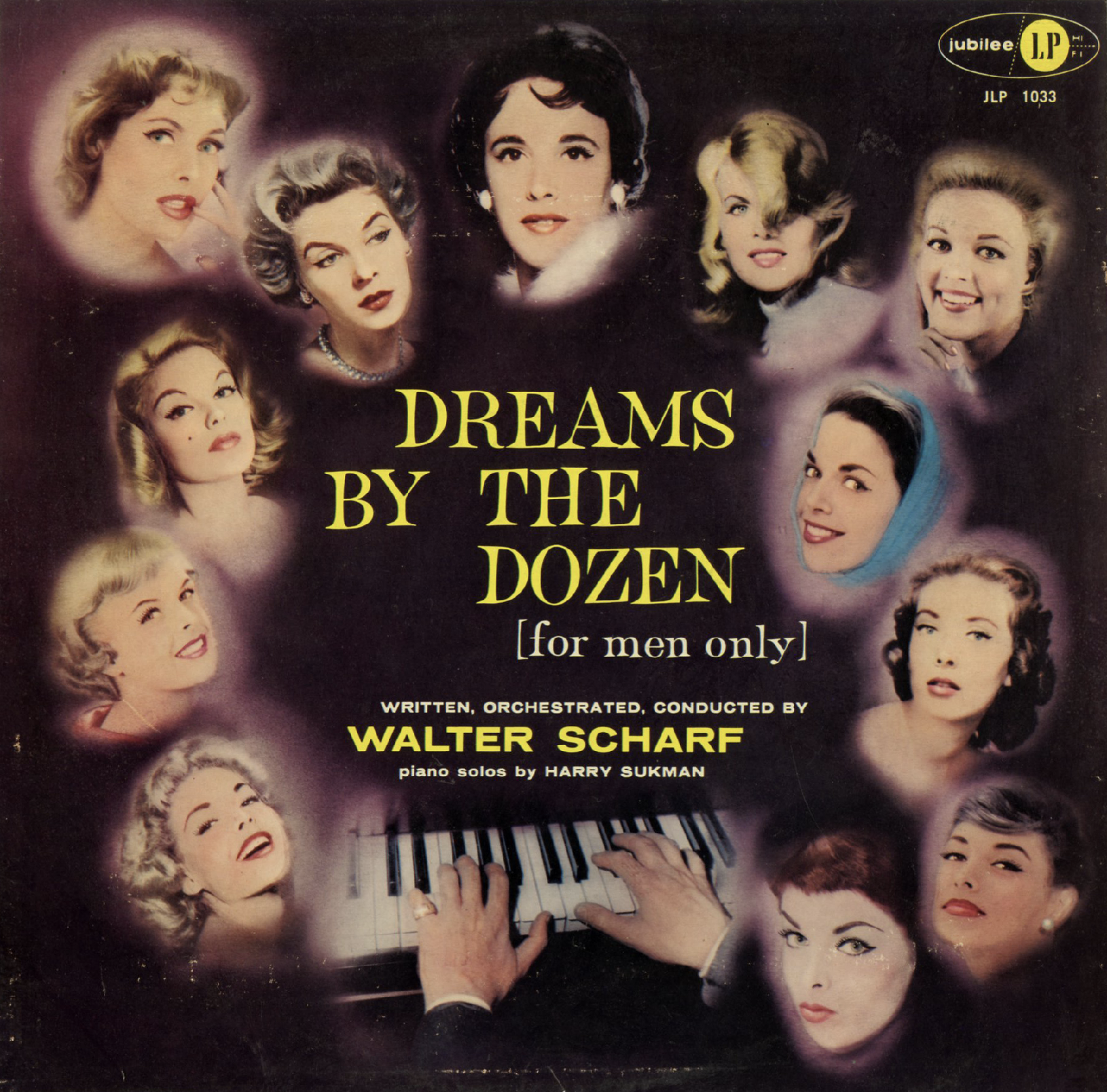
Dreams By The Dozen - Walter Scharf


Virginia

Dreams By The Dozen
(For Men Only)
Written, Orchestrated and Conducted by Walter Scharf
Piano Solos by Harry Sukman (pronounced "Sookman)
Produced by Morty Palitz
Cover Design: Sy Leichman
Jubilee Records JLP 1033
1959

From the back cover: He was born in New York City, August 1, 1910. He studied music at New York University in 1929. In 1931 he was Kate Smith's accompanist, then joined Rudy Vallee as arranger-accompanist.

In 1935 Vallée made a pitre at Warner's. Walter Scharf signed a two-year contract there as a result of the picture. He was at 20th Century Fox from 1936 through 1940... arranged all the musicals produced by Darryl Zanuck... "Alexander's Ragtime Band," "You Can't Have Everything," "Sally, Irene and Mary," "Lillian Russell."

Walter went to Paramount in '41 as arranger-composer. He worked on such films as" "Vert Of The Blues," "Louisiana Purchase," "Holiday Inn," "Star-Spangled Rhythm," etc. 1942 - 1946, he headed the Music Department at Republic Studios, where he composed and directed the scores for "In Old Oklahoma," "The Prodigal's Mother," "The Cheaters," "I've Always Loved You," "Love, Honor And Goodbye."

At Universal-International, Walter Scharf composed 19 pictures including "Casbah," "The Saxon Charm," "Take One False Step," "Yes, Sir, That's My Baby." For KRO, he did "Two Tickets To Bradway" and "The French Line." He scored and directed the music for "Hans Christian Anderson"; composed and directed: "Lie It Up," "Three Ring Circus," "You're Never Too Young," "Artists And Models," the last four Martin & Lewis pictures and "The Birds And The Bees" with George Gobel.

At NBC Walter was musical director of the Phil Harris-Alice Faye Radio Show for 8 years. In 1954 did the Texaco TV Show with Donald O'Connor. His most recent picture assignments include: "Hollywood Or Bust," "Three Violent People" and "Bundle Of Joy" with Eddie Fisher and Debbie Reynolds. He is now working on "The Joker" with Frank Sinatra and an untitled picture with Jane Russell.

During the past 20-odd years as composer, arranger and director, Walter Scharf has been nominated for the Academy Award 9 times. In 1955 he was notated for the TV Emmy Award for the Texaco Show and won the Radio Life Award in 1947. Walter won the Musical Courier Award in 1946 for "I've Always Loved You," the life of Leopold Godowshy.

Walter Scharf is now working on his 208th motion picture. He, therefore, is neither foolhardy nor braggadocios when he states, musically, that he nows many girls with the same names very well.

Shakespeare wrote: "What's in a name? A rose by any other name would smell as sweet," He hade sense.

But he might also have written:" Same name... same dame... some of the times." – Notes by Mort Goode

Jean
Debbie
Rita
Mary
Joan
Vickie
Katherine
Toni
Virginia
Patricia
Becky
Alice

Saturday, June 10, 2023

Percussion At Work - Pete Rugolo


Percussion At Work

Percussion At Work
Pete Rugolo and His Orchestra
EmArcy Mercury Records MG 36122

From the back cover: Pete Rugolo's history as an EmArcy recording artist has followed a unique, symmetrical pattern. In Music For Hi-Fi Buys (Mg 36082) he put all the tweeters and woofers to work in ta simultaneous exposition of the whole range of instrumental sounds from piccolo to tuba. Subsequently, as the titles made clear, he began to break down the instrumental processes with such adventures in sound as Reeds In Hi-Fi (Mg 20260) and Brass In Hi-Fi (MG 20261). As a natural follow-up to these reed and brass section salutes he now focus attention on the omnipresent rhythm team, with distinctive accent on drums.

Pete prefers to think of this as an abstract album of interesting sounds rather than specifically as a jazz set. The basic premise was to provide a variety of rhythms and of percussive tonal effects in a colorful setting; the secondary objective was the revivification of hi-fi of several of the tunes Pete originally created fr the Stan Kenton orchestra during his tenure as that band's chief arranger from 1945-49.

"Bongo Riff; Chorale For Brass, Piano And Bong' Fugue For Rhythm Section and Artistry In Percussion," he points out, "were all originally done for the Kenton band. In this new versions, of course, we had the advantage of not being held down to the three-minuet time limit that restricted the performances in those days. Luckily some of the key men who were in that band ar still working around Los Angeles, so we were able to have a reunion. Buddy Chliders, Milt Bernhart, Shelly Manne, Jack Costanzo and Al Porch, who are on this new session, were all members off that Kenton Band in the '40s, when we first played these tunes."

Bongo Riff is mainly Jack Costanzo's track. Dumerama, with the mambo-tinged piano and the vocal calls by Costanzo, is the non-Rugolo work in the set, the composition begin created to Eddie Cano, Funky Drums, which Pete says "we more or less made up at the end of the session," opens with a few starling and biting measures of the three drummers (Manne, Bunker, Lewis) establishing a triplet rhythm, then settles effectively into some wonderfully funky blues piano by Previn and pursues the rest of its course in a relay race between Andre and the drummers, with the latter taking over briefly again fro eight measures at the end during which the toilet motif returns.

Percussion At Work has everybody busy, with Larry Bunker heard first on xylophone, then on vibes, later on tympani; the later solo tympani passage are by Shelly.

Chorale opens with phrases by Previn answered by Costanzo's bongos and moves on to some brass passages notable for the superb writing and the stately solemnity of mood. Fugue For Rhythm Section, originally recored by the Kenton band in September, 1947, benefits from its aded hi-fi qualities and from a superlative performance in this new version featuring Costanzo, Previn and, briefly, Porch. Artistry In Percussion, which dated back to August, 1946, as a Kenton item, is a shrinking example of the progress made in the past decade, both mechanically and musically, as Manne gets a complete hi-fi workout in one of the most celebrated of Rugolo's originals.

One Plus Four was written to feature Larry bunker. On first hearing, its form may seem hard to grasp; basically, through, it is a blues with a 3/4 bridge added, but the reason for the title is that the time signature in the main phrase changes as follows: a measure of 1/4 followed buy two of 4/4, then the same pattern repeated until the bridge.

Interplay For Drums And Brass is a heady mixture of driving bongo rhythm, grandiose brass section effects, and jazz solo touches by Fagerquist's trumpet, Rosolino's trombone and Previn's piano.

The overall impact of Percussion At work is that of a flamboyant yet tasteful display of tone colors that show in brilliant high fidelity the astonishing variety of drum sounds at the disposal of the modern musician. With the interest in both percussion and hi-fi at a new peak, it can be predicted with assurance that this latest sample of "artistry in Rugolo" will be one of his most popular to date. – Leonard Feather - Author, The Book Of Jazz

Bongo Riff
Drumerama
Funky Drums
Percussion At Work
Chorale For Brass, Piano & Bongo
Fugue For Rhythm Section
Artistry In Rhythm
1 + 4
Interplay For Drums, Brass

A Double Shot Of Joe Saye


Wonderful Wonderful

A Double Shot Of Joe Saye
Recorded in New York City, July 21 and 25, 1958
Supervison: Jack Tracy
Mercury SR 80022

Joe Saye - Piano
Spencer Sinatra - Flute
Barry Galbraith - Guitar
John Drew - Bass
Jimmy Campell - Drums (Walter Bolden replaces Campbell on Tenement Symphony)

From the back cover: On hearing this album, it is not difficult to see that Joe Saye has been well-grounded in classical music. Of course, I know this anyway, since I have known Joe personally and professionally since the early '40s.

I have never known anyone with a greater sense of humor in my entire life. No one is more capable of laughing through trail and tribulation than Joe. Being completely without sight, he is very partial to practical jokes, which are idiosyncratic to blind people. He will ask a friend what color shirt someone is wearing, then later, in conversation with that person, will compliment or disparage the shirt, giving the color.

Musically, he has enough good taste to exclude jazz where it should be excluded. These Scotch compositions he features give him a real identity – something which is of the utmost importance to every group. His accent, both personally and musically, is Scotch. There are three adaptation of Scottish folk tunes. A Double Shot is adapted from the reel, Mrs. McLead; Scot Free is adapted from the reel, Rosy O'More; Heather Hop is adapted from The Inverness Gathering.

All the arrangements are made by Joe, and a great deal of skill is shown by obtaining the maximum of tone color and the fullest and most satisfactory musical sound from a group which, because of its size, must necessarily be limited to tone color. The standards round out a most tasteful album. A Double Shot (the album title), was the brainchild of Dakota Staton, a great new singing sensation with whom Joe has worked considerably.

The personnel of the group consists of Spencer Sinatra, flute and alto flute; Barry Galbraith, guitar; John Drew, bass and Jimmy Campbell, drums. On the Tenement Symphony track, Walter Bolden is playing drums. Light Tread, a composition by Joe Saye, and Scot Free are performed without drums. – George Shearing

From Billboard - September 14, 1959: Tasty jazz treatments of standard show tunes laced with originals by the pianist. Group includes piano, rhythm section and flute. The "originals" are Scotch-oriented and based on traditional Scottish tunes. Nice stereo effects are achieved. But the tasty arrangements are the big attraction here.

No Two People
Scot Free
Younger Than Springtime
Heather Hop
Wonderful Wonderful
Tenement Symphony
Double Shot
Let's Call The Whole Thing Off
Light Tread
The Blue Moon
If I Were A Bell

Everything I Have Is Yours - Billy Eckstine


Do Nothin' Till You Hear From Me

Everything I Have Is Yours
Billy Eckstine 
A&R Coordinator: Ira Stimler
Director of Engineering: Val Valentin
Cover Photo by Charles Stewart
Electronically enhanced for stereo reproduction
Metro MS 537
1965

From the back cover: In an era when too many male vocalists are of the non-singing variety, it's a pleasure indeed to hear th big, masculine voice of Billy Eckstine. New styles enter and depart. Current faddists may sing everything in subdued key or, on the opposite side of the musical coin, treat every song as though it's a Grand Finale. But there remains Mr. B. with his beautifully trained, mellow voice, and his expert showmanship. It's all still there, the gigs, clear as bells and those resounding, vibrating lows that have been much imitated but never duplicated.

The imitation factor, incidentally, is an interesting facet of Billy's career. At 17 he won an amateur contest show by imitating Cab Calloway, as well as singing like himself. Even today, Billy enjoys mimicry, and likes to include the Calloway bit in his night club routines, reminiscent of Ella's charming imitation of Louis Armstrong in here's! And, to round the whole cycle, Billy is, of course, often imitated in other acts, along with Bogey, Lionel Barrymore and Jimmy Stewart. You have to  be a pretty vivid personality to move in that company.

What makes a Mr. B? A lack of gimmickry, for one thing. Sincerity. Discrimination. A genuine respect for and appreciation of the intent of the lyricist. And talent.

Billy's style is more subtle than you may be aware of. It all seems so forthright and commanding. But the underplaying is still there, just beneath the booming surface. In this album, Billy sings old favorites such as Temptation, Blue Moon, That Old Feeling and, of course, Everything I Have Is Yours. He sings them, not only straight from the shoulder, by t straight from the heart.

Everything I Have Is Yours
Temptation
I Let A Song Go Out Of My Heart
Do Nothin' Till You Hear From Me
If You Could See Me Now
Don't Get Around Much Anymore
No One But You
That Old Feeling 
Wonder Why
Blue Moon

Monday, June 5, 2023

Meet The Moon-A-Tiks


Moon-A-Tiks

Meet The Moon-A-Tiks
Songs & Fun... From Outer Space
Produced by Jody Cameron from Midnight Music. Inc.
Little World Records LW 910
1965 (disc label date) 1966 (jacket date)

Did You Ever See A Moon-A-Tik?
Meet The Moon-A-Tiks
Song: The Moon-A-Tiks Are Coming
Moon-A-Tiks Meet Little Girl
Moon-A-Tiks Tell Fairytales
Song: Pop Goes The Moon-A-Tik
Song: Earthlings How We Love You
More Fairy Tales
Moon-A-Tiks Say Good Bye