Search Manic Mark's Blog

Friday, September 9, 2022

A Night At Eddie Condon's


The Sheik Of Araby

A Night At Eddie Condon's
Eddis Condon And His Orchestra
With All Star Jazzmen
Decca Record DL 8281

From the back cover: Yes, jazz is getting respectable. Virgil Thomson, ultra-critical collaborator with Gertrude Stein in interviewing one of Condon's concerts says: "The tuttis were a grandeur, a sumptuousness of sound and a spontaneous integration of individual freedom that makes one proud of the country that gave birth to such a high manifestation of sensibility and intelligence, and happy to be present at such a full and noble expression of the musical facilities." And so on. Very respectable indeed!

Impromptu Ensemble No. 1
The Sheik Of Araby
Farewell Blues
Stars Fell On Alabama
Nobody Knows
Aunt Hagar's Blues
Just You, Just Me
Atlanta Blues (Make Me A Pallet On Your Floor)
The Way You Look Tonight
Some Sunny Day
Rose Of The Rio Grande
We Called It Music

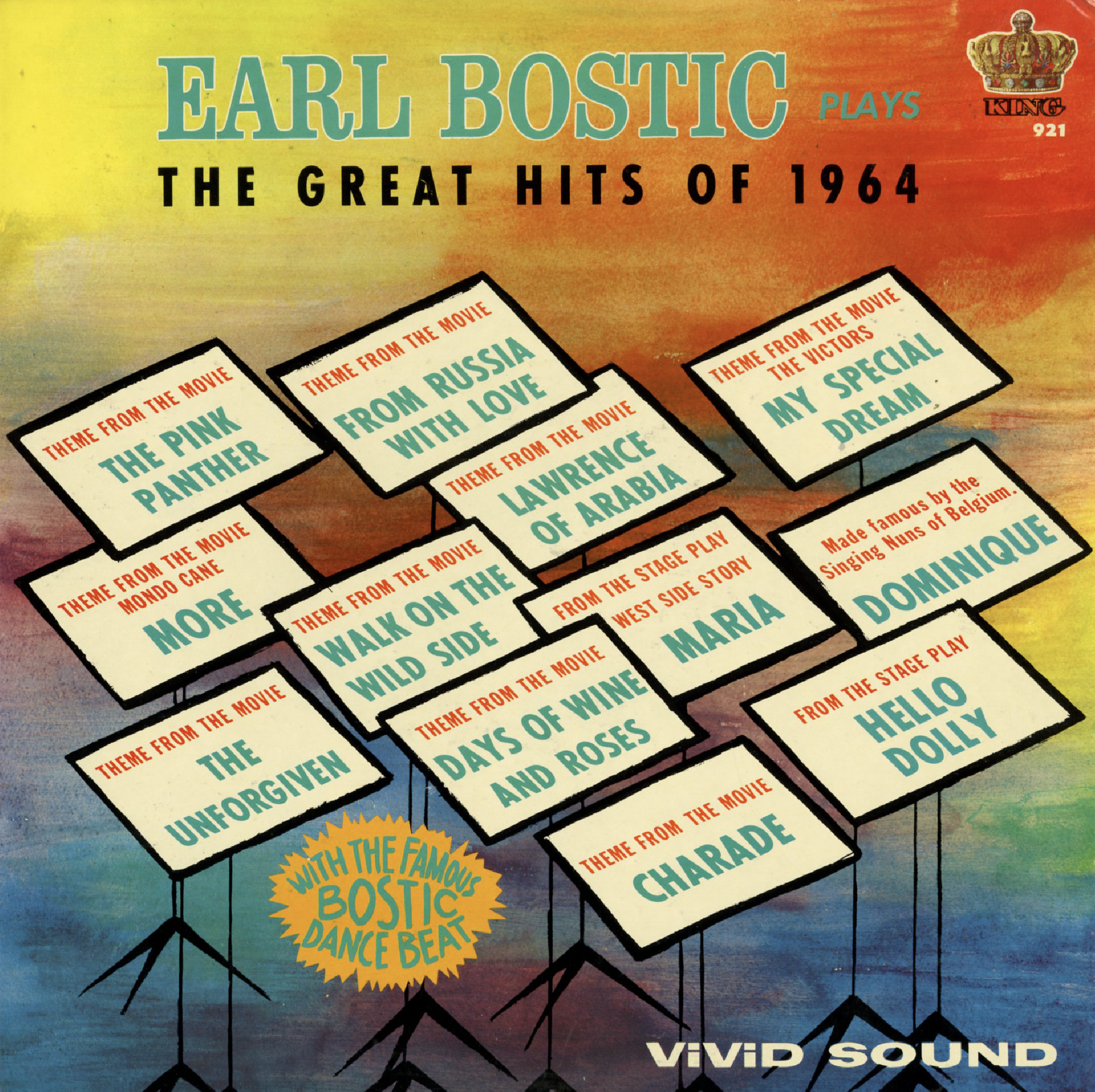
Earl Bostic Plays The Great Hits Of 1964


Theme From The Unforgiven

Earl Bostic
The Great Hits Of 1964
King Records 921

Pink Panther
Charade
Dominque
Walk On The Wild Side
Hello Dolly
More
From Russia With Love
Theme From The Unforgiven
Days Of Wine And Roses
My Special Dream
Maria
Lawrence Of Arabia

Tuesday, September 6, 2022

Double Barrel Jazz - No Blanks Here


Took The Spook

Double Barrel Jazz
(No Blanks Here)
Bethlehem Records BCP 87
1959

I Loves You Porgy - Nina Simone
There Will Never Be Another You - Stu Williamson
Extraversion - Stan Levey
Delighted - Sal Salvador
The Night We Called It Day - Terry Morel
Over The Rainbow - The Six
The Thrill Is Gone - Howard McGhee
Ghost Of A Chance - Herb Jeffries
Swinging 'Til The Girls Come Home - Oscar Pettiford
Mean To Me - Ruby Braff
East Side - Eddie Chu
Lou's Blue - Bob Hardaway
West Coasting - Stan Levy
Took The Spook - Sal Salvador

Giants Of Jazz - Brass - Volume V


Home

Giants Of Jazz
The Jazz Greats
Brass - Volume V
EmArcy MG36053
A Product of Mercury Record Corporation
1955

From the back cover: The remarkable series of albums dedicated to "Giants Of Jazz" hits a new high with this wonderful collection of performances featuring some of the leading brass men of our time.

Trombones take precedence on the first side, while trumpets have the spotlight on the second. Home, Too Marvelous For Words and Somebody Loves Me were originally recored under the name of George Wettling's New Yorkers, but the group assembled by that distinguished drummer for the date (on December 12, 1944) included Jack Teagarden, whose trombone and vocal work naturally dominated the proceedings. There is a brass bonus, too, in the presence of Joe Thomas, a fine trumpeter who played with Benny Carter and other name bands in the early 1940's. Completing the unique all-star lineup on this date are Coleman Hawkins, long acknowledged the first and foremost of all tenor saxophonists; Handk D'Amico, a fine clarinetist who had worked with Red Norvo, Tommy Dorsey and Raymond Scott; Herman Chittison, the fine pianist who has led his own trio for the past fifteen years; and Billy Taylor, the ex-Ellington bass player (not related to the piano player of the same name).

Liza,  Where Or When and Once In A While were recorded at a unique session by "Benny Morton's Trombone Choir," and the first date of this kind ever made. Benny Morton, a native New Yorker, was prominent in the 1930's with the bands of Fletcher Henderson, Don Redman and Count Basie, and in the '40's with Teddy Wilson, Raymond Scott and Edmond Hall. In recent years he has worked mainly in pit bands for Broadway shows, but he is remembered as one of the most personable trombone stylists. On this session, recorded May 30, 1944, he had with him Bill Harris, who was due the following year to win the first of a long series of Down Beat awards as the country's number one trombonist; Vik Dickenson, who was to wing the Esquire Silver Award in the trombone division in 1946 and 1947 (Vic, too,  is a Basie alumnus); and Claude Jones, who played in the Henderson, Calloway and Chick Webb bands and was with Duke Ellington from 1944-48. These four trombonists are accompanied by Johnny Guarnieri on piano, Al Hall on bass and the late Sid Catlett on drums.

St. Louis Blues, Don't Be That Way, I Want To Be Happy and Fiesta In Brass were recorded at a session that did for the trumpets what Morton's date accomplished for the trombones. Recorded in January, 1944 as the "Little Jazz Trumpet Ensemble,"these tunes feature Roy "Little Jazz" Eldridge, Emmett Serry and Joe Thomas on trumpets, with Johnny Guarnieri, bassist Israel Crosby and drummer Cozy Cole. If our ears and the musicians' memories serve un correctly, the solo order is as follows. On St. Louis Blues – Eldridge, Thomas, Berry, Eldridge; on Don't Be That Way - the same; on I Want To  Be Happy – Berry, Eldridge, Thomas, Eldridge; on Fiesta In Brass – Eldridge, Thomas, Berry.

Finally, on My Man and El Salon De Gutbucket, another product of the 1944 Golden Era of jazz recording, we meet the one and only Charlie Shavers. At that time Charlie was just about winding up a seven-year association with the John Kirby Sextet and was just about to start an intermittent association with Tommy Dorsey that is still operative. On the beautiful muted mood of My Man and the open work on the swinging Gutbucket Blues, Charlie is aided  by four more true giants of jazz; Coleman Hawkins on tenor saxophone, Teddy Wilson on piano, Billy Taylor on bass, Denzil Best on drums.

Home
Too Marvelous For Words
Somebody Loves Me
Liza
Where Or When
Once In A While
St. Louis Blues
Don't Be That Way
I Want To Be Happy
Fiesta In Brass
My Man
El Salon De Gutbucket

New Horizons - Les Brown


Something

New Worlds
Les Brown
And The Super Sounds Of Renown
With The Jack Halloran Singers
Producer: Sonny Burke
Recording Engineer: Lenny Roberts
Recorded in Hollywood, California 
Cover Illustration by Bob Krogle thru Art Expo
Art Direction: Ken Kim
Daybreak Stereo Records DR2007
1972

From the  back cover: A Pisces blessed with enormous dedication and drive, Les Brown grew up in Reinerton, Pa., where his father worked as a baker who moonlighted as a music teacher and band conductor. Les learned music by playing his dad's little soprano sax.

Everyone by now knows of young Les''s achievements while he was attending Duke University in the 1930's. His Duke Blue Devils dance orchestra became so regionally prominent in America's South that they were recorded by mighty RCA for its Bluebird Table. But few are aware that even before his Duke triumps, Les attended the Conservatory of Music in Ithaca, N.Y., where he studied and perfected the fundamentals leading to his enviable arranging and conducting skills.

Eventually, because they were college kids who had prepared for vocations in fields unrelated to music, the Devils disbanded. Les then made New York City his headquarters and prospered, cleffing arrangements for the "big name" bands of Larry Clinton, Isham Jones and others.

In 1938, Les tried again as a leader. It was the era of Benny Goodman, Artie Shaw, Jimmy and Tommy Dorsey, Jimmie Lunceford, Count Basie and Duke Ellington. Nothing came easy for the fledgling Brown band. Vital radio broadcasts and lucrative gigs in the nation's theaters, ballrooms and hotels were, for a couple of distressing, lean years, hard to come by. But eventually Brown's musicianship paid off.

His records on Decca and Columiba began to move up to the charts. His blonde vocalist, Doris Day, a frustrated dancer, helped the band attract attention and national popularity. The World War II period brought a smash in "Sentimental Journey" which, oddly, was contributed by one of Brown's sidemen, Ben Homer.

It was '47 that Les began his association with Bob Hope. They still work together nearly a quarter of a century later. Brown and his band have toured the world many times with the ski-nosed comic, repeatedly playing for U.S. servicemen in Korea and, more recently, Vietnam. The "Band of Renown" was long featured on Steve Allen's NBC and ABC television series, and since 1965 Les has worked as musical director of Dean Martin's program on NBC-TV. – Noted by Pepper Prothro

From Billboard - February 5, 1972: Top mood package is this debut by bandleader Les Brown on the Daybreak (RCA) label. Effectively the Jack Halloran Singers and intertwined between lush strings, arrangements of the them from "Kotch," as well as recent pop hits such as "I Feel The Earth Move," "Didn't We," "Something" and "Michelle." Another standout is the swinging big band reading of "Superstar."

Life Is What You Make It
Something
I Feel The Earth Move
All His Children 
Hello Forever
Didn't We
Superstar
This Way, Mary
Michelle
Love Is Good For Everyone
Wave

Monday, September 5, 2022

Rio At Midnight - Dante Varela


Rio At Midnight

Rio At Midnight
Dante Varela and His Orchestra
Decca DL 8334
1957

One of Decca's 1957 "At Midnight" series of LPs which included the sets: Manhattan, Paris, New Orleans, Rome, Hollywood and London At Midnight.

Amor
Quizás, Quizás, Quizás (Perhaps, Perhaps, Perhaps)
Baia (No Baixa Do Sapateiro)
The Romantic Cha Cha Cha
The Peanut Vendor (El Manisero)
Noche De Ronda
Baa-Too-Kee
Adios
Misirlou
El Coco
Come Closer To Me (Acercate Mas)
Estrellita 
La Paloma
Cavaquinho (Cava-Keen-Yo)

The Sounds Of Spain - Adventures In Sound

La Luna Enamora

The Sounds Of Spain
Adventures In Sound
Photo by Ormond Gigli
Columbia WL 110
1958

Mi Jardinera - Imperio de Triana with Orchestra
Temas De Mi Aragon - Rondalla de la "Casa de Aragon de Madrid, conducted by A. L. Merinero
Jotas De Picadillo - Ascension Herrero and Angel Burgos with Rondalla de la "Casa de Aragon" de Madrid
Margarita - Coro de estudiantes
Ole Mi Bailaora - Aquilino de la Rosa - Guitarist
Tientos De Punto Y Coma - Imperio de Triana with A. Arenas and R. Reguera - Guitarists 
Madrid - Antonio Apruzzesse - Organillo
Pandeirada De Igresia Fetta - Coros gallegos "Rosalia de Castro" de Madrid, conducted by D. Bravo
La Luna Enamora - Los 4 de Ruff
Carrascoasa - Cuando La Aurora - Clavelitos - Estudiantina de Madrid
A La Rueda Mi Carino - Aquilino de la Rose - Guitarist
Ria's Baixas and Rueda De Allariz - Imperio de Triana, with A. Arenas and R. Reguera - Guitarists
Jotas De Estilo - Ascenion Herrero y Angel Burgos with the Rondalla de la "Casa de Aragon" de Madrid
Seguidillas De Lecinena - Cuadros de jotas de la "Casa de Aragon" de Madrid with rondalla, conducted by A. L. Merinero

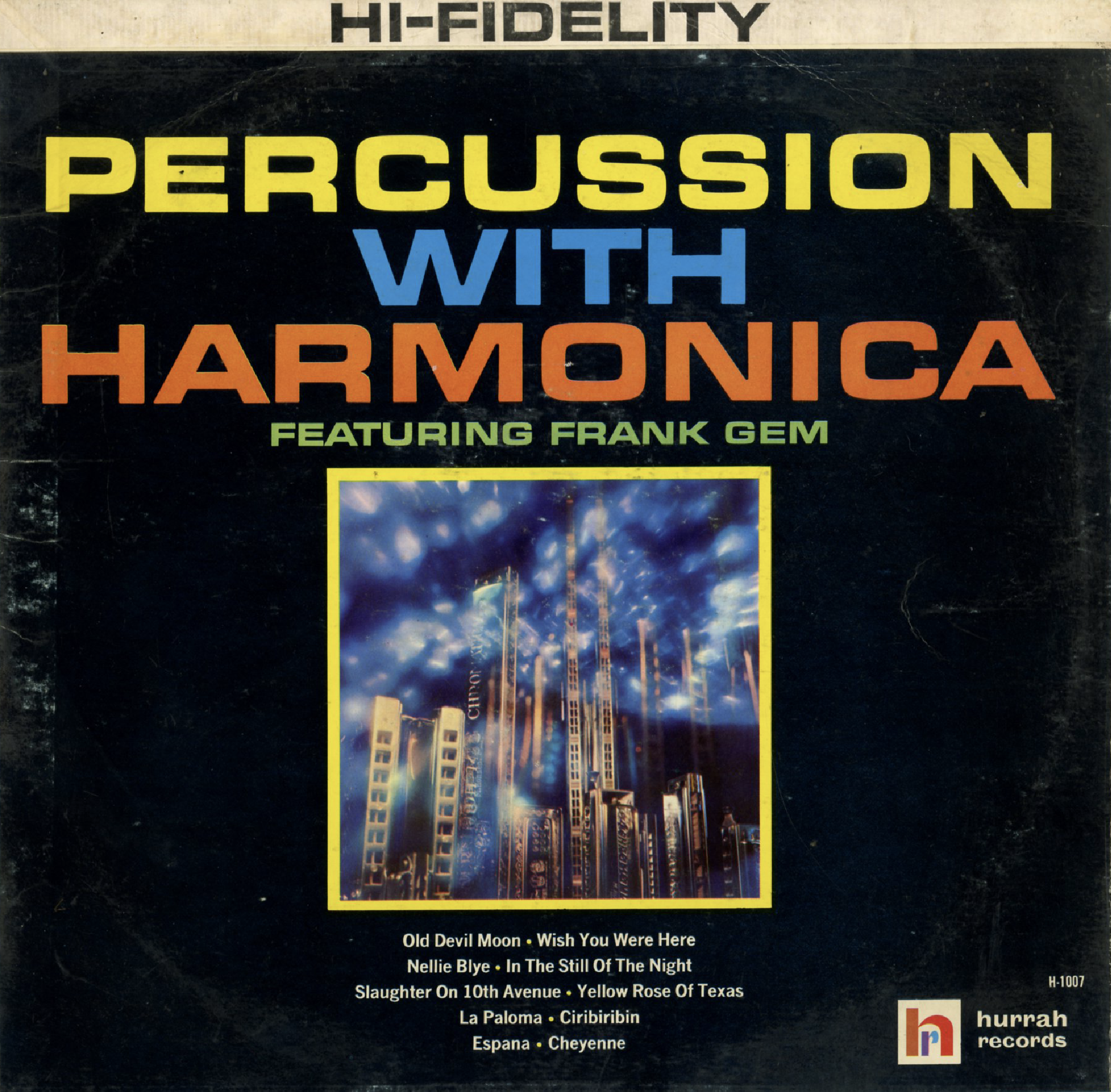
Percussion With Harmonica - Frank Gem


Cirbirbin 

Percussion With Harmonica
Featuring Frank Gem
Hurrah Records H-1007
Pickwick International

Old Devil Moon
In The Still Of The Night
Espana
Slaughter On 10th Avenue 
Yellow Rose Of Texas
Wish You Were Here
Cheyenne 
Cirbirbin
Nellie Blye
La Paloma

Tuesday, August 30, 2022

Jazz Lab 2 - John Graas


Cluster

Jazz Lab 2
John Graas
Decca Records DL 8478
1957

From the back cover: There has been throughout the history of jazz criticism a constant tendency, to which this writer is on less prone than any other, toward the pigeonholing of jazz performances into a neatly departmentalized set of categories. An intricately written and played work by six men may be described as a combo performance though it many in effect have fewer combo and more big-band qualities than many works by larger groups. A session recorded by musicians resident in California will be identified automatically as a sample of West Coast jazz, while the label "Kansas City Jazz" will be applied to a group in New York, simple because its members (who are probably natives of Philadelphia or Boston) once worked with Count Basie (from Red Bank, N.J) who once led a band not far from the banks of the Missouri River.

The time has come for this foolishness to stop; for us to acknowledge that there may be today, in an LP by an all-Swedish band, more of the sound of what we have tended to call West Coast jazz than is perceptible in many a session cut within a Cadillac's throw of Sunset and Vine. Jazz Lab 2 provides an excellent illustration of the breadth of conception and execution that can be sheltered under one geographical roof, for possibly more than any of its admirable predecessors in the Grass series it shows the extent to which John and his colleagues have drawn from every contemporary jazz source to distill a brew that defies definition beyond the application of admiring adjectives.

A glance at the backgrounds of the main contributors to Jazz Lab 2 serves in itself to illustrate the variety of origins skillfully assembled and utilized under Grass' guidance. John himself, born in Dubuque, Iowa Oct. 14, 1924, started out with the hot in his high school days, and while still in his middle teens won a national contest that led to performances under Koussevitsky at Tanglewood. In 1941-2 he played first horn with the Indianapolis Symphony and in '45-6 with the Cleveland Symphony; between the two engagements he gained his first dance band experience, playing with Claude Thornhill in 1942, when the French horn was an unprecedented novelty in orchestras of that type; and his first Army experience, leading his own band while in the service from '43-5.

Graas was back in the dance band field again with Tex Beneke in 1947-8, then did a couple of concert tours with Stan Kenton, and since 1950 has been a resident of California, working on TV shows, doing movie scores for several studios, and even occasionally touring with Liberace. The belated interest in modern jazz around Los Angeles which until a few years ago was considered an unregenerate Dixieland town, enabled him at last to experiment with his convictions concerning jazz. Despite (or possibly because of) his strict classical background, he had felt inhibited when symphony conductors insisted on their own methods of interpretations, leaving him no freedom for personal expression. He had long had the ambition to develop the interest in new jazz forms that had been stimulated by his first contacts with the medium, and felt that the same fluency of improvisation he had heard applied to trumpets and trombones could be put to effective use on the French horn. At that time there were only two French horn players with any jazz reputation at all, Graas on the west coast and Julius Watkins in the East. Since John embarked on his full-fledged efforts, around 1953, to establish himself as a composer, arranger and instrumentalist, the ideas that motivated him have been internationally accepted and the instrument through which he expressed them has craved an ever-growing niche for itself as a medium for jazz.

Jack Montrose, whose tenor sax decorates most of these performances,  is a Detroiter  who began as an amateur in a Chattanooga high school band. Earning ha BA at Lost Angeles State College, he later worked with Jerry Gray's dance band and with various combos led by west coasters. At 28, Jack is almost five years Bill Perkins' junior. Bill, a San Francisco by birth but raised in Chile and in Santa Barbara, California, started his name band career in 1950, after a long period of music studies under the GI Bill.

One of the two main rhythm sections on these sides comprises Paul More, from Meadville, Pa. (ex-Benny Carter, Zoot Sims, Stan Getz, Jerry Gray), and the superlative bassist and drummer heard for the past year or so in Miles Davis' group, Paul Chambers, 22 from Pittsburgh (winner of the Yearbook Of Jazz poll as the fellow-musicians' choice for the greatest new bass man) and 34-year-old Philadelphia Joe Jones. On most of the other numbers the pianist is a 35-year-old native New Yorker, Gerry Wiggins, who has toured with Benny Carter and worked a long spell as Lena Horne's accompanist, the bassist is Walter Buddy Clark, 28, formerly with Beneke, Les Brown and Peggy Lee. Larry Bunker, 28, from Long Beach, California, who has worked with Georgie Auld, Howard Rumsey, Gerry Mulligan and Peggy Lee, completes the team on drums. 

Be My Guest was recorded at an earlier session, featuring the baritone sax of 36-year-old Jimmy Giuffre from Dallas, now a successful leader with his own combo; Don Fagerquist, the ex-Les Brown trumpeter from Worcester, Mass., now a top Hollywood studio man; Dave Pell, also ex-Brown, a former Brooklynite who's a multidextrous combo leader, sideman, photographer and publicist; 30-year-old Claude Williamson, whom many consider the best California exponent of the Bud Powell piano style (a native of Brattleboro, VT., he played with Norvo, Barnet and June Christy); Howard Robert from Phoenix, AZ, a Los Angeleno since 1950; Curtis Counce, from Kansas City, who has toured with Shorty Rogers and Stan Kenton; the one and only Kenneth "Red"  Norvo, from Beardstown, IL., whose career has spanned three decades of jazz and who now lives in Los Angeles and leads his own combo; and "Bert Herbert," a 29-year-old native of Los Angeles, who has played alto with Rumsey, Rogers and many other West Coasters. – Notes by Leonard Feather (author of The Encyclopedia Yearbook Of Jazz)

Love Me Or Leave Me
Cluster
Mood
Three Line Blues
Chuggin'
Trio
Canon-Frair
Be My Guest

Rendezvous With Kenton - Stan Kenton


Two Shades Of Autumn

Rendezvous With Kenton
Stan Kenton
Back cover photo by Ken Whitmore
Recorded in October, 1957
Capitol Records T932

Personnel: 

Leader and Piano - Stan Kenton
Trumpets - Sam Noto, Phil Gilbert, Lee Katzman, Billy Catalano and Ed Leddy
Saxophones - Lennie Niehaus (Alto), Bill Robinson (Alto), Bill Perkins (Tenor), Wayne Dunstan (Tenor), and Steve Perlow (Baritone)
Trombones - Kent Larsen, Jim Amlotte, Don Reed, Archie Le Coque and Kenny Shroyer (Bass)
Drums - Jerry McKenzi
Bass - Red Kelly

From the back cover: The Stan Kenton band first blazed into musical prominence on Memorial Day, 1941, at the Rendezvous Ballroom in Balboa, California. Since then, Stand has traveled the high-road of musical success, winning spectacular acclaim all along the way. And now, that long road has brought him back to the Rendezvous and a home-base under his personal management - back to the sand and stars and the ocean murmur of Balboa.

More than sentiment prompted this memorable homecoming, Kenton, for his next album, wanted to find a recording area with a good natural big-hall sound. The Rendezvous was it, supplying just the right acoustics for the mood and manner of his contemporary jazz style. And in keeping with Stan's ambition to activate a vital new dancing spot on the West Coast, the Rendezvous again seemed the answer.

This album is an exciting preview of the kind of music that will be rolling out of Balboa in the months to come. It's the happy result of an "on location" recording date that saw Capitol's top engineers trucking up to the Rendezvous with tons of equipment, working with a fever and finesse matched only by the musicians themselves. On hand were all of the components of the first Kenton success – the fine, wide sound of the hall, stellar sidemen, and, of course, Stan himself.

The songs, all ballad standards except for two originals, have never been recorded by Stan previously, Joe Coccia, a brilliant new Kenton discovery, wrote Desiderata and Two Shades Of Autumn, and arranged all the other numbers. They are swingy and stimulating, blending the forthright buoyancy of the early Kenton hits with the adventurous jazz idioms which Stan has conceived, developed and refined during the seventeen years since his Balboa debut.

With The Wind And The Rain In Your Hair
Memories Of You
These Things You Left Me
Two Shades Of Autumn
They Didn't Believe Me
Walkin' By The River
High On A Windy Hill
Love Letters
I Get Along Without You Very well
Desiderata
This Is No Laughing Matter
I See Your Face Before Me