Search Manic Mark's Blog

Saturday, January 8, 2022

Hawaii - Martin Denny


Oro

Martin Denny 
Plays The Theme From The United Artists Motion Picture
Hawaii
Producer: Joe Saraceno
Arrangers: Harold V. Johnson & Julius Wechter
Engineer: Eddie Brachett
Art Direction: Woody Woodward
Liberty Records LST-7488
1966

Hawaii (from the United Artists Motion Picture "Hawaii")
Lahaina Luna
The Wishing Doll (from the United Artists Motion Picture "Hawaii")
I'll Remember You
Jerusha's Theme
Tiny Bubbles (Hua Li'l)
Here Is Happiness (Koko Ni Sachiari)
Hawaiian Rhapsody
Oro (God Of Vengeance)
Return To Paradise
Manuela Boy
Sukiyaki

Clap Hands - Luther Henderson


I'm Happy Sometimes

Clap Hands!
With Luther Henderson
Columbia CL 1340 & CSR 8149 (Special Re-issue)
1959

From the back cover: The orchestra Luther Henderson has assembled for this visit to the bright side of rhythm is as follows: four trombones, one a bass trombone; clarinet, two alto saxes, tenor sax and electric guitar playing the melody with the reeds; eight violins; drums, bass and another electric guitar in the rhythm section. And through all of this is threaded Luther's solo piano work, every element crystal clear in Columbia's High Fidelity.

Also from the back cover: Luther Henderson was born in Kansas City and grew up in Langston, Oklahoma, where his mother and father were both teachers, and in New York City. As the child of two educators he was brought into the classroom when most of us were hitting play school and found himself in the second grade in New York public schools at the age of five. Although he took piano lessons sporadically as a youngster, it was understood that he would be a teacher, and the only unresolved question lay in the choice of subject. When he hit a 100% on the geometry Regents exam it looked like the hand of fate had picked out mathematics.

About this time, however, he and two other sixteen-year-old lads tried their luck on Amateur night at the Apollo Theater and won (first prize, $10). The trio continued together, playing weekend dates and, as Luther explains it, the weekends kept getting longer and longer. From about this time he decided that if he had to spend life counting he would rather do it with beats and bar lines than with trigonometry.

He promptly enrolled himself in Juilliard where, before he graduated, he managed to learn the basic technique of every instrument in the book – a major factor in his present usual grasp of instrumental writing. Meanwhile, back at the nightclub, he was playing as one of the Five Spirits of Rhythm and then in the Leonard Ware Trio. His introduction to arranging came when he was called to do orchestrations for Katherine Dunham's Tropical Revue and, shortly afterward, dance sets for Duke Ellington.

A two-year hitch in the Navy was spent writing and arranging for Navy bands and shows. When he came out of the blue, Ellington and Strayhorn recommended him to Lena Horne. For the following three years he was Lena's accompanist and arranger, a choice plum he only gave up to get on with the main business of his own independent career.

He opened his own vocal coaching and arranging studio in New York, and here begins a list of show business notables a mile long that he has worked with in one capacity or another. Some of them were: Eartha Kitt, Juanita Hall, Carmen MacRae, Janis Paige, Marge and Gower Champion, Carol Lawrence, Jane Morgan, Diahann Carroll, Olga James, Helen Forrest and on and on. Carol Haney brought Luther into TV for arrangements for her appearances on the Ed Sullivan Show. Anita Ellis worked with Luther and out of it came a very special kind of story-record, called I Wonder What Became Of Me, for Epic Records. And then Polly Bergen chose Luther to back her musically for the TV production of "The Helen Morgan Story" and subsequent Polly Bergen Shows and records for Columbia: Bergen Sings Morgan, The Party's Over, My Heart Sings, and All Alone By The Telephone.

Luther himself points out that, after Ellington, his career has been primarily advanced through associations with celebrated women, a fact which his wife, lovely TV actress Stephanie, accepts with notable indulgence. He does keep a nodding acquaintance with the male sex, however, in such productions as the Victor Borge Shows and records with Ed Kenney and Larry Blyden.

With two complete scores for musicals tucked away in his trunk awaiting production, Luther has contributed arrangements for Broadway's Top Banana and Beggars' Holiday and the ballet music for Rodgers and Hammerstein Flower Drum Song. And now, with as solid a professional background as one could hope to accumulate in a young lifetime, he is arriving on his own track, under his own steam.

Stay As Sweet As You Are
Out Of Nowhere
On The Sunny Side Of The Street
Three Little Words
The Honey Song
Sometimes I'm Happy
I Love Paris
Let's Fall In Love
A-Two-At-A-Time
Lover, Come Back To Me
Clap Hands Here Comes Charley
I'll See You Again

Friday, January 7, 2022

Day By Day - Doris Day


There Will Never Be Another You

Day By Day
Doris Day
With Paul Weston and His Music From Hollywood
Photo: Theda and Emerson Hall
Columbia CL 942
1957

From the back cover: In her fine program here she (Day) is accompanied by the splendid Music from Hollywood orchestra of Paul Weston, complete with his famous string section. In some selections, the instrumentation is that of a full dance band, and in others, Barney Kessell (courtesy of Contemporary Records) on electric guitar, Frank Flynn on vibes, and Ted Nash on alto and tenor sax contribute outstanding solo selections. Throughout, the careful hand of Weston is in evidence, providing her with the kind of solid accompaniment that makes it possible for her to relax and really sing as only she can sing. Day by day, and day after day, this is a collection to provide heart-warming listening: fine songs, a fine artist and some of her finest performances.

The Song Is You
Hello, My Lover, Goodbye
But Not For Me
I Remember You
I Hadn't Anyone Till You
But Beautiful
Autumn Leaves
Don't Take Your Lover From Me
There Will Never Be Another You
Gone With The Wind
The Gypsy In My Soul
Day By Day

Hawaiian Luau! - Johnny Pineapple & Johnny Poi

Mani Chant - Johnny Pineapple

Tahiti - Johnny Poi

Hawaiian Luau!
Johnny Pineapple & Company
Johnny Poi & The Oahu Islanders
Galaxy Twin-Pack 2 DP 732
A Product of Pickwick International

Johnny Poi & The Oahu Islanders

Aloha Oe
Hawaiian Wedding Song
Ua Like Noa Like
Makalapua
Tahiti
Kila Lila Haleakala
Song Of The Islands
Tahu Oahu
One, Two, Three, Four
Wiki Wiki Mai

Johnny Pineapple & Company

Paradise Isle
Hilo March
My Hawaiian Kula Lani
Na Ka Pueo
I Hear Hawaii Calling
Pretty Maid Of The Southern Dea
Maui Chant
Aloha Oe E Kuu Lei
My Take

Standards In Silhouette - Stan Kenton


The Thrill Is Gone

Standards In Silhouette 
Stan Kenton
Stan Kenton and his great band in varied shades of blue, with a brand-new book of brilliant concert arrangements 
Produced by Lee Gillette
Capitol Records T 1394
1960

Personnel:

Leader and Piano: Stan Kenton
Saxophones: John Bonnie, Marvin Holladay, Charlie Mariano, Jack Nimitz & Bill Trujillo
Trumpets: Bud Brisbois, Bill Chase, Rolf Ericson, Roger Middleton & Dalton Smith
Trombones: Jim Amlotte, Bob Knight, Kent Larsen, Archie LeCoque & Don Sebesky
Bass: Pete Chivity
Drums: Jimmy Campbell
Percussion: Mike Pacheco & William Rodriguez 
(Clyde Reasinger in for Smith on The Meaning Of The Blues, and Lonely Woman)

From the back cover: In this album the Kenton band works with fresh and imaginative interpretations of fine standards, blending the familiar Kenton touch with a warm, yet bluesy sound that's strikingly new.

The arrangements are by talented Bill Mahieu, the youthful Chicagoan who has worked with the band as both trumpet player and staff writer. His inventive writing is enhanced by some truly outstanding solo performances which are skillfully woven into the framework of each selection. Especially in evidence is the sensitive trumpet stylings of Rolf Ericson, the great Scandinavian instrumental star who has helped to brighten the American jazz scene in recent years. Charlie Mariano is featured on alto, Bill Trujillo on tenor, with Don Sebesky and Archie LeCoque sharing the trombone solos.

Willow Weep For Me
The Thrill Is Gone
The Meaning Of The Blues
When Sunny Gets Blue
Ill Wind
Django
I Get Along Without You Very Well
Lonely Woman

Thursday, January 6, 2022

Beauty And The Beat! - Peggy Lee & George Shearing - Live At The National Disc Jockey Convention


All Too Soon

Beauty And The Beat!
Peggy Lee & George Shearing
Recorded Live At The 1959 National Disc Jockey Convention In Miami, Florida
Produced by Dave Cavanaugh
Capitol Records T1219

From the back cover: Miami, May 29, 1959 – More than 2500 of the nation's top disc jockeys were on hand to cheer performances by Peggy Lee and George Shearing during the Friday night concert at the American Hotel. The occasion was the DJ's second annual convention, held in Miami this year. And the concert, staged in the hotel's huge ballroom as combined entertainment and recording session, treated the audience to the opportunity of hearing these two famous "names" in a first-rate appearance together.

Even after the intense pressure of frantic all-day rehearsals, the artists turned up for the session completely relaxed and in a mood to swing. Miss Lee, in a shimmering gown, was as beautiful to see as she was to hear. And she, George Shearing, and the other musicians, swung handsomely through tune after tune with a spontaneous beat that was felt by everyone in the vast room.

A troublesome PA system caused the audience some difficulty in hearing parts of the session, but their warm applause give a good indication of the response with which the professional DJ's greeted the performances. And fortunately, great sounds were being fed continuously to Capitol's engineers manning the recording equipment back stage, so that the recorded results escaped unscathed.

The Quintet played with spirit and taste in support of the famous Shearing piano lead – both in instrumental numbers and in the inventive vocal backings. And Peggy Lee sang as though she didn't have a care in the world other than her interpretations, which included quite a variety of ballad and uptempo stylings. For example, her treatment of I Lost My Sugar In Salt Lake City was sultry and insinuating. Ellington's beautiful All Too Soon emerged lush and dreamy, and she breezed delightfully through an "up" version of If Dreams Come True.

The instrumentals by George Shearing and the Quintet included an original penned for the occasion by conga drummer Armando Peraza, and entitled Mambo In Miami, Satin Doll and Isn't Romantic? showed off the free-swinging precision of the group.

Do I Love You
I Lost My Sugar In Salt Lake City
If Dreams Come True
All Too Soon
Mambo In Miami
Isn't It Romantic
Blue Prelude
You Came A Long Way From St. Louis
Always True To You In My Fashion
There'll Be Another Spring
Get Out Of Town
Satin Doll

Viva - Mexicali Brass


Mexican Jumping Bean

Viva
Mexicali Brass
Crown Records CST-540
1967

My Granada
Mexican Jumping Bean
Adios Muchachos
Habanera
Dengozc
Toreador Song
La Paloma
Viva, Viva
Two Guitars
Chiapanecas

Vote For Billy Williams


This Side Of Heaven

Vote For Billy Williams
Mercury Wing MGW 12131
1959

From the back cover: For an entertainer who has spent his entire professional life singing in quartets, Billy Williams is a most remarkable solo performer. Rare indeed is the artist of such ease and musical grace, yet of such dramatic power and personal magnetism.

And for change of pace, he's a delightful fun-maker, as attested by more than a million fans who grabbed up his splendid treat, "Gonna Sit Right Down And Write Myself A Letter".

It all started when young Billy, of Waco, Texas, the son of a minister, decided to follow his father's career. As a student at Wilbeforce University, he joined with three other students to sing songs of gospel. They called themselves The Charioteers. Station WLW, Cincinnati, soon persuaded them out of their amateur status. A few years later, they were guests on Bing Crosby's radio show and stayed there for six years.

In 1949, his eye on the fast-growing television industry, Billy Williams decided to form a group of his own, to combine first-rate singing with polished visual presentation. The Billy Williams Quartet, soon a fixture on the Sid Caesar-Imogene Coca "Show Of Shows", became one of the hottest musical attractions in America.

Then records firmed Billy Williams' popularity and his secure place among the greats of modern popular music. His personal warmth and skill with an artful ballad insure that here, for your pleasure over and over again, is a musical treat and a dramatic experience.

I Don't Know Why (I Just Do)
Azure-Te
Who Knows
You're The One For Me
This Side Of Heaven
A Smile For Suzette
Cattle Call
You're The Only One I Adore
It's Best We Say Goodbye
Mad About Cha
If I Never Get To Heaven
Ask Me No Questions

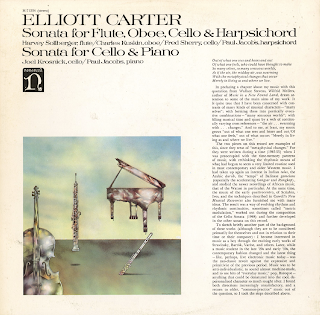
Sonata For Flute, Oboe, Cello & Harpsichord - Elliot Carter


Sonata for Flute, Oboe, Cello & Harpsichord - Allegro

Elliott Carter
Sonata for Flute, Obeo, Cello & Harpsichord
Harvey Sollberger: Flute 
Charles Kusin: Oboe
Fred Sheery: Cello
Paul Jacobs: Harpsichord
Sonata For Cello & Piano
Joel Krosnick: Cello
Paul Jacobs: Piano
Coordinator: Teresa Stone
Art Director: William S. Harvey
Cover Art: Peter Schaumann
Cover Design: Robert L. Heimall
Cover Concept: Hess and/or Antupit
Recorded under the musical supervision of the composer
Recording Engineer: Marc J. Aubort
Nonsuch Records H-71234
1969

From the back cover: When I was asked in 1947 to write a work for the American Cellist Bernard Greenhouse, I immediately began to consider the relation of the cello and piano, and came to the conclusion that since there were such great differences in expression and sound between them, there was no point in concealing tase as had usually been done in works of the sort. Rather it could be meaningful to make these very differences one of the points of the piece. So the opening Moderato presents the cello in its warm expressive character, playing a long melody in rather free style, which the piano percussively marks a regular clock-like ticking. This is interrupted in various ways, probably (I think) to situate it in a musical context that indicates that the extreme disassociation between the two is neither a matter of random or indifference but to be heard as having an intense, almost fateful character.

The Vivace, a breezy treatment of a type of pop music, verges on a parody of some Americanizing colleagues of the time. Actually it make explicit the undercurrent of jazz technique suggested in the previous movement by the freely performed melody against a strict rhythm. The following Adagio is a long, expanding, recitative-like melody for the cello, all its phrases interrelated by metric modulations. The finale, Allegro, like the second movement based on pop rhythms, is a free rondo with numerous changes of speed that ends up by returning to the beginning of the first movement with the roles of the cello and piano reversed.

As I have said, the idea of metrical modulation came to me while writing this piece, and its use becomes more elaborated from the second movement on. The first movement, written last after the concept had been quite thoroughly explored, presents one of the pieces basic ideas: the contrast between psychological time (in the cello) and chronometric time (in the piano), their combination producing musical or "virtual" time. The whole is one large motion in which all the parts are interrelated in speed and often in idea; even the breaks between movements are slurred over. That is: at the end of the second movement, the piano predicts the notes and speed of the cello's opening of the third, while the cello's conclusion of the third predicts in a similar way the piano's opening of the fourth, and this movement concludes with a return to the beginning in a circular way like Joyce's Finnegan's Wake.

The Sonata for Flute, Obeo, Cello and Harpsichord was commissioned by the Harpsichord Quartet of New York and uses the instruments of which that ensemble was composed. My idea was to stress as much as possible the vast and wonderful array of tone-colors available on the modern harpsichord (the large Pleyel, for which this was first written, produces 36 different colors, many of which can be played in pairs, one for each hand; the Dowd that Paul Jacobs uses for this recording even has "half-hitches" which permits the different colors to be played at half as well as full force). The three other instruments are treated for the most part as a frame for the harpsichord. This aim of using the wide variety of the harpsichord involved many tone-colors which can only be produced very softly and therefore conditioned very drastically the type and range of musical expression, all the details of shape, phrasing, rhythm, texture, as well as the large form. At the time (in 1952, before the harpsichord had made its way into pop) it seemed very important to have the harpsichord speak in a new voice, expressing characters unfamiliar to its extensive Baroque repertory.

The music starts, Risoluot, with a splashing dramatic gesture whose subsiding ripples form the rest of the movement. The Lento is an expressive dialogue between the harpsichord and the others with an undercurrent of fast music that bursts out briefly near the end. The Allegro, with its gondolier's dance fading into other dance movements, is cross-cut like a movie – at times it superimposes one dance on another. – Elliot Carter

Sonata for Flute, Oboe, Cello & Harpsichord (1952)
1. Risoluto
2. Lento
3. Allegro

Sonata for Cello & Piano (1948)
1. Moderator
2. Vivace, Molto Leggiero
3. Adagio
4. Allegro

Today's Top Hits - Capitol


Seventeen

Today's Top Hits
Volume 13
Capitol Records T9127

Learnin' The Blues - Frank Sinatra
Humming Bird - Les Paul & Mary Ford
Unchained Melody (from The Warner Bros. Picture) - Les Baxter
My One Sin - Nat "King" Cole
Seventeen - Ella Mae Morse
A Blossom Fell - Nat "King" Cole
Day By Day - The Four Freshmen
Wake Up The Town And Tell The People - Les Baxter
Too Popped To Pop (The Popcorn Song) - Cliffie Stone
Razzle Dazzle - Ella Mae Morse


Charmaine

Today's Top Hits
Volume 14
Capitol Records T9130

Memories Are Made Of This - Dean Martin
Someone You Love - Nat "King" Cole
Moments To Remember - Ray Anthony
Love And Marriage - Frank Sinatra
Alabamy Bound - Les Paul & Mary Ford
Sixteen Tons - "Tennessee" Erine Ford
Lisbon Antiqua - Nelson Riddle
(Love Is) The Tender Trap - Frank Sinatra
Band Of Gold - Kit Carson
Charmanie -Four Freshman