Jo + Jazz
Jo Stafford
Arranged and Conducted by Johnny Mandel
Featuring Ben Webster, Johnny Hodges, Ray Nance, Jimmy Bowles & Don Fagerquist
Photo: John Engstead
Columbia CS 8361
1960
Available from online vendors so I will not be posting a sample. Presented here to share the original cover art and jacket notes excerpt.
From the back cover: This album, the most casual hearing will quickly confirm, is something very special. It marks a departure unique in Jo Stafford's recording career, though completely in keeping with everything her name stands for in music.
While Jo is generally acknowledged to be one of the classic singers in the popular field, her acceptance in terms of the printed word has not always matched the enthusiasm accorded to some of her peers. Critics tend to draw an arbitrary line between so-called "pop music" singers and jazz vocalists, though anyone who saw Jo trading choruses with Ella Fitzgerald on a TV spectacular last year will agree that there are more elements uniting them than dividing them.
Three factors give this program its remarkable character. First, it was decided to surround Jo with several outstanding instrumental soloists, whose reputation in their field is comparable with Jo's in hers. Second, tunes were selected that have built a long and honorable reputation in both popular music and jazz. Third, all these components had to be tied together by an arranger with ideas sympathetic to Jo and the soloists.
Johnny Mandel was an inspired choice for this duty. Only 35, a native New Yorker now living near Los Angeles, he has worked in a multitude of jobs, ranging from TV staff writing, and a number of name band engagements as trumpeter or trombonist (including five months in Count Basie's brass section in 1953) through a series of West Coast studio assignments, of which his magnificent film score for I Want Love is the best known. Johnny has had extensive experience as a writer of background music for a variety of singers from Annie Ross to Gary Crosby and the stars on the pioneer TV Show of Shows.
Because Jo is one of the most distinguished alumnae of the Tommy Dorsey band, and because several men long identified with the Duke Ellington orchestra took part in these sessions, inevitably half the material chosen had a Dorsey or Ellington association. But the songs, which are from 13 to 34 years old, were selected mainly on the basis of their suitability for the musical wedding achieved on these sides. – Leonard Feather
Just Squeeze Me
For You
Midnight Sun
You'd Be So Nice TO Come Home To
The Folks Who Live On The Hill
I Didn't Know About You
What Can I Say After I Say I'm Sorry
Dream Of You
Imagination
S'posin'
Day Dream
I've Got The World On A String
Howdy Folks! Welcome to The UnEarthed In The Atomic Attic album blog! Here you will find a wide variety of unusual Space Age Vinyl finds that feature good quality cover scans, jacket notes and audio samples for you to enjoy. I'm here to have fun and hope you will share in my process of discovery!
Search Manic Mark's Blog
Saturday, June 8, 2019
Super Mann - Herbie Mann
Superman
Herbie Mann
Recorded at Power Station, NYC
A Patrick Adams Productions, Inc.
Engineers: Bert Szerup & Scott Litt
Assistant Engineers: Jeff Kendrickson & Joan Rotondi
Sound Place, NYC Engineers: Ralph Moss
Assistant Engineers: Robin Martinez & Tim Benedict
Photography: Jim Houghton
Art Directions: Bob Defrin
Atlantic Recording Corporation
SD 19221
1978
Musicians:
Flutes: Herbie Mann
Keyboards: Patrick Adams, Nate Adderly, Jr. Thom Bridwell, Leroy Burgess & John Cooksey
Guitars: Clarence Burke, Stan Lucas & Ken Mazur
Fender Bass: Norbert Sloley
Drums: Richard Taninbaum
Percussion: Eddie Colon, John Cooksey & Michael Lewis
String & Brass Contractor: Jeff Delinks
Vocalists: Krystal Davis, Venus Dodson, Merle Medvene, Bruni Pagan, Sheila Pate, Jocelyn Shaw, Pete Warner & Christine Wiltshire (contractor)
Superman (Produced by Patrick Adams, Ken Morris & Stan Lucas)
Etagui (Produced by Patrick Adams & Ken Morris)
Jisco Dazz (Produced by Patrick Adams & Ken Morris)
Rock Freak (Produced by Patrick Adams & Stan Lucas)
Stomp Your Feet (Produced by Patrick Adams & Leroy Burgess)
Body Oil (Produced by Herbie Mann & Patrick Adams)
Django (Produced and Arranged by Patrick Adams)
Swing And Sway - Sammy Kaye
Rio Rita
Sammy Kaye and His Orchestra
Designed For Dancing / One Of A Series
RCA Camden CAL 355
Always
Rio Rita
Stairway To The Stars
Sweet Leilani
Blue Skies
When You Wish Upon A Star
Alexander's Ragtime Band
A Pretty Girl Is Like A Melody
Say It Isn't So
How Deep Is The Ocean
Penny Serenade
Moon Love
Friday, June 7, 2019
Then There Was Light - Hubert Laws Vol. 1 & 2
Airegin
Hubert Laws
Vol 1 & 2
Produced by Creed Taylor
CTI Records CTI 6065 & 6066
A Division of Creed Taylor, Inc.
Recorded at Van Gelder Studios
Engineer: Rudy Van Gelder
Recorded February, 1974
Cover Photograph by Pete Turner
Liner Photograph by Pete Turner
Album Design: Rene Schumacher
Previously Released as CTX 3+3 – A 2 Record Set
Vol. 1
All arrangements by Hubert Laws except Gymopedie #1 arranged by Bob James - In The Beginning arranged by Clare Fischer - Come Ye Disconsolate arranged by Bob James and Hubert Laws
Flute: Hubert Laws
Bass: Ron Carter
Drums: Steve Gadd
Percussion: Airto, Dave Friedman (vibes)
Guitar: Gene Bertoncini
Keyboard: Clare Fischer (electric piano in The Beginning), Bob James (all piano and electric piano solos except in The Beginning), Richard Tee (organ Come Ye Disconsolate)
Tenor Saxophone: Ronnie Laws
Violin: David Nadien
Viola: Emanuel Vardi
Cello: George Ricci
In The Beginning
Restoration
Gymopedie
Come Ye Disconsolate
Airegin
Vol. 2
Arranged by Hubert Laws
Flute: Hubert Laws
Bass: Ron Carter
Drums: Steve Gadd
Percussion: Airto, Dave Friedman (vibes)
Guitar: Gene Bertoncini
Keyboard: Clare Fisher (piano Mean Lene), Rodgers Grant (piano Mean Lene), Bob James (all piano and electric piano solos)
Tenor Saxophone: Ronnie Laws
Restoration
Mean Lene
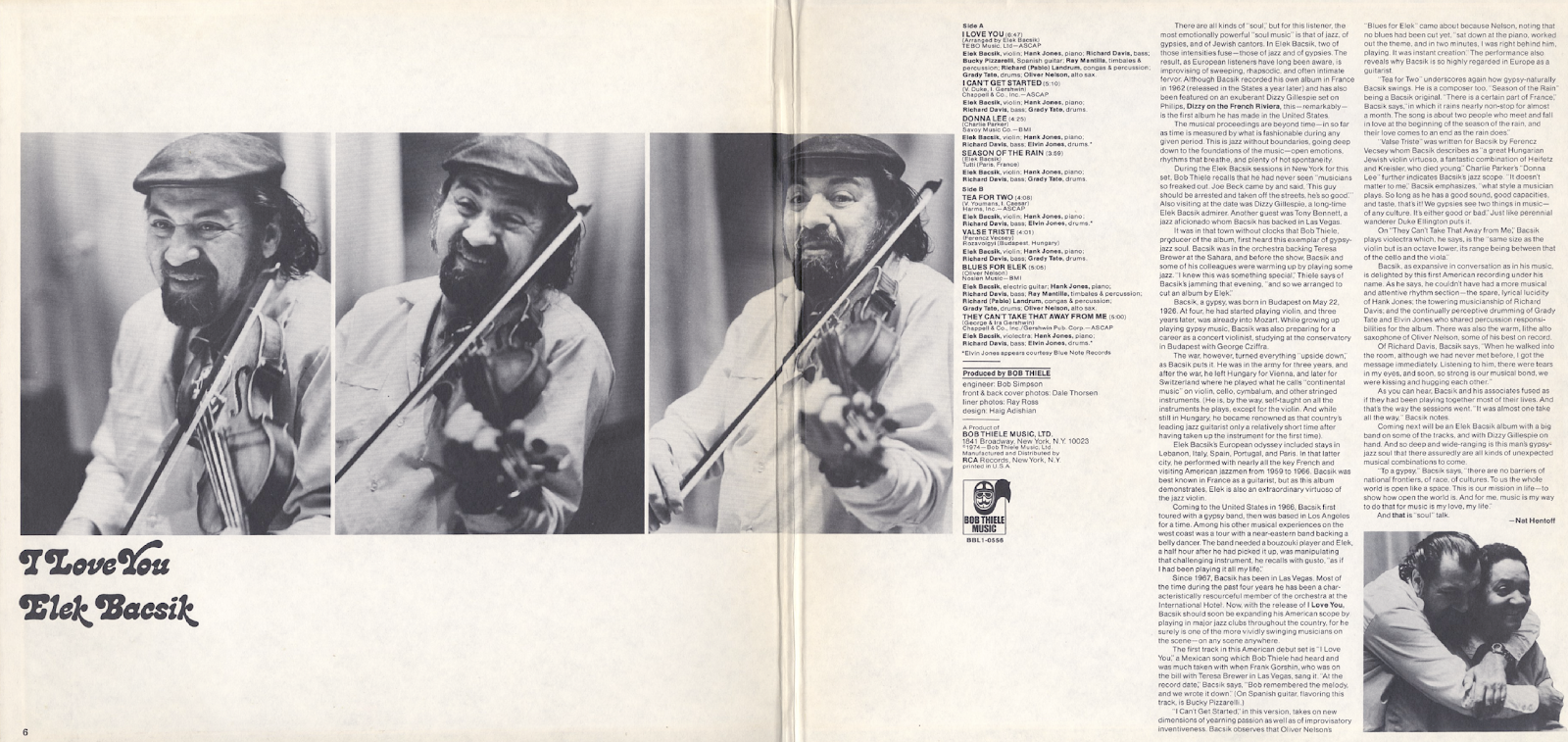
I Love You - Elek Bacsik
Tea For Two
Elek Bacsik
Produced by Bob Thiele
Engineer: Bob Simpson
Front & Back Cover Photos: Dale Thorsen
Liner Photos: Ray Roos
Design: Haig Adishian
A Product of Bob Thiele Music, LTD
Bob Thiele Music BBL-1-0556
Manufactured and Distributed by RCA Records - New York, N.Y.
1974
Featuring:
Oliver Nelson
Hank Jones
Richard Davis
Bucky Pizzarelli
Ray Mantilla
Richard (Pablo) Landrum
Elvin Joes
Grady Tate
From the inside cover: Bacsik, a gypsy, was born in Budapest on May 22, 1926. At four, he had started playing violin, and three years later, was already into Mozart. While growing up playing gypsy music, Bacsik was also preparing for a career as a concert violinist, studying at the conservatory in Budapest with George Cziffra.
The war, however, turned everything "upside down," as Bacsik puts it. He was in the army for three years, and after the war, he left Hungry for Vienna, and later for Switzerland where he played what he calls "continental music" on violin, cello, cymbalum, and other stringed instruments. (He is, by the way, self-taught on all the instruments he plays, except for the violin. And while still in Hungry, he became renowned as that country's leading jazz guitarist only a relatively short time after having taken up the instrument for the first time).
Elek Bacsik's European odyssey included stays in Lebanon, Italy, Spain, Portugal and Paris. In that latter city, he performed with nearly all the key French and visiting American jazzmen from 1959 to 1966. Bacsik was best known in France as a guitarist, but as this album demonstrates, Elek is also an extraordinary virtuosos of the jazz violin.
Coming to the United States in 1966, Bacsik first toured with a gypsy band, then was based in Los Angeles for a time. Among his other musical experiences on the west coast was a tour with a near-eastern band backing a belly dancer. The band needed a bouzouki player and Elek, a half hour after he had picked it up, was manipulating that challenging instrument, he recalls with gusto, "as if I had been playing it all my life."
Since 1967, Bacsik has been in Las Vegas. Most of the time during the past four years he has been a characteristically resourceful member of the orchestra at the International Hotel. Now, with the release of I Love You, Bacsik, should soon be expanding his American scope by playing in major jazz clubs throughout the country, for he surely is one of the more vividly swinging musicians on the scene – on any scene anywhere.
From Billboard - July 27, 1974: This gypsy violinist-guitarist is a master musician, and his treatment of classic standards and originals is very noteworthy. While he plays guitar on only one track, he shows his versatility as a jazz musician. Back up musicians include Olvier Nelson, Richard Davis and the Jones brothers (Hand and Elvin). Best Cuts: "I Can't Get Started, " "Donna Lee," "Tea For Two," Blues For Elek." Dealers: The cover art is very appealing and with the violin in the mainstream. Play selected cuts.
I Love You
Blues For Elek
Valse Triste
Season Of The Rain
Tea For Two
They Can't Take That Away From Me
Donna Lee
I Can't Get Started
The World Of Country - Jeannie C. Riley
The World Of Country
Jeannie C. Riley
Hilltop by arrangement with Share Records
1972 Shelby Singletown Corporation
A Product Of Pickwick International, Inc.
Pickwick JS-6119
Available from online vendors so I will not be posting a sample. Presented here to share the cover art and jacket notes excerpt.
From the back cover: Jeannie's entire life is centered around music. She has an exceptionally large collection of records which she constantly plays. For relaxation she likes to take a drive in her car. As she explains it, the drives not only give her a chance to be alone, but also the opportunity to listen to the radio and find out the current trends in music in all fields. Many people have wondered whether Jeannie C. Riley is an impish pixie or in reality like "sock-it-to-em" sexpot from the mythical Harper Valley. The hazel eyed beauty is in fact very much a young woman with the likes and dislikes of the the feminine world.
The real Jeannie C. Riley is truly a very warm and human person, but she is also a person with a great amount of curiosity. Perhaps this is why she's never too busy to stop and chat with everybody, but when she does it's usually Jeannie that has all the questions.
The Wedding Cake
I Almost Called Your Name
We Were Raised On Love
I Love Him
A Change Of Heart
He Made A Woman Out Of Me
Darkness Falls
My Man
Thin Ribbon Of Smoke
Jeannie C. Riley
Hilltop by arrangement with Share Records
1972 Shelby Singletown Corporation
A Product Of Pickwick International, Inc.
Pickwick JS-6119
Available from online vendors so I will not be posting a sample. Presented here to share the cover art and jacket notes excerpt.
From the back cover: Jeannie's entire life is centered around music. She has an exceptionally large collection of records which she constantly plays. For relaxation she likes to take a drive in her car. As she explains it, the drives not only give her a chance to be alone, but also the opportunity to listen to the radio and find out the current trends in music in all fields. Many people have wondered whether Jeannie C. Riley is an impish pixie or in reality like "sock-it-to-em" sexpot from the mythical Harper Valley. The hazel eyed beauty is in fact very much a young woman with the likes and dislikes of the the feminine world.
The real Jeannie C. Riley is truly a very warm and human person, but she is also a person with a great amount of curiosity. Perhaps this is why she's never too busy to stop and chat with everybody, but when she does it's usually Jeannie that has all the questions.
The Wedding Cake
I Almost Called Your Name
We Were Raised On Love
I Love Him
A Change Of Heart
He Made A Woman Out Of Me
Darkness Falls
My Man
Thin Ribbon Of Smoke
Guitar Moods - Elario
Girl From Ipanema
Elario
All Arrangements with the exception of "Romanza de Amor" by Elario
EPI - Elario Production Inc. - New Orleans, LA
Recorded at Wild Dog Studio - Gentilly, LA
Engineer: Bill Strong
Photography: Sid Bowman
Jacket Design: Judi Lozano
Produced by Elario Productions Inc.
Instruments: Ovation Instrument Corp., Ignacio Fleta, Arcangel Fernandez
EPI-1003
Malaguena
Girl From Ipanema
Theme from "Love Story"
Lara's Theme from "Dr. Zhivago"
Romanza De Amor
La Virgen De La Macarena
Manha De Carnival from "Black Orpheus"
El Condor Pasa
Meditation
Theme from "The Godfather"
Theme from "The Sting"
Thursday, June 6, 2019
10 Trombones Like 2 Pianos - Pete Rugolo
Willow Weep For Me
Pete Rugolo And Orchestra
David Carroll: Recording Director
Mel Chisholm: Recording Engineer
Mercury Records PPS 6001
1961
Personel
Session 1 (May 10, 1960)
Conductor: Pete Rugolo
Tenor Trombones: Frank Rosolino, Bob Fitzpatrick, Vern Friley, Herbie Harper, Milt Bernhart, Bob Pring, Harry Betts and Joe Howard
Bass Trombones: Kenny Shroyer and Russ Brown
Pianos: Russ Freeman and Johny Williams
Bass: Red Mitchell
Drums: Shelly Manne
Session 2 (May 12, 1960) as Session 1 except:
Tenor Trombones: Dick Nash replaced Herbie Harper and Dick Noel replaced Joe Howard
Bass Trombone: George Roberts replaced Russ Brown
Piano: Claude Williamson replaced Johnny Williams
From the inside cover: Pete Rugolo was born in San Piero, Patti, Sicily on Christmas day in 1915. His parents brought him to the United States when he was five. He was raised in Santa Rosa, California.
Pete inherited much of his musical talent from his father who loved opera and played banjo and baritone horn. Pete himself played baritone horn in his high school band. In the school orchestra he played French horn. In the dance orchestra he played piano. Thus, even as a teenager, Rugolo became personally acquainted with the various instruments of the orchestra.
"I studied myself." Pete affirms. "I just listened to records. I'd listen to a Duke Ellington record maybe a hundred times. I learned by trail and error."
Rugolo received his BA degree at San Francisco State College. He then studied with Darious Milhaud (as did Dave Brubeck) and received his MA at Mills College.
"You know I always loved tone colors," Pete recalls, "I used to listen then mostly to Stravinsky, Ravel, Debussy and Bartok. When I started composing and arranging, people said I was too modern. And you known, I didn't care!"
Rugolo's first job as a professional instrumentalist was with the famous Johnny Richards. The job was at Hermosa Beach, in southern California.
"We all wrote fantastic wild arrangements. In those days we didn't worry about public acceptance. And the whole band rehearsed regularly every afternoon before the job," Pete remembers.
This Johnny Richards band was basically in the Lunceford style.
"However," says Pete, "we used flutes, waltz introductions, everything! This was a very experimental band!"
Then in November 1942, Rugolo went into the army. During the war he met Stan Kenton. He started arranging for Kenton and, on his discharge from the army at the end of 1945, he joined the Kenton organization. Rugolo's associations with Kenton produced some of the most historic compositions and arrangements in jazz.
In 1949 Pete Rugolo went to New York as musical director for Capitol Records.
He had unique and unprecedented success at Capitol. He discovered, developed, signed, arranged for and recorded so many artists who are, today, the biggest names in the business. He produced some of the earliest records for Nat King Cole (the first string dates), Mel Torme, June Christy, Peggy Lee, Miles Davis (the historic Cool album), Woody Herman, Charlie Barnet, Lennie Tristano and Harry Belafonte – to mention but a few.
Then Pete was called to Hollywood to work for MGM studios.
"I did 25 film scores in four year," he notes.
During the middle fifties he did a tour with his own 20 piece orchestra. However, he was so overwhelmed with studio assignments that he was forces to disband, after just a few months.
For the last five years Pete has been constantly busy composing and arranging in all media – films, records and television. TV producer Dick Powell points out: "Pete Rugolo's scoring was one of the major factors in making our Richard Diamond series so different and so popular. No one but Pete could have written such exceptional music."
From Billboard - February 6, 1961: Here's a solid entry in Mercury's new Perfect Presence Sound Series with strong appeal for sound fans. Rugolo's inventive arranging genius is utilized to great effect on a group of standards and originals, including "Love Is Here To Stay," "Willow Weep For Me" and "Like Love." Stereo effects are fine with 10 trombones and two pianos split between two speakers. Bass and drums complete the ork. Handsome double-fodld album packaging.
Marie
Moonglow and Theme From "Picnic"
Let There Be Love
Like Love
Willow Weep For Me
Intermission Riff
Love Is Just Around The Corner
Angel Eyes
Love Is Here To Stay
It's A Most Unusual Day
Basin Street East
Ten Trombones Like
Romantic Riviera - Bruno Canfora
Riviera
Bruno Canfora and His Orchestra
Art Direction: Ken Kim
Original Dischi Ricordi Production - Italy
Monument Record Corp. SLP 18056
1966
Riviera
Monaco Concerto
Montecarlo
La Mer
Volare (Nel Blu Dipinto Di Blu)
Love In Portofino
Adriatico
Venezia, La Luna E Tu
Vitti 'Na Crozza
Santa Lucia
Luna Caprese
Torna A Surriento
Hi-Fi Hammond Vol. 2 - Jackie Davis
You Don't Know What Love Is
Vol. 2
Jackie Davis
Produced by Bill Miller
Capitol Records T1517
1961
From the back cover: A "volume two" album nearly always indicates a highly successful predecessor. This one is certainly no exception. The first "Hi-Fi Hammond" was a hard-to-match hit. But both Jackie Davis and Capitol Records sincerely believe that this one tops it, with Jackie playing at his very best and the most advanced recording techniques providing the ultimate in fine sound. Those who have interest in the technical "how" and "why" of the sound can read about it below. But, first and foremost, here's some information about the music and the man at the console.
Jackie Davis has a very rare knack for translating fluid jazz-flavored ideas into terms the Hammond can deal with. And when this is expertly done, the electronic organ can indeed, deal with them in a way that no other instrument can. It has the potential sound of a big band, and when Jackie goes into action his uptempo style brings forth all the cracking force of brass and percussion sections at full power; his ballad treatments are full, yet rich and mellow.
Jackie's success on records is matched by his popularity at clubs across the country, where a Davis engagement always calls for many happy returns. His repertoire is probably as vast as any artist's ever has been or will be. And the selections here are some that draw the best response from his audiences.
There are many more things that cane be told about Jackie – he received his B.A. degree in music from Florida A&M and got his early inspiration from listening to Art Tatum and Fats Waller (Notice their influence on Jackie's piano style, too, where he has "overdubbed" in two selections.) But the things he likes most to get across to people can be learned best through listening to his music. He has a great way with the Hammond, and it follows that nearly everyone who hears him play soon agrees that it's about as good a way as there is!
From Billboard - March 20, 1961: Jackie Davis at the organ always means enjoyable listening and this new album is no exception. It is Volume 2 in this series and it features strong performances of a group of standards by Davis, over swinging drum backings. The tunes include "Walkin' My Baby Back Home," "I Hadn't Anyone Till You," "Star Eyes" and "Without A Song." Stereo recording adds depth and color to the swinging performances.
Walkin' My Baby Back Home
You Don't Know What Love Is
Without A Song
I'll Never Stop Loving You
Stop At My House
I Hadn't Anyone Till You
Sweet And Lovely
Star Eyes
I Would Do Anything For You
Just Friends
Subscribe to:
Posts (Atom)