Search Manic Mark's Blog

Friday, October 19, 2018

Larry Adler

Love For Sale
Larry Adler
A Study In High Fidelity Sound
Harmonica Virtuoso with Piano, Trumpet, Bass, Guitar and Drums
Audio Fidelity
AFLP 1916
1959

From the back cover: I am not now, nor have I ever been a jazz musician. This does not disbar me, happily, either from liking jazz or from the pleasure of making music with jazz musicians.

Which immediately reminds me of a story. In 1934 I was engaged to play a solo in a film called "Many Happy Returns" for Paramount. My fee for the solo was to be $300 and even in 1934 that kind of money for a movie salary was hardly considered princely.

When I reported to the 2nd assistant director, which was all that my $300 rated, he told me that my scene would take place in a radio studio – my, my, that does date me, doesn't it – and that my solo would be accompanied by Guy Lombardo and His Royal Canadians.

I said that I didn't happen to like the music of Mr. Lombardo.

The 2nd assistant director said he was not asking for my likes or dislikes, he was telling me what I was going to do.

That, to use a British idiom, put my back up and I flatly refused. I was then ushered into the Presence, which is to say the director, to whom my fracas with 2nd assistant director was reported. The director told me to stop being a damned fool and to do as I was told. I still refused and so I was fired.

The next day I heard from the producer who summoned me to the studio for a talk. He was very patient with me and pointed out the opportunity that was being handed to me, an unknown, in giving me a chance to play a solo in a major film accompanied by a name orchestra. I agreed, but said that I didn't want to play with this particular name orchestra. The producer looked pained by his first encounter with juvenile delinquency (I was 18) and my status as a fired person, remained quo.

Later that week I heard from the secretary of Mr. William LeBaron, then head of Paramount. He wanted me in the office at 9:30 the next morning.

I still do not understand, and I'm not fishing, why so much trouble take over a comparatively insignificant item. Mr. LeBarron was kind and friendly and tried to get me to reconsider. He told me that Mr. L. was getting $40,000 as against my $300 but I remained unimpressed.

"You know who I like," I said, though no one asked me, "I like Duke Ellington."

"So do I, Larry," replied Mr. LeBarron, "but we can't just go hiring orchestras on your say-so."

I agreed but mention that the Duke was already on the lot, making a film with Mae West, so it shouldn't be too difficult to get him for one day's shooting. Mr. LeBaron suggested that I leave the running of the studio to him. He gave me one more chance to repent my iniquitous ways but I wouldn't do so home I went, no less fired than before.

At midnight the director phoned me.

"Well, you little bastard," he said, "we've got Ellington for you."

They had too. They paid him $5000 for the day to accompany my $300. He wasn't photographed because the whole thing had to be kept secret from Mr. Lambardo. The public never did know that Duke Ellington played my accompaniment but for the kick, for me, remains the same.

Almost everything on this alum is improvisation I say almost everything because we did tend to form a set pattern on "Summertime," say, or "Funny Valentine." But we play "How High The Moon" differently each time and while the pianist is consistently good I am less predictable.

No two takes of any title were very much the same, even on "Summertime" and even on my own composition, "Genievieve." The latter is the title waltz in the film, "Genevieve," for which I wrote the score. Bragging is permitted when a soloist writes his own sleeve notes so I will tell you that my music for "Genevieve" was nominated for an Academy Award award. It was beaten out by the score of "The High And The Mighty" by Dmitri Tiomkin and I don't believe there's any such person as Dmitri Tiomkin. The whole thing was fixed, that's what I think.

Let me call "Le Grisbi" to your attention. This too, is film music, from a French gangster film called "Touchez Pas au Grisbi." Even if you got straight A's in French you are liable no to know what that means. It is Montmartre argot and means, in effect, "Lay off the dough." My first record of "Grisbi," in 1953, won the Grand Prix du Disque, making me the first American artist to get this prize. The melody is by Jean Wiener, who was once half of a famous piano team called Wiener and Doucet and who claims to have introduced American jazz to Europe after the 1st World War. His "Grisbi" is, to me, one of the best blues since that "St. Louis" one.

You will notice that the tunes, except for "Genevieve" and "Grisbi" date from the 30s and 40s. Few musicians today are attracted by the meretricious product that passes for music in this Age of the Gimmick. For full details consult your local Hit Parade.

So, on this one album, Rodgers and Hart are represented four times with "The Girl Friend," "My Funny Valentine," (we play the verse twice – once as a piano and once, to end the melody, on unaccompanied harmonica.) "This Can't Be Love," and "Little Girl Blue," Les Freres Gershwin with tow melodies from "Porgy and Bess," "Summertime" and the wonderfully evil seduction them of "There's A Boat Leavin' For New York.' Cole Porter also twice with "Love For Sale" and "Begin The Beguine," Arlen and Ellington with one each, "Blues In The Night" and "Sophisticated Lady."

Every one of the songs just mentioned have lyrics fashioned by men who respected the English language and I wish that I could sing them on my harmonica. I think that the harmonica is, in fact, a singing instrument but it does tend to mess up its consonants.

One last bit of memory. The first time that I ever played the "Porgy And Bess" melodies was at a party in Beverly Hill. The hostess sang "Summertime" in a lovely delicate soprano. I played obligates and at the piano we had George Gershwin.

I should mention that Mr. Gershwin and I were in hot competition for the attention of the soprano. She, not unaware of this, had purposely invited us both and had thoughtfully installed a recording machine by the piano. She recorded the whole evening and I must say I'd like to hear those records again. You, on the other hand, (where I have a blister) want to know how that competition come out, don't you?

Gershwin won. – Larry Adler


From Billboard - November 9, 1959: Larry Adler, certainly one of the finest and most versatile of harmonica player, has a set of standards styled in quality renditions. He also includes some of his own material. They are played soulfully over excellent piano, trumpet, bass and drum support. It's a highly programmable item. Tunes include "My Funny Valentin," "Little Girl Blue" and "Grisbi." His wide range of expression includes overtones of jazz, pop and classical influences.

How High The Moon
Blues In The Night
Girl Friend
Love For Sale
My Funny Valentin
Gribi
This Can't Be Love
Summer Time
There's A Boat Leaving
Sophisticated Lady
Little Girl Blue
Genevieve
Begin The Beguine

Thursday, October 18, 2018

Machito Dances And Other Latin Dance Favorites

Lucky Mambo
Machito Dances
And Other Latin Dance Favorites
Design: Alleen Hunt
Photo: B & J Kerr
Palace
Buckingham Records - New York City
PST 725

Apparently there is at least one or two tracks on this set that can be attributed to Machito. The remaining tracks are credited to Pepito Pavon & his Orchestra (credit on disc label). However, it sounds like there are three or four possible artists featured on this LP. Generally speaking for a budget Palace release, this isn't a bad set.

Been-Blen
Tu-Felicdad
(Machito & his Afro Cubana)
Crazy Cha Cha
Mexican Hat Dance
Rainbow Cha Cha
Lucky Mambo
Glow Worm Cha Cha
Palm Tree Cha Cha
So Long Fellow Tango
Isla Verde Cha Cha
Cha Cha Amorosa
Good Times Meringue

Peter Duchin At The St. Regis

Something Gotta Give
Peter Duchin
His Piano and Orchestra
At The St. Regis
Decca Records
DL 74373
1963

From the back cover: "It was the biggest Maisonette opening I've attended in years," said Gene Knight, New York Journal-American critic, of Peter Duchin's fabulous first night at the plush room in New York's swank St. Regis Hotel. "He is something special as a pianist," the noted critic went on to say, and "who could help but dance to this new band with the exuberance of youth?"

I Left My Heart In San Francisco
This Could Be The Start Of Something
A Fine Romance
I Concentrate On You
Whispering
Something Gotta Give
It Had To Be You
The Second Time Around
Mine
The Way You Look Tonight
What Kind Of Fool Am I? (From the Musical Production "Stop The World - I Want To Get Off")
From This Moment On

Tuesday, October 16, 2018

Guitars Play The Sound Of Ray Charles - Tom & Jerry

Unchain My Heart
Guitars Play The Sound Of Ray Charles
Tom & Jerry
With The Merry Melody Singers
Mercury Records
MG 20671

From the back cover: Tom Tomlinson has been playing guitar since he was four. Born in Minden, Louisiana in 1928, he began plucking a Sears Roebuck guitar as a toddler and had mastered the instrument, without the benefit of formal training, by the time he was eight. During his high school years, he fronted his own band. After a stint in Korea as a U. S. Marine, he returned to music, to serve as lead guitarist for Johnny Horton, contributing his valuable sound to such Horton hits as Battle of New Orleans, Sink the Bismarck and North to Alaska. Injured in the same auto crash that took Horton's life, Tom spent months recuperating, then teamed with Jerry Kennedy in recording a hit Mercury single, Golden Wildwood Flower, which began the partnership that's still flourishing.

Jerry is from Shreveport, Louisiana. Like Tom, he flashed signs of musical talent at an early age age. He began studying the guitar at at the age of eight; by the time he was turned to the guitar, recording with Horton, Rusty Draper, June Valli Patti Page, George Jones and others. His present work with Tom indicates that he's taken advantage of that experience to become a mature musician.


Unchain My Heart
I Got A Woman
Hit The Road Jack
What'd I Say
Hallelujah I Love Her So
This Little Girl Of Mine
One Mint Julep
I'll Drown In My Own Tears
The Right Time
Swanee River Rock
Lonely Avenue
Leave My Woman Alone

Monday, October 15, 2018

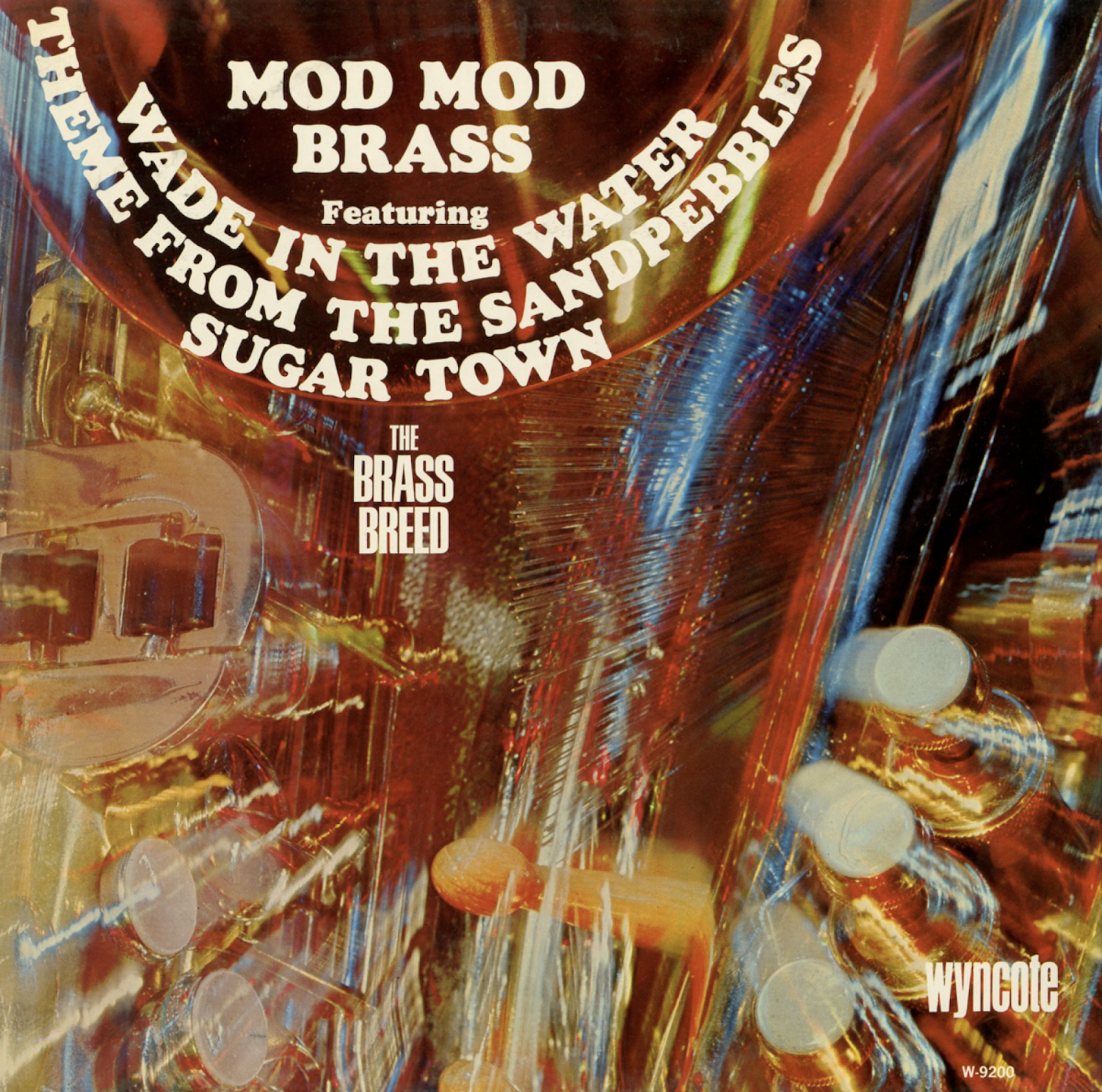
Mod Mod Brass - The Brass Breed

Wade In The Water
Mod Mod Brass
The Brass Breed
Wyncote W9200
A Product of Cameo Parkway Records

There are only a few numbers on this typical Wyncote budget set, that may have been produced by a single studio group (The Brass Breed), that sound "mod."  Otherwise, the majority of the tracks are pretty drab sounding Latin filler material.

Wade In The Water
Sandpebbles
Sugar Town
March Of The Trumpets
Toro
Brass Theme
La Entrado
Opera Flamenco
Vito
Tequilla & The Bull

The Wizard Of Oz And Other Harold Arlen Songs - Shorty Rogers

If I Only Had A Brain
The Wizard Of Oz & Other Harold Arlen Songs
Shorty Rogers And His Orchestra
Featuring The Giants
Arranged and Conducted by Shorty Rogers
Produced by Dick Peirce
Cover Photo: Jerome Kuhl - Garrett Howard
RCA Victor LPM-1997
Recorded in Hollywood, California, February 3, 5 and 10, 1959

From the back cover: Heard throughout in solo spots on trumpet and flugelhorn is the effervescent Shorty constantly chased by the horns of Jimmy Giuffre (clarinet and tenor), Barney Kessel (guitar), Bob Enevoldsen (valve-trombone), Herb Gelder (tenor), Bud Shank (alto and tenor), Larry Bunker (vibes), Don Fagerquist (trumpet in the small group) and Frank Rosolino, whose gymnastic solo trombone is heard only in The Merry Old Land Of Oz. Joe Mondragon is responsible for the occasional bass interludes, and his rhythm mate, Mel "The Tailor" Lewis, sews up the time with relentless imaginative drive. Pete Jolly, whose piano is an unfailing asset both in rhythm section and solo, takes charge on Over The Rainbow which here takes the for of a miniature concerto for Pete's considerable talent. – John Tynan - Associate Editor, West Coast Down Beat

From Billboard - August 24, 1959: A very imaginative set of arrangements, bringing a modern jazz quality to some great material including "We're Off To See The Wizard," "In The Merry Land Of Oz," "Get Happy," and "That Old Black Magic." Performances range from slightly more than one minute, to five and one-half minutes – in brief, these are not cut and dried orchestrations. For smart programming.

We're Off To See The Wizard
Over The Rainbow
The Jitterbug
The Merry Old Land Of Oz
If I Only Had A Brain
Ding Dong! The Witch Is Dead
My Shining Hour
Get Happy Blues In The Night
Let's Fall In Love
That Old Black Magic

Friday, October 5, 2018

The Night Was Made For Love - Tony Martin

The Night Was Made For Love
Tony Martin
With Henrie Rene's Orchestra
RCA Victor LPM-1218
1956

Available from online vendors so I will not be posting a sample. Presented here to share the original cover art and jacket note excerpt.

From the back cover: A California both by birth and inclination – Tony was born on a sunny Christmas morning and christened Alvin Morris, Jr. – he discovered music at such an early age that today he literally can't remember when he first came to know and love it. At any rate, by the time he was twelve he had mastered the sax and clarinet, and at sixteen, while still in high school, he was making more than $100 a week playing and singing with a band at the Palace Hotel in San Francisco.

After graduating from high school, Alvin, Jr. continued his dual role of student-singer. He attended St. Mary's College during the day and worked with local bands at night, making his coast-to-coast radio debut in 1932 on the "Lucky Strike Hour." It was a rough working schedule and conflict between his ultra-conservative daytime environs and the flamboyant entertainment world was inevitable. One day he was caught playing jazz on the college organ, and the next week his school days were over for good.

Leaving college and California behind him, Tony hit the road for a playing and singing date at the World's Fair in Chicago, where he met Frances Langford, then at the height of her fame as a singing star of radio and motion pictures. On her advice, the handsome young six-footer returned to the West Coast to try his luck in pictures. A few months later he signed a contract with 20th Century Fox, and the studio bigwigs promptly changed his name from Al Morris to Tony Martin.

The young troubadour was making a fairly prominent name for himself in Hollywood musicals when World War II cut short his movie career, and in 1942 he entered the Army Air Force. After serving overseas for four years in the China-Burma-India theater, he was honorably discharged as a Technical Sergeant with the Bronze Star and a Presidential Citation.

Upon his return to show business, a startled public soon discovered that something new had been added, and the results were electrifying. Whereas before the war he had been just another personable performer with a fine voice, the "new" Tony Martin fairly radiated confidence and that indefinable presence labeled "star quality" by the trade. The impact of his solid, all-around showmanship was particularly magnetic in person, and Tony quickly became one of the top ten night club attractions in America

Today, a decade later, Tony Martin is still a top night club draw, in addition to being a big name on records, TV and in motion pictures. At the same time his personal life couldn't be happier, and understandably so, since his lovely wife and mother of his two children is M-G-M's breathtaking beautiful dancing star Cyd Charisse. Maybe that's why no other singer today sells a love song with quite as much anticipation and warm conviction as Tony Martin does in this album. – June Bundy


The Night Was Made For Love
Night And Day
Valencia
Marta (Rambling Rose Of Wildwood)
Tenement Symphony
There's No Tomorrow
Comme ci - Comme ca
La Vie en rose
Domino
Deep Night
Goodnight, Sweetheart

The Ahmad Jamal Trio

Love For Sale
The Ahmad Jamal Trio
Epic
LN 3212
1962

From the back cover: Jamal's subtle keyboard structures were first heard with George Hudson's Orchestra insofar as public performance is concerned. A few years later he broke away to form his own group, known as Ahmad Jamal's Three Strings, and with this trio he played throughout the midwest and in New York, attracting considerable attention with his deft articulations. The Three Strings made a number of single records for Epic Records, collection as a best-selling Extended Play disc, and then returned to Chicago. The present group, heard in the first Jamal Long Playing Record, consists of Israel Crosby on bass and Ray Crawford on guitar, in addition to the leader.

Perfidia
Love For Sale
Rico Pulpa
Autumn Leaves
Squeeze Me
Something To Remember You By
Black Beauty
The Donkey Serenade
Don't Blame Me
They Can't Take That Away From Me

O. C. Smith At Home

My Cherie Amour
O. C. Smith At Home
Produced by Jerry Fuller
Arranged by H. B. Barnum
*Arranged by Tom McIntosh
**Arranged by Benny Golson
Cover Photo: Don Peterson
Back Cover Photo: Yoram Kahanna
Engineer: Peter Romano
Columbia Records
CS 9908
1969

Daddy's Little Man
Friend, Lover, Woman, Wife
Color Him Father
Clean Up You Own Back Yard
If I Leave You Now
My Cherie Amour
The Learning Tree*
Didn't We
Sweet Changes
San Francisco Is A Lonely Town*
Can't Take My Eyes Off You**

The Voice Is Rich - Buddy Rich

Born To Be Blue
The Voice Is Rich
Buddy Rich Sings
Mercury Records
SR 60144
1959

From the back cover: Moody, metallic, masculine, magnetic, mesmerizing, motivating, in fact, The Most!

Surprisingly, Buddy Rich, oft referred to as America's No. 1 Drummer, comes off mellifluously at the microphone making with the vocal music. Like the first martini or fifth martoonie that introduced on to the anchovie-filled olive, or the initial time one read Hemmingway writing a sports story, after a bit, the realization comes that Mr. Buddy Rich is one, deep-feeling vocalist.

Right-off, Rich regales the ear with his very own distinctive sound and style. Like the first time you heard Sgt. Friday on radio or maybe it was later on TV, it was his voice that fascinated. Buddy Rich's voice is an intimate voice. No big crescendos necessary to get the message home. It's a warm voice, one that reaches the heart strings in a hurry. It's a musician's voice that knows where to meld the words and music so the blend is just right.

Jack of all trades and master of One almost fits Buddy Rich, up to this album. Erstwhile actor with both motion picture and TV credits; moppet vaudeville actor; teen-age drummer sideman with bands; early twentiesh leader of his own big band and/or small jazz combo – And now, Buddy Rich Vocalizing!


Down The Old Ox Road
I Was Born To Be Blue
I've Heard That Song Before
I Want A Little Girl
I Can't Give You Anything But Love
You've Changed
Me And My Shadow
Ah, The Apple Trees When The World Was Young
It's Been A Long Long Time
I Don't Want To Walk Without You
Back In Your Own Back Yard